watercolor
#
portrait
#
watercolor
#
romanticism
#
costume
#
watercolour illustration
#
genre-painting
#
history-painting
Dimensions: height 266 mm, width 188 mm
Copyright: Rijks Museum: Open Domain
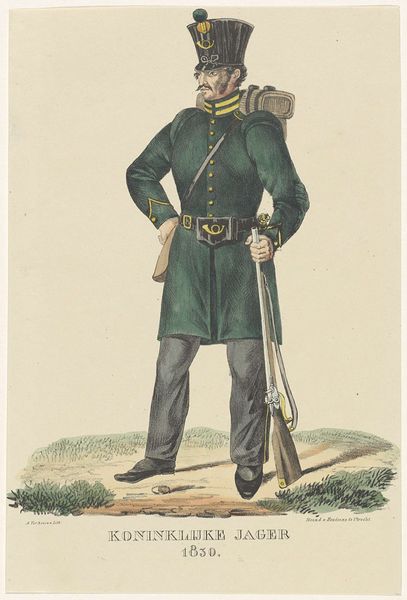
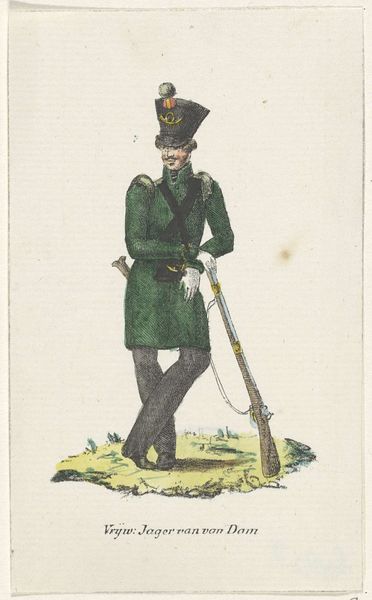
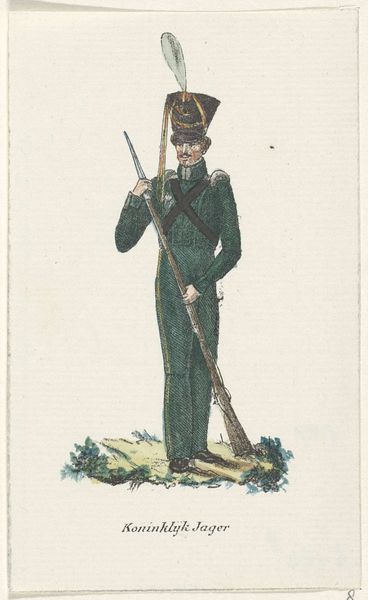
Curator: This is "Voluntary Rifleman of Van Dam, 1830," a watercolour from 1830 or 1831. What are your immediate impressions of it? Editor: Well, I’m immediately struck by how carefully posed this figure is. His costume appears somewhat oversized, as if obscuring and overwhelming the individual it clothes. There is a somewhat awkward, self-conscious feel. Curator: Indeed. These volunteer riflemen, or "jagers," were civic guards, embodying a wave of bourgeois empowerment sweeping through Europe in the early 1830s, even after the post-Napoleonic restoration tried to turn back the clock on such movements. This particular watercolour captures not just the uniform, but also the aspirational identity of these men. Editor: So, a meticulously crafted visual argument for bourgeois patriotism, then. I wonder about the artist's intent, as well as the commissioner's expectations, specifically how this work aimed to shape public perceptions. Curator: Absolutely. Romanticism idealized this form of civil engagement and sacrifice. We also cannot ignore the setting of that time, because genre paintings were increasingly used to explore national identities, as well as political messages through art. Editor: And perhaps this portrait contributes to constructing a romanticized, visually consumable figure, and a nationalistic narrative. I am wondering about accessibility, and how effective watercolours would be in the context of distribution. Curator: Interesting point. In addition to traditional art circuits, such as displays and acquisitions, it can potentially be broadly disseminated as illustrations and prints, increasing accessibility among a wider audience that included those involved in politics. The goal of the illustration was very practical in essence. Editor: I see, so in that sense this work of art served a specific ideological role, creating cultural capital. Thinking about the politics, and also its aesthetics really makes the viewing so much more complex. Curator: Exactly. When we view art, we gain critical insights into historical, sociopolitical forces and the human experience, and these shape our perceptions. It allows us to understand better what this work tried to address.
Comments
No comments
Be the first to comment and join the conversation on the ultimate creative platform.
 Collect
 React
React Comment
More like this