drawing, paper, pencil
#
portrait
#
drawing
#
landscape
#
figuration
#
paper
#
11_renaissance
#
pencil
#
academic-art
#
italian-renaissance
Dimensions: height 245 mm, width 181 mm
Copyright: Rijks Museum: Open Domain
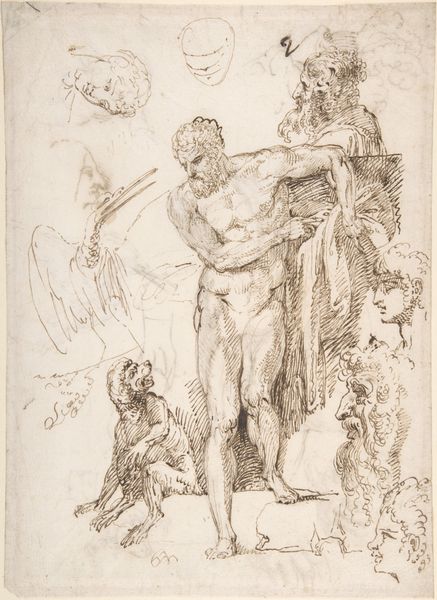
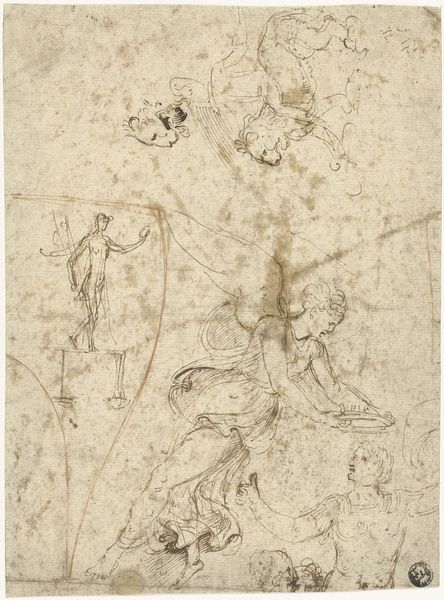
Editor: This is "Study Sheet with Heads, Figures and Architectural Fragments" by Piero di Cosimo, made with pencil on paper, sometime between 1472 and 1521. It has such a frenetic energy! What do you make of it? Curator: I see a microcosm of the Renaissance artist’s world. This wasn't created for public display; it offers a glimpse into the artistic process itself. Look at how architecture intertwines with anatomical studies. How does that speak to you? Editor: Well, it makes me think about the Renaissance ideal of the artist as a master of all disciplines. They had to understand anatomy and perspective, architecture and the humanities! This sheet is almost a demonstration of that expectation. Curator: Exactly. It reflects a period when art was deeply intertwined with scientific and humanistic inquiry. The inclusion of architectural fragments is not mere decoration. How were classical ideals informing architectural design at this time, and how might this drawing reflect that? Editor: It's like they’re reaching back to antiquity to build a new future. You can see it both in the structure and in the idealised figures. What’s most interesting is how the mundane – a sketch sheet – contains these aspirations. Curator: Yes, the materiality of paper, the quick pencil strokes—they democratise access to these "high" ideals. It underscores art’s function within the broader social fabric, how it facilitates and documents intellectual exchange. Ultimately, even discarded drawings are social documents of the period. Editor: It’s amazing how much we can learn from something that wasn't even intended as a finished work of art. It's shifted how I perceive Renaissance drawings! Curator: Indeed. By looking beyond the celebrated masterpieces, we access richer understandings of artistic intention and social influence.
Comments

rijksmuseum about 2 years ago
⋮
The female nudes at the top of this page of studies are drawn in various poses. One pose, with the weight resting on one leg (contrapposto), is worked out in more detail in the figure at centre. In addition, there are faces, architectural details and a kneeling, nude figure of St Sebastian. These studies reveal the curiosity and restless searching of Renaissance artist Piero di Cosimo.


Join the conversation
Join millions of artists and users on Artera today and experience the ultimate creative platform.
 Collect
More like this