About this artwork
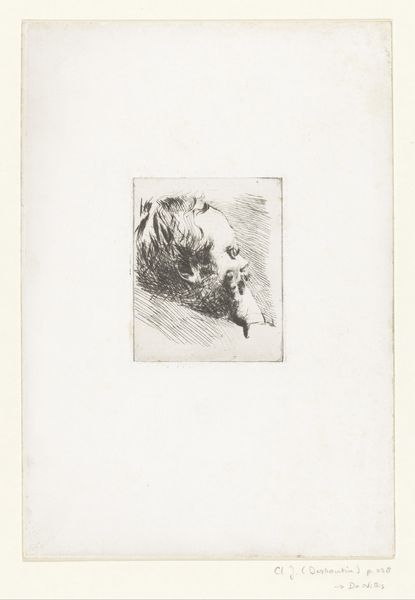
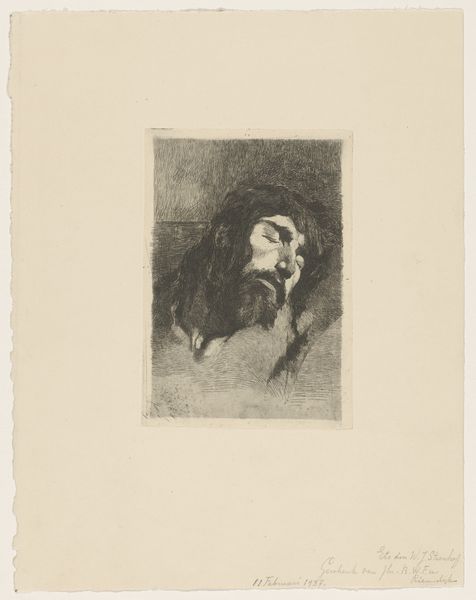
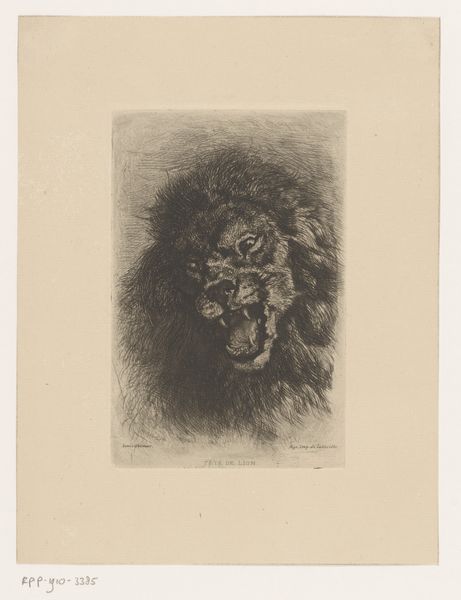
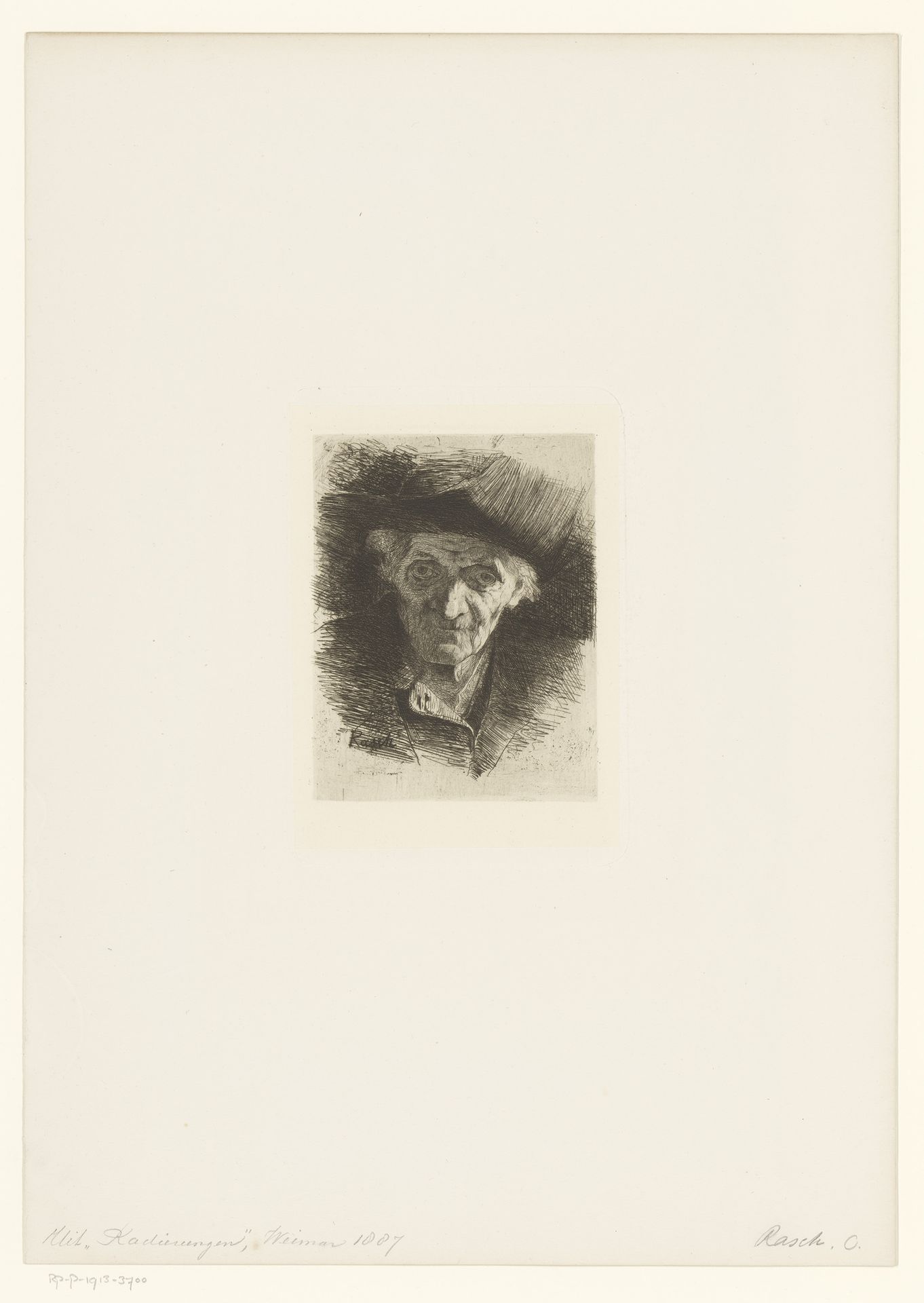
Curator: Oh, this portrait hits me right in the gut. There's such weariness etched on that face; it feels deeply personal. Editor: Indeed. Let’s delve into Otto Rasch’s "Head of an Old Man," created in 1887. It's a graphite drawing and etching printed on paper. Formally, it’s a stunning study in tonal contrast. Curator: Tonal contrast, sure, but look at the vulnerability! It's almost like he’s peering out from a dark well. That deep shadow surrounding him--is he disappearing, or just hidden? Editor: The darkness definitely enhances the expressiveness. Rasch utilizes hatching and cross-hatching masterfully to define form and texture. Notice the concentration of lines around the eyes and mouth; this directs our attention to those areas, amplifying emotional impact. Curator: It works, doesn't it? The lines practically vibrate with age and life... hard-won wisdom, perhaps? Editor: Quite possibly. Realism dominates here. Rasch meticulously captures the surface details--the wrinkles, the folds of skin--creating a palpable sense of verisimilitude. The subject seems undeniably present. Curator: Present, but also, somehow, lost in thought. I find myself wondering about his story, the hardships he faced... did Rasch know him? Was he imagining him? There's something haunting about it, almost like a memory fading away. Editor: Memory is a poignant lens through which to view it. Perhaps the softness in areas of the print, contrasted against those intensely etched lines, lends itself to that interpretation. Curator: It's like holding a ghost story in your hands. Beautiful and unnerving all at once. I’ll never forget this face now. Editor: A fine example of the power of the portrait to connect across time and elicit deeply felt emotional responses, wouldn’t you say?

Artwork details
- Medium
- drawing, print, etching, paper, graphite
- Dimensions
- height 194 mm, width 139 mm
- Copyright
- Rijks Museum: Open Domain
Tags
Comments
Share your thoughts
About this artwork
Curator: Oh, this portrait hits me right in the gut. There's such weariness etched on that face; it feels deeply personal. Editor: Indeed. Let’s delve into Otto Rasch’s "Head of an Old Man," created in 1887. It's a graphite drawing and etching printed on paper. Formally, it’s a stunning study in tonal contrast. Curator: Tonal contrast, sure, but look at the vulnerability! It's almost like he’s peering out from a dark well. That deep shadow surrounding him--is he disappearing, or just hidden? Editor: The darkness definitely enhances the expressiveness. Rasch utilizes hatching and cross-hatching masterfully to define form and texture. Notice the concentration of lines around the eyes and mouth; this directs our attention to those areas, amplifying emotional impact. Curator: It works, doesn't it? The lines practically vibrate with age and life... hard-won wisdom, perhaps? Editor: Quite possibly. Realism dominates here. Rasch meticulously captures the surface details--the wrinkles, the folds of skin--creating a palpable sense of verisimilitude. The subject seems undeniably present. Curator: Present, but also, somehow, lost in thought. I find myself wondering about his story, the hardships he faced... did Rasch know him? Was he imagining him? There's something haunting about it, almost like a memory fading away. Editor: Memory is a poignant lens through which to view it. Perhaps the softness in areas of the print, contrasted against those intensely etched lines, lends itself to that interpretation. Curator: It's like holding a ghost story in your hands. Beautiful and unnerving all at once. I’ll never forget this face now. Editor: A fine example of the power of the portrait to connect across time and elicit deeply felt emotional responses, wouldn’t you say?
Comments
Share your thoughts