drawing, watercolor, pencil
#
drawing
#
landscape
#
watercolor
#
pencil
#
watercolour illustration
#
watercolor
#
realism
Copyright: Rijks Museum: Open Domain
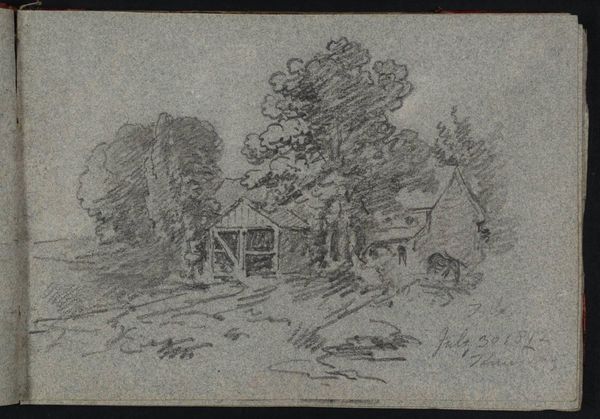
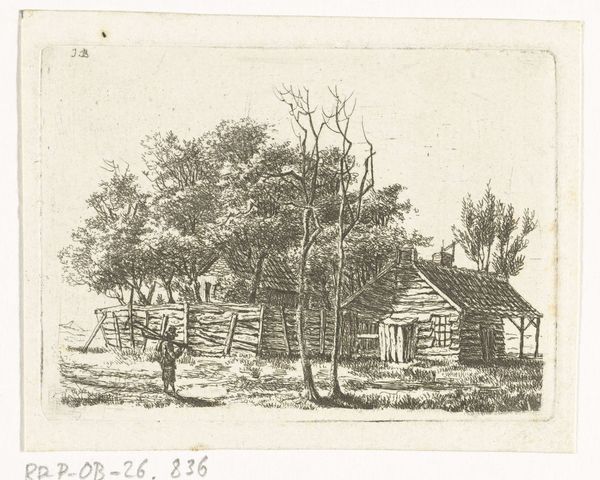
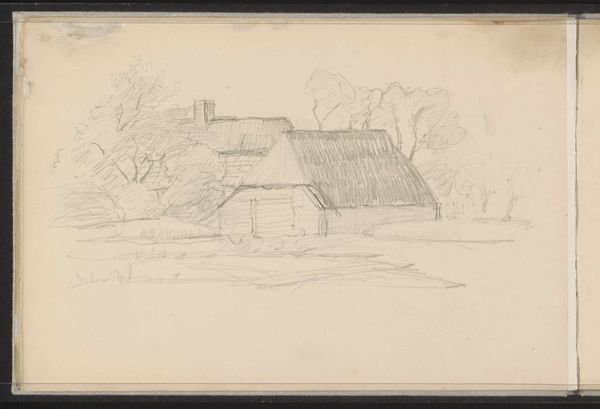
Curator: Looking at this artwork, I’m immediately struck by the starkness and simplicity. The light palette adds to this feeling. Editor: Indeed. We're looking at "Wintervoederplaats voor wilde dieren in Marienbad", or "Winter Feeding Place for Wild Animals in Marienbad." It's a drawing rendered with pencil and watercolor by Johannes Tavenraat in 1869, now housed in the Rijksmuseum. Curator: 1869... interesting. Knowing that it depicts a structure designed to feed wild animals in winter raises all sorts of questions. Who has access, and on what terms? Is this an act of compassion or control? It's a power dynamic visualized, right? Editor: That’s precisely where my thoughts are heading. Marienbad was, in 1869, a popular spa town—a place of leisure for the European elite. This "feeding place" takes on a different hue in that context, reflecting societal attitudes towards nature and control. Perhaps those visitors found some purpose in commissioning its architecture. Curator: Right! And this artist choosing to render the wild animals with this architecture is, perhaps, indicative of its true function in the landscape of leisure in this German resort-town: civilizing them through control by giving them shelter. I wonder to what degree they found dignity inside. Editor: The subdued palette also reflects the mood: the leafless trees, the suggestion of winter. It certainly moves beyond documentation and begins speaking to our relationship with our environment. Even the architecture isn't presented imposingly, the structure's rough construction materials blend with the natural landscape. Curator: You’re right. It presents something more nuanced than overt control. Tavenraat, through the materiality of the feeding structure and surrounding environment, perhaps finds a place to pose difficult questions about environmental custodianship in our contemporary landscape. The feeding site serves as a microcosm reflecting the dynamics of resource allocation, care, and, ultimately, social and political agendas. Editor: An important work to consider, particularly today. Curator: Absolutely. A somber scene offering an insight into social consciousness about wild animals through landscape architecture.
Comments
No comments
Be the first to comment and join the conversation on the ultimate creative platform.
 Collect
 React
React Comment
More like this