drawing, ink, pen
#
portrait
#
drawing
#
pen sketch
#
pencil sketch
#
figuration
#
ink
#
pen
#
realism
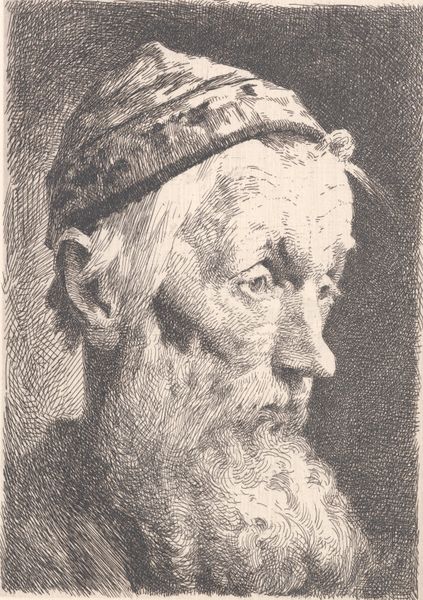
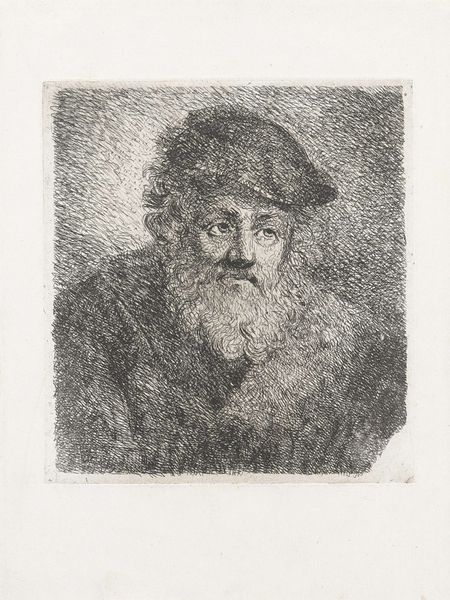
Dimensions: height 70 mm, width 62 mm
Copyright: Rijks Museum: Open Domain
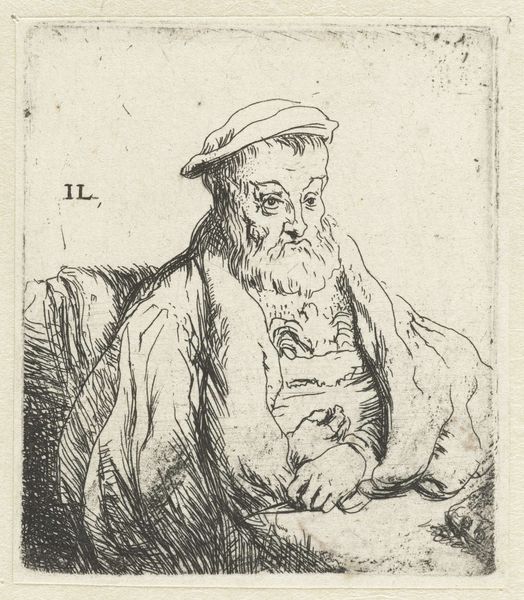
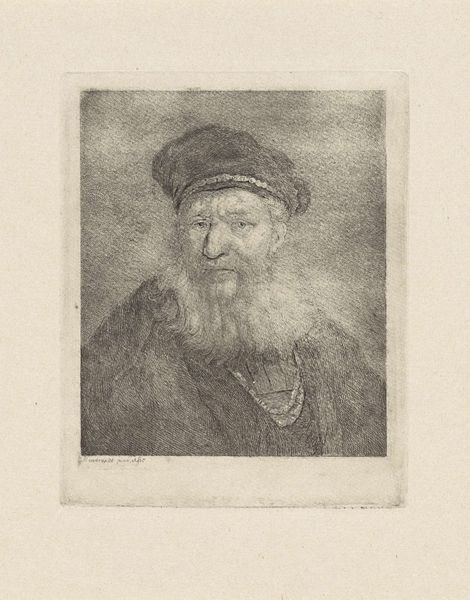
Editor: Here we have "Man met een bontmuts en een baard," or "Man with a fur cap and a beard," a drawing in ink and pen by Johann Wilhelm Friedrich Kachel, dating sometime between 1836 and 1873. It's a detailed portrait, but the sketch-like quality gives it an unfinished feel. What stands out to you in this work? Curator: The intensity of the gaze immediately pulls me in. But it's more than just that; consider the social and historical context. What power dynamics are at play when an artist chooses to portray a man so…distinguished? The beard, the fur cap - these are symbols of status and perhaps even rebellion against industrial uniformity. Do you see that in the rigid lines and careful crosshatching? Editor: I do see that tension. The detail almost feels… critical? But of what? Curator: Precisely. Perhaps a critique of established power. Consider the time period. Were there burgeoning movements that questioned authority? How does the sitter’s gaze – is it defiant, knowing, or simply observing? – reflect broader societal anxieties about class, privilege, and the shifting sands of social order? Editor: So you're saying this isn't just a portrait; it's a statement about class and perhaps even societal change? Curator: Absolutely. It invites us to question not just who is being represented, but *why* and in what manner. What narrative is Kachel, consciously or unconsciously, constructing? And how does this seemingly simple sketch challenge or reinforce the power structures of its time? Editor: That shifts my perception entirely. It makes you think about what a portrait *does*, beyond just showing what someone looks like. I’ll definitely look at other portraits differently now! Curator: Wonderful. Art’s greatest power lies in its ability to provoke that kind of questioning, to force us to reconsider our assumptions about the world.
Comments
No comments
Be the first to comment and join the conversation on the ultimate creative platform.
 Collect
 React
React Comment
More like this