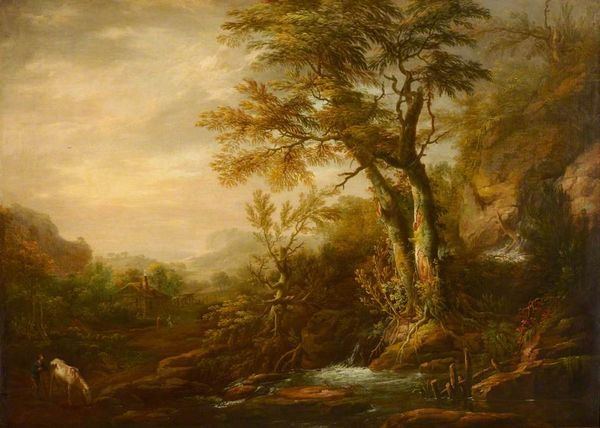
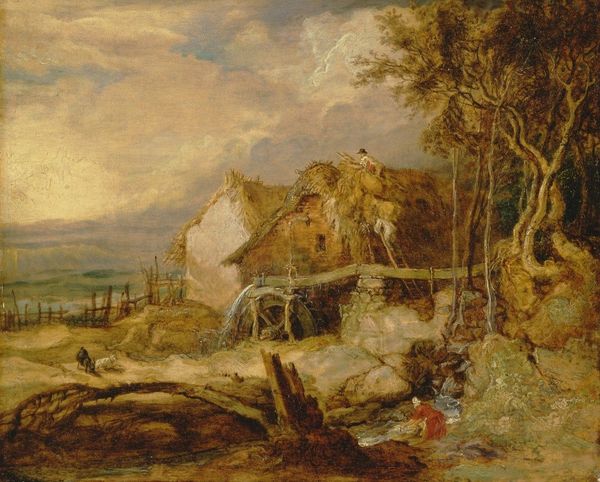
An Overshot Mill in Wales (Aberdulais) 1847

jamesward
National Museum Cardiff, Cardiff, UK, National Library of Wales, Aberystwyth, UK
abstract painting
charcoal drawing
impressionist landscape
possibly oil pastel
oil painting
fluid art
acrylic on canvas
underpainting
painting painterly
watercolor
Dimensions: 63 x 137 cm
Copyright: Public domain
Editor: James Ward’s "An Overshot Mill in Wales (Aberdulais)," created in 1847, is such a fascinating scene! The interplay of nature and industry feels almost staged, a perfect picturesque moment. What's your take on how the painting fits into its historical context? Curator: This is a compelling piece precisely because it freezes a moment of transition. Ward paints Aberdulais Mill right at the cusp of major industrial advancement in Wales. Think about the politics of imagery at the time; what message is being conveyed? Editor: It almost romanticizes labor. Is Ward perhaps glossing over the tougher realities of industrial work with the beauty of nature? Curator: Exactly. Landscape painting in the 19th century becomes heavily intertwined with notions of national identity and cultural heritage. The mill is presented within this idyllic, almost untouched landscape. What does choosing *this* view signify about how society views industrial progress? Was this commissioned by the owner? And to what purpose? Editor: So, instead of documenting the grim reality, Ward may have intentionally crafted a more palatable, almost celebratory image of industrial activity within the cultural discourse of his era? Curator: Precisely. Consider how the placement of figures, the subdued palette, and the almost fairytale-like light all work together to achieve that effect. How the mill *sits* within the scene communicates something profound. It’s not just about what’s depicted, but how it’s depicted and what this idealised image is suggesting to a wider audience. Editor: I see now how a landscape painting like this serves a public role. Thanks to your insights, I will certainly approach landscape depictions more critically moving forward. Curator: My pleasure! It’s always insightful to re-examine works of art, not only for their aesthetic merit, but as visual evidence of socio-political forces at play.
Comments
No comments
Be the first to comment and join the conversation on the ultimate creative platform.
 React
React Comment