Copyright: Public domain
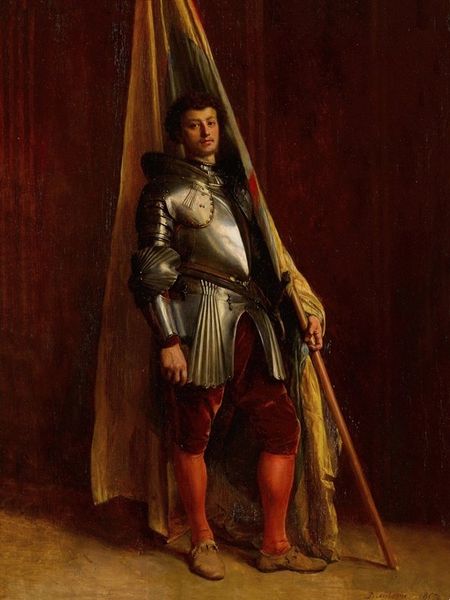
Editor: So here we have Albert Lynch's "Joan of Arc" from 1903, done in oil paint. It strikes me as an interesting depiction. What I immediately notice is the highly detailed armor and how that contrasts with the softer features of her face, and the lilies. What's your take on this portrait? Curator: I see a fascinating interplay of power dynamics embedded in the material choices and artistic processes at play here. Look at the depiction of the armor: highly polished, seemingly mass-produced elements signify industrial power and stand in stark contrast to the handcrafted quality we might associate with Romantic or even earlier artistic depictions of armor. Editor: Mass produced armor, even in 1903? Curator: Well, it speaks to the increasing mechanization and industrialization that permeates all aspects of society, including warfare, and its visual representation. The canvas itself, pre-stretched and likely commercially produced, further underscores this point. How does this production context shape your interpretation of Joan's heroism? Editor: So the materials themselves are making a statement. How do you mean? Curator: The oil paint, now commercially available, suggests accessibility and standardization. Compared to pigments meticulously ground by hand, its ready-made nature subtly shifts the narrative from individual craft to a more democratic, or even mass-market, production. How does the choice of depicting Joan with such readily available materials impact the legend itself, do you think? Does it democratize or diminish her image? Editor: That's really fascinating. I never thought about how even the type of paint used could change the story. I’ll definitely be considering materials more closely in the future! Curator: Precisely! It is critical to question the story told by not only the image itself, but how the work came to be and what social and historical implications that brings.
Comments
No comments
Be the first to comment and join the conversation on the ultimate creative platform.
 React
React Comment