painting, oil-paint, photography
#
still-life
#
painting
#
oil-paint
#
landscape
#
photography
#
oil painting
#
naive art
Copyright: Mary Fedden,Fair Use
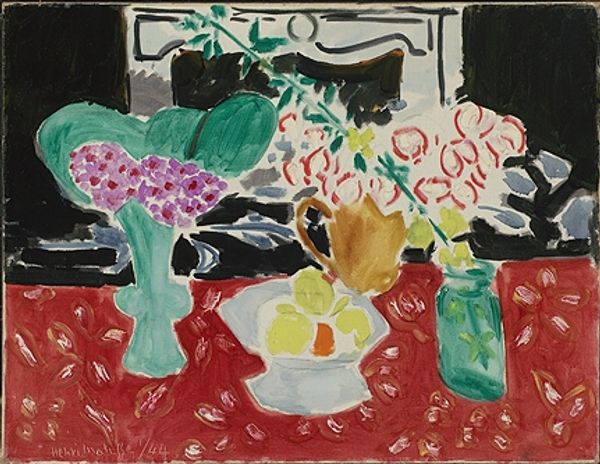
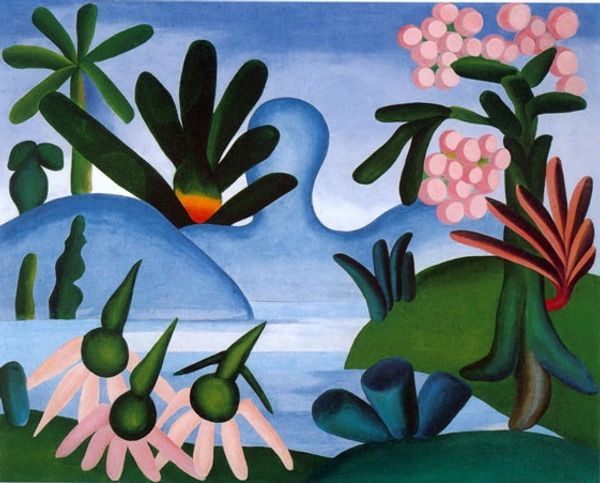
Editor: This is Mary Fedden's "The White Hyacinth," painted in 1984 using oil paints. The still life, set against an odd landscape, strikes me as a curious combination. What formal qualities stand out to you in this composition? Curator: Note how the geometric rigidity of the drawer-table establishes a clear foreground. Then, observe how Fedden uses the alternating dark and light bands of the tabletop to mediate the distance between the foreground still life and the backdrop, composed of loosely geometric landscape elements. The white hyacinth and plate almost create visual rhymes. Editor: So you see a conversation primarily between shapes and their placement, not necessarily symbolism? Curator: Precisely. Consider how Fedden’s palette utilizes a restrained range of hues. Note the flat application of paint that emphasizes form and minimizes depth, collapsing the landscape into a near-planar composition. The eye is not guided into the depth of field, but across the surface of the work. Are you drawn to the subtle variation in the application of white? Editor: I hadn’t thought of it that way. It’s as though the different shades and textures create a sense of contained chaos, playing off of one another. Curator: Indeed. By denying conventional perspective and emphasizing flatness, Fedden prompts us to contemplate the picture as an object rather than a window. This allows us to focus on the relationship between forms, colors, and textures within the pictorial space itself. Editor: It’s fascinating to reconsider this as less of a representation and more of an arrangement of pure visual elements. Thanks for pointing that out. Curator: It has been a pleasure to analyze this piece together and observe these relationships between line, color and form, and to discover an aesthetic unity beyond subject.
Comments
No comments
Be the first to comment and join the conversation on the ultimate creative platform.
 Collect
 React
React Comment
More like this