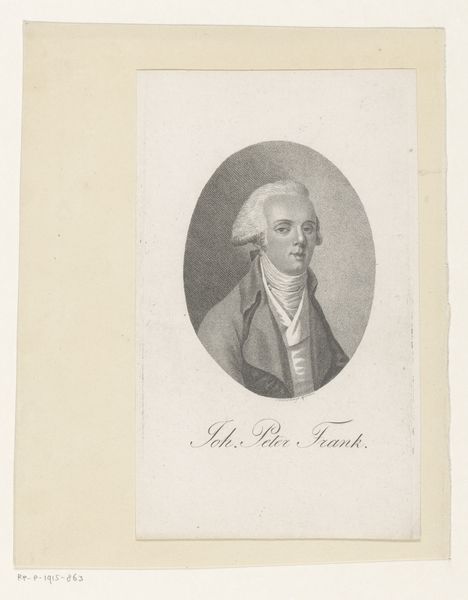
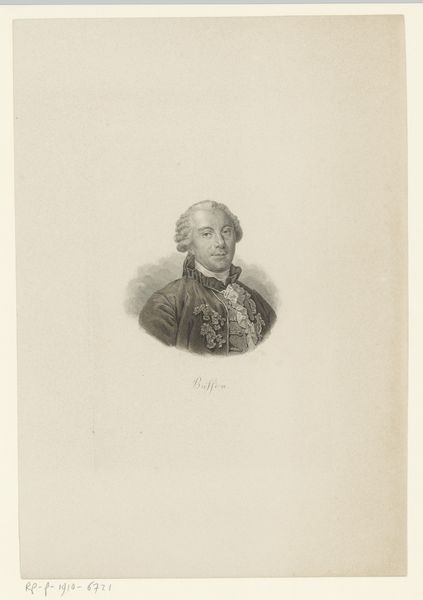
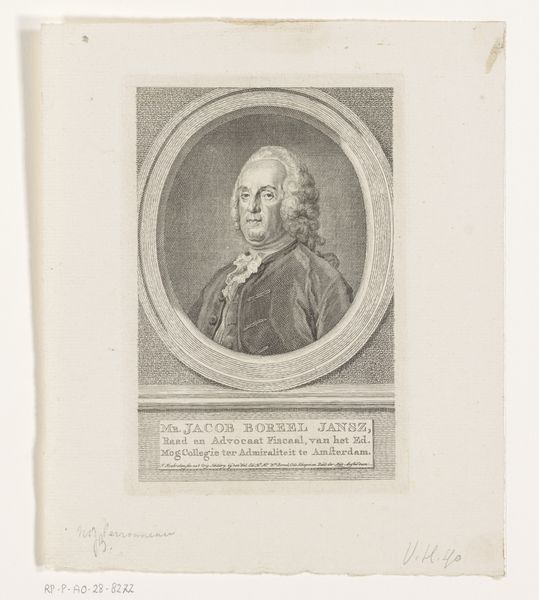
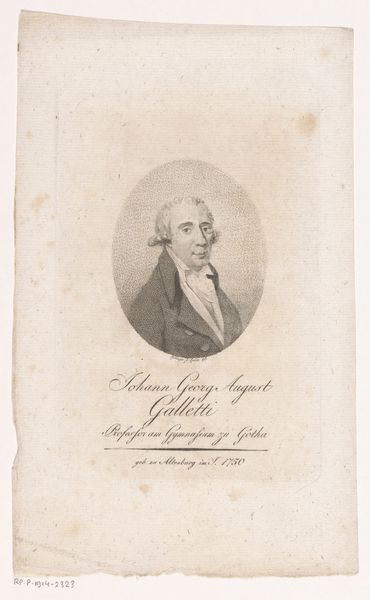
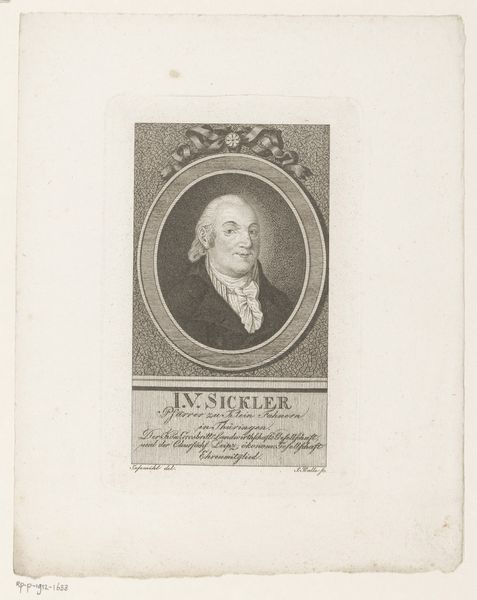
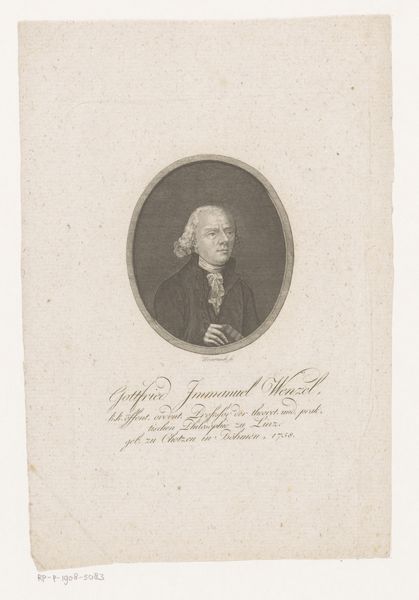
print, paper, engraving
#
portrait
#
pencil drawn
#
neoclacissism
# print
#
old engraving style
#
paper
#
engraving
Dimensions: height 131 mm, width 83 mm
Copyright: Rijks Museum: Open Domain
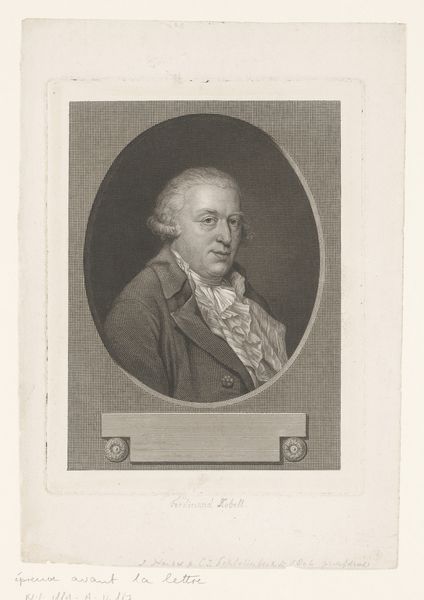
Curator: Johann Friedrich Bolt created this engraving, "Portret van Ernst Ferdinand Klein," in 1794. It's currently held here at the Rijksmuseum. What's your first take on this piece? Editor: There’s a distinct severity about it. The tight composition and almost stark rendering amplify the man's imposing gaze. One senses authority and perhaps a hint of the constraints of that era. Curator: I agree. And Bolt's choice of engraving as a medium is crucial here. The incised lines, meticulously etched into the plate and then printed onto paper, allowed for a dissemination of images reflective of Enlightenment ideals. Consider the paper itself: likely a high-rag content, indicating the availability of specific material and craft knowledge during its creation. Editor: Exactly! It makes you wonder about the relationship between portraiture and power. Ernst Ferdinand Klein, identified in the inscription below, was evidently a man of stature, and the print serves as a potent tool of visibility, projecting his status outward into society. To me, it speaks to issues of class, influence, and the construction of identity in the late 18th century. How much did Bolt engage critically with his sitter, and how much did he just execute? Curator: The process implies a layer of objectivity. Engraving requires translating likeness through a mediated technique, which inevitably shapes perception. Each line carved, each area shaded, had a physical origin, which required careful attention to the materiality. I suppose what is particularly important about Bolt’s work is to examine not just *what* he depicts, but *how* the material realities of printmaking influence that depiction and understanding. Editor: I think also about the socio-political currents present. What specific structures allowed Herr Klein access to Bolt's services? It also gives pause to examine what other kinds of representational access, at that historical juncture, existed only in specific spheres, like wealthy white cis men? And whose access was restricted and how did this all work to keep the rich and privileged richer and more privileged. Curator: These printed portraits circulated as markers of identity and status, indeed, within a fairly closed circuit of elites. By examining the material and social processes embedded in their production, we gain insight into the mechanics of social representation and the circulation of power. The print embodies a moment, a practice, and its lasting echo. Editor: And thinking about the material legacies also encourages crucial questions about equality and how visibility functioned historically in relationship to personhood. So this image encourages crucial historical reflexivity, no matter what "camp" we view it from.
Comments
No comments
Be the first to comment and join the conversation on the ultimate creative platform.
 Collect
 React
React Comment
More like this