1908
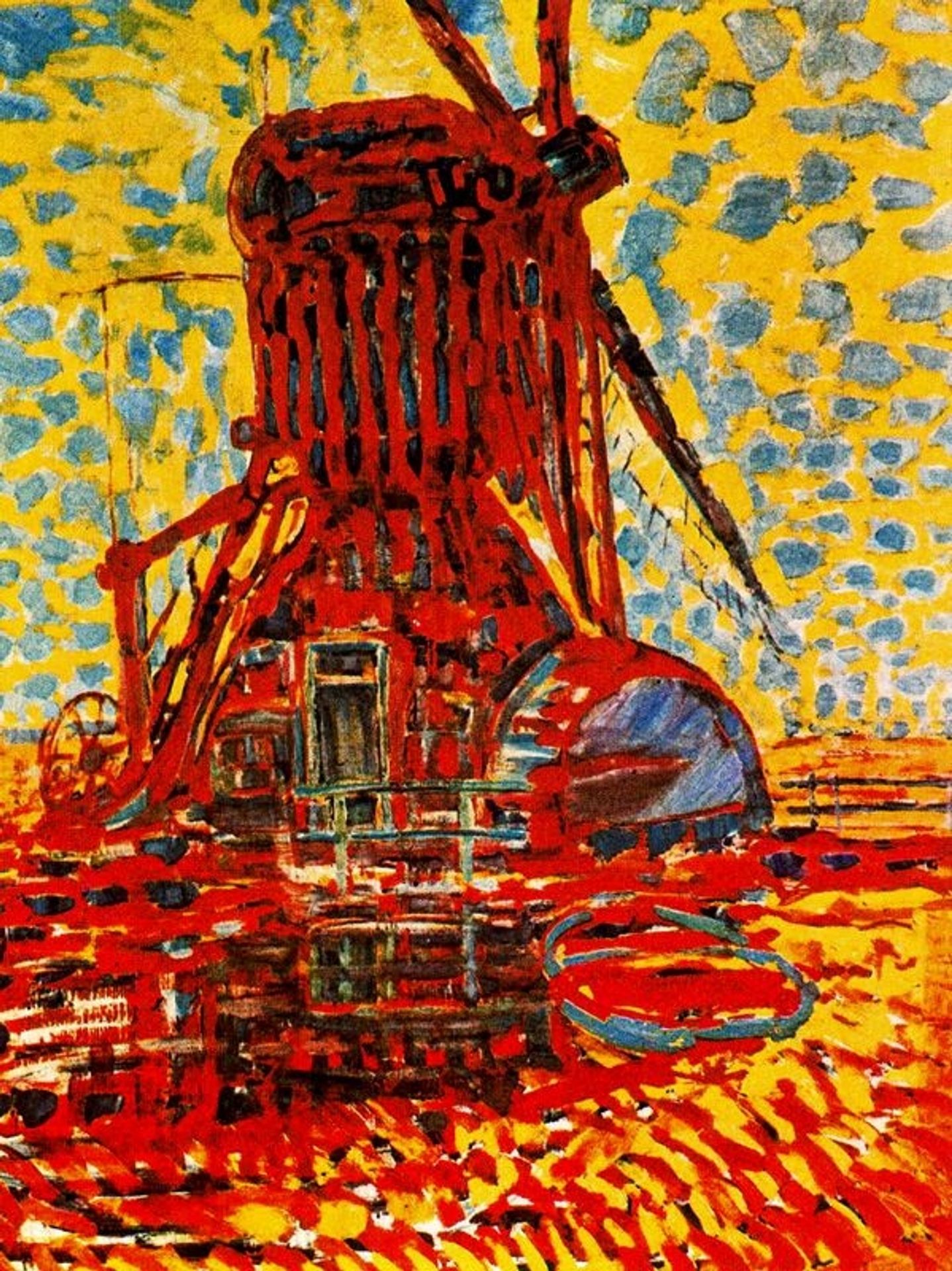
Mill in Sunlight: The Winkel Mill

Piet Mondrian
1872 - 1944Location
Gemeentemuseum den Haag, Hague, NetherlandsListen to curator's interpretation
Curatorial notes
Editor: Here we have Piet Mondrian’s “Mill in Sunlight: The Winkel Mill” painted in 1908. It’s oil on canvas, and honestly, it just explodes with color, doesn’t it? It feels so raw and energetic, not at all what I expect from a landscape. How do you interpret this work? Curator: Raw is a good word! It’s as though Mondrian isn't just showing us a windmill but, dare I say, he’s letting us *feel* its essence. It pulses, right? Think about his path. He was seeking a spiritual dimension, something beyond the merely visible. He once said, "The purer the form, the greater the expression.” The red isn't just red; it’s passion, fervor, the life force of the thing itself. Editor: So, the almost violent brushstrokes, that's intentional? It isn't a mistake, or just an artistic choice about technique? Curator: Oh, absolutely intentional! Remember, he's teetering on the edge of abstraction here. Look how the mill seems to almost dissolve into its surroundings. The blue dabs in the "sky" mirroring the reds and yellows below. Everything is interconnected, vibrating. He wants to transcend representation and get to the soul of the windmill, the idea of a windmill. Can you feel it almost moving toward complete abstraction, leaving only the idea, or pure form, of windmill-ness behind? Editor: I think I get it. It's less about the windmill, and more about… the *feeling* of windmill. The colors definitely contribute. I can feel the fervor and vibration. Curator: Exactly! It's a brave new world of seeing. Or, more precisely, feeling *through* seeing, eh? It makes one ponder what it really means to see! It surely altered my idea of what landscapes might be. Editor: Mine too. I'll never look at a landscape painting the same way again. Thank you for that vision, so vibrant in its intensity.