Dimensions: Overall: 13 1/4 × 16 1/2 in. (33.7 × 41.9 cm)
Copyright: Public Domain
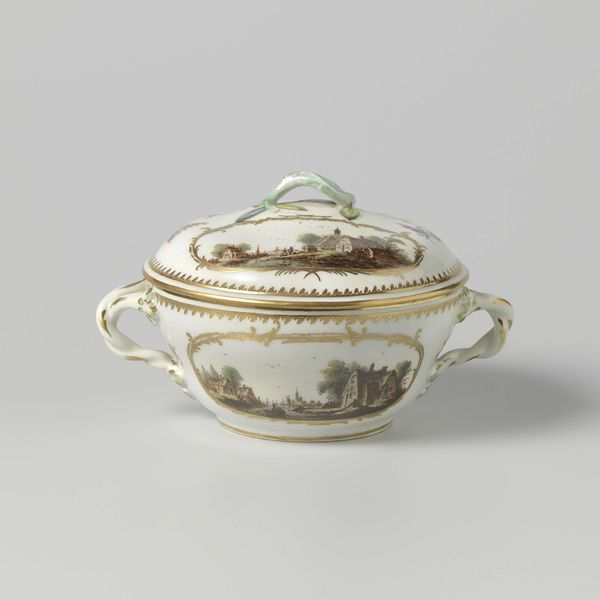
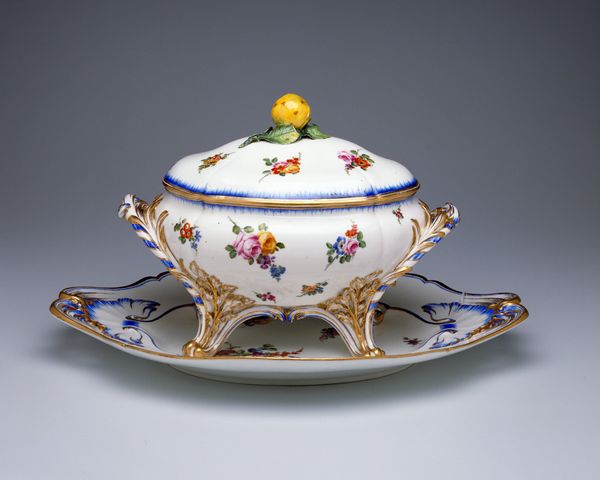
Editor: Here we have an exquisite porcelain Tureen with Cover, crafted by the Meissen Manufactory between 1767 and 1779. What strikes me first is the contrasting imagery; it's so delicate, yet the lion seems to disrupt the entire aesthetic with his intimidating posture. How do you read this sculpture? Curator: Precisely, this juxtaposition creates a captivating tension within the piece. Note how the artist has deployed the Rococo style, with its emphasis on asymmetry and playful dynamism. The flowing lines of the tureen itself are offset by the assertive angles of the lion’s pose. The maritime scenes decorating the porcelain further enrich the composition. Editor: Yes, I see that, but how do these seemingly disparate elements unify into a cohesive whole? Curator: Observe the tonal harmony achieved by the consistent color palette, predominantly whites, blues, and browns. The painted ships, though picturesque, also imply themes of travel and perhaps trade, grounding the overall sculpture, while the lion may function as an allegory, and we could dive further into bestial representation in Rococo porcelain. How does the scaling interact to add to the unity, for you? Editor: I understand how the formal elements now point to the lion becoming more a part of the sculpture as a whole; its whiteness allows it to flow into the porcelain glaze, and I appreciate the added historical context with the ships that adorn it. Curator: It becomes clear that the formal execution gives precedence to all other contextual concerns, even symbolic representation; an emphasis of line, tone, color, and scale create harmony among conflict, producing, arguably, beauty. A truly fascinating example of Rococo sculpture, I would say!
Comments
No comments
Be the first to comment and join the conversation on the ultimate creative platform.
 Collect
 React
React Comment
More like this