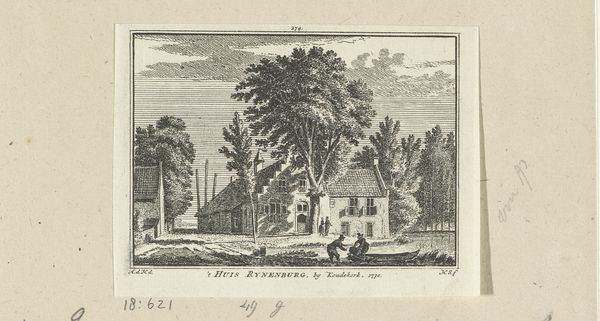
Dimensions: height 80 mm, width 115 mm
Copyright: Rijks Museum: Open Domain
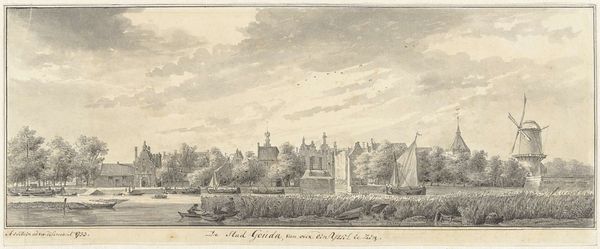
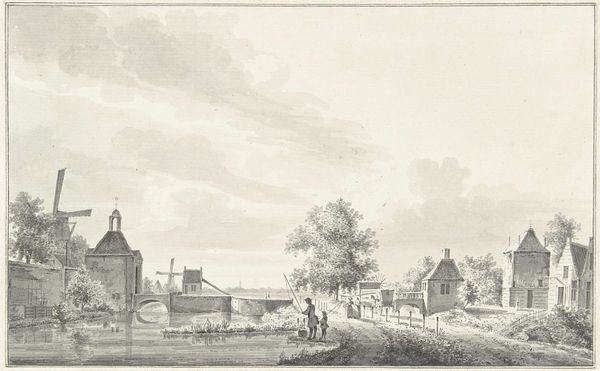
Editor: Here we have Abraham Rademaker's "Gezicht op het veer bij Gorinchem", made sometime between 1727 and 1733. It's currently housed in the Rijksmuseum. The scene is so precise and detailed. What are some of the first things that strike you when looking at this work? Curator: Immediately, it’s the intricate play of lines that demands attention. The artist’s reliance on linear elements – the dense hatching that describes the sky, the distinct, almost architectural definition of each building, the rippling effect on water – they all contribute to a formal clarity, organizing the pictorial space into distinct, measurable zones. The composition adheres to a strict horizontal division. Do you see that too? Editor: Yes, the sky, the city and then the landscape are clearly delineated horizontally. Is that a conscious choice, or simply a reflection of how the landscape naturally falls? Curator: Perhaps both. Notice how the artist does not offer any kind of blending. Each stratum exists independently and, yet, cohesively. The success hinges upon Rademaker's expert management of tonal values, achieved through the consistent application of his distinct linear approach. Consider also the texture created; is it smooth, rough, or something in between? How does that support the composition? Editor: That's fascinating. It feels precise and calculated. Thinking about that division really helps. Curator: Indeed, viewing art through its formal components can yield profound understanding. Hopefully, this fresh vision empowers future viewings as well. Editor: Thank you, it really does. I am sure this will affect how I look at art from now on.
Comments
No comments
Be the first to comment and join the conversation on the ultimate creative platform.
 Collect
 React
React Comment
More like this