1593 - 1597
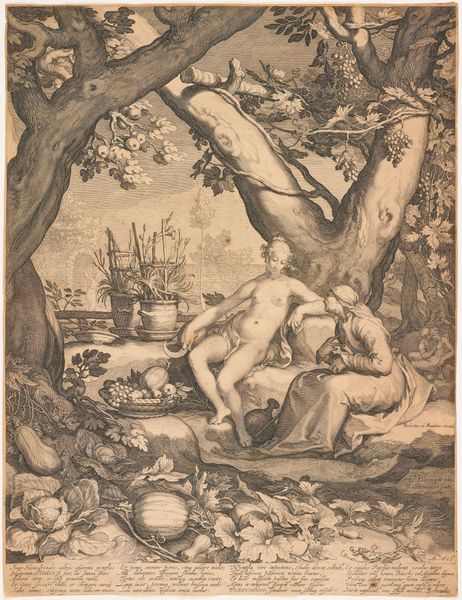
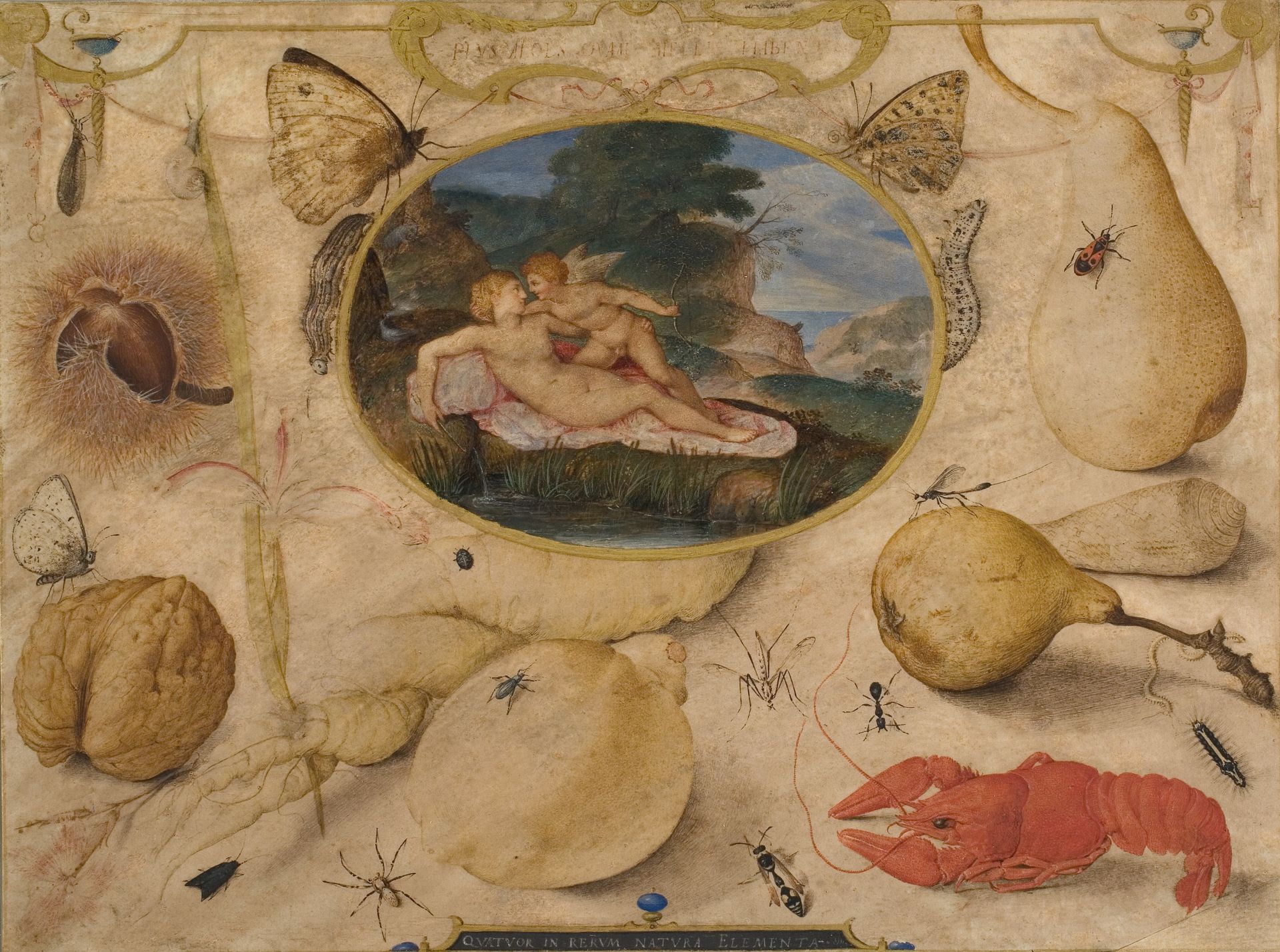
"Venus disarming Amor" in a medallion surrounded by plants, fruits, insects and shellfish


Listen to curator's interpretation
Curatorial notes
Editor: This is Joris Hoefnagel’s “Venus disarming Amor” in a medallion, painted between 1593 and 1597 using watercolor and gouache. What strikes me is how the central scene, almost classical, is overwhelmed by the meticulous rendering of these natural specimens—fruits, insects, even shellfish. What do you see in this piece, beyond its obvious Mannerist style? Curator: Let's consider the formal arrangement first. The oval medallion containing the Venus and Cupid myth offers a moment of idealized beauty, rendered with delicate precision, against the density and almost overwhelming detail of the surrounding natural elements. Notice how the textures—the smooth skin of the figures versus the rough surfaces of the fruits and insects—create a dynamic tension. Editor: So, it’s about contrasting textures and forms, but what about the meaning generated by that contrast? Is Hoefnagel making a statement through these elements? Curator: Indeed. Think of the meticulous detail applied to each insect, each piece of fruit. The work invites close looking, rewarding careful observation of line, form, and color. Each element seems self-contained, yet part of a larger composition. The framing inscription reinforces the symbolic relation among these three elements, which have an "elective affinity." How does the inscription impact your understanding? Editor: Now I see it: each element contributes to the overall balance and compositional dynamism. Together, they exemplify nature's artistry. Curator: Precisely. Ultimately, what this exercise underscores is the formal complexity that creates new perspectives on this early example of the Renaissance. Editor: This close reading really illuminated the complex, balanced structure of Hoefnagel’s composition. It made me appreciate how deliberate his artistic choices were!