About this artwork
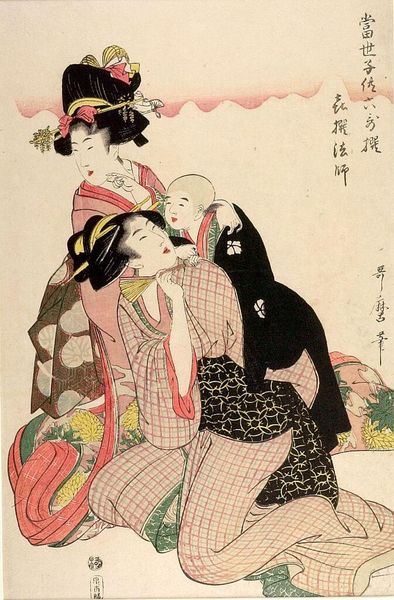
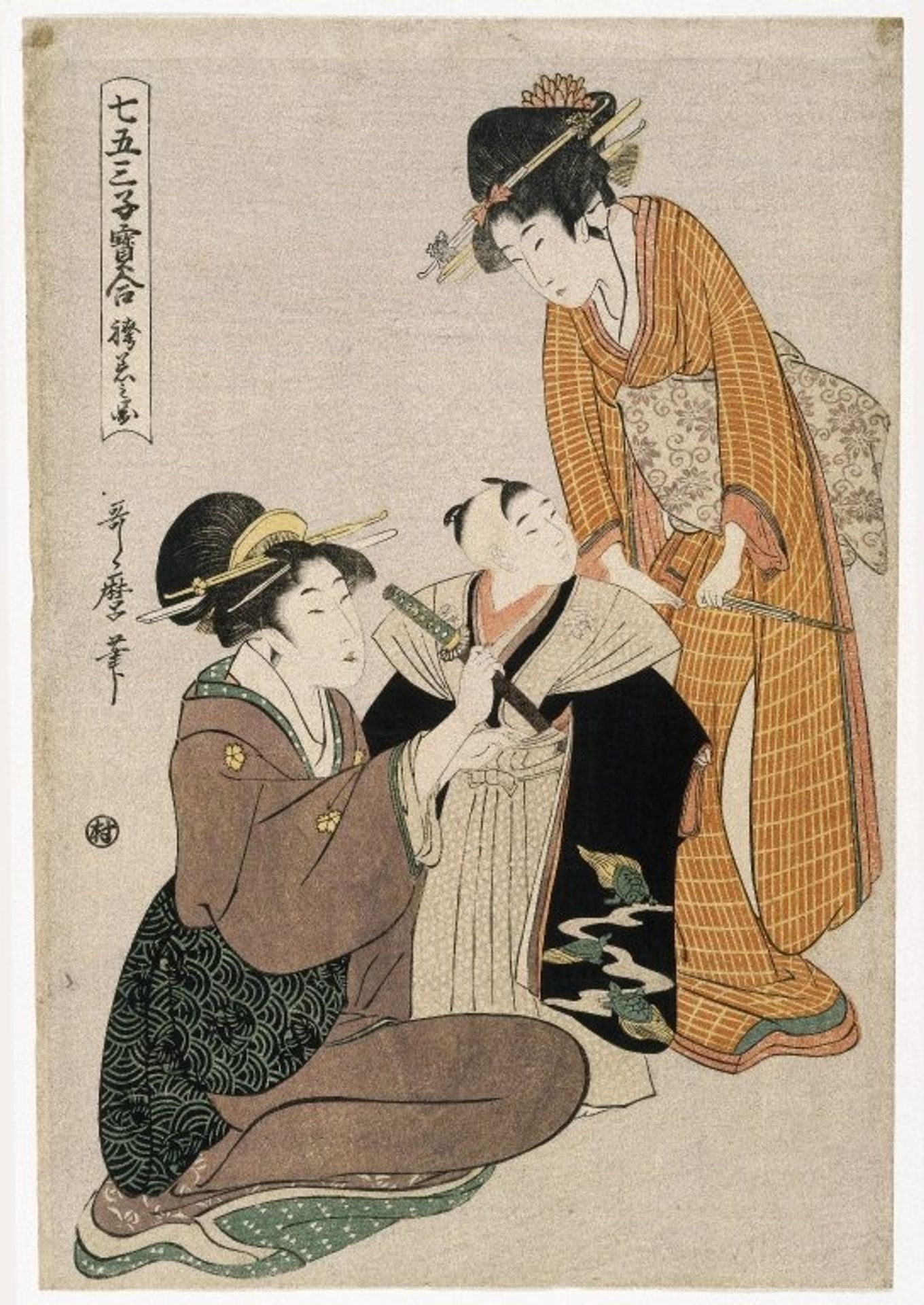
Kitagawa Utamaro created this woodblock print titled, Dressing a Boy on the Occasion of His First Letting His Hair Grow. During Utamaro's time, Japanese society was highly structured, with rigid social hierarchies. The artist's prints often focused on the lives of ordinary people, particularly women. Here we see a tender moment as women dress a young boy, marking an important transition in his life. The occasion is a Shinto ritual celebrated on November 15th that marks three important passages for children aged three, five and seven. Utamaro’s work offers a window into the cultural rituals around gender and childhood. The act of dressing the boy can be seen as a performance of gender, where clothing and adornment play a crucial role in shaping identity. Instead of traditional representations Utamaro develops alternative narratives which capture personal moments. This print reflects societal values, and gives insight to the emotional and personal experience of transitioning into a new stage of life.
Dressing a Boy on the Occasion of His First Letting His Hair Grow 1795


Artwork details
- Medium
- print, woodblock-print
- Dimensions
- 39.3 x 27 cm
- Location
- Brooklyn Museum, New York City, NY, US
- Copyright
- Public domain
Tags
portrait
asian-art
caricature
ukiyo-e
historical fashion
child
woodblock-print
genre-painting
Comments
No comments
About this artwork
Kitagawa Utamaro created this woodblock print titled, Dressing a Boy on the Occasion of His First Letting His Hair Grow. During Utamaro's time, Japanese society was highly structured, with rigid social hierarchies. The artist's prints often focused on the lives of ordinary people, particularly women. Here we see a tender moment as women dress a young boy, marking an important transition in his life. The occasion is a Shinto ritual celebrated on November 15th that marks three important passages for children aged three, five and seven. Utamaro’s work offers a window into the cultural rituals around gender and childhood. The act of dressing the boy can be seen as a performance of gender, where clothing and adornment play a crucial role in shaping identity. Instead of traditional representations Utamaro develops alternative narratives which capture personal moments. This print reflects societal values, and gives insight to the emotional and personal experience of transitioning into a new stage of life.
Comments
No comments