About this artwork
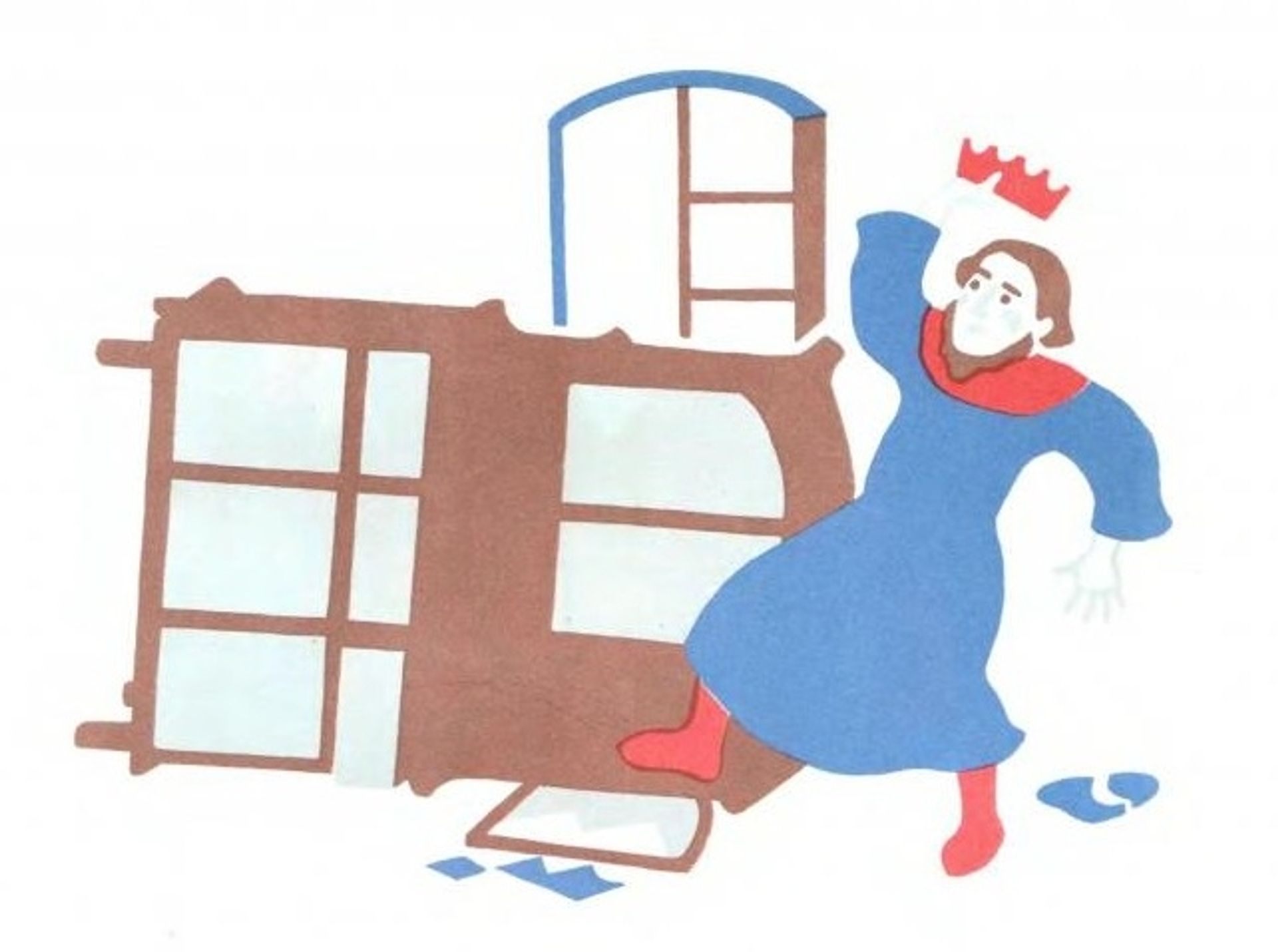
Curator: This is Hryhorii Havrylenko’s "Illustration to Daniil Kharms' book 'Fairy Tale'," created in 1971 using mixed media including collage and acrylic paint on paper. What strikes you immediately? Editor: An odd sense of tension, I would say. The color palette is quite cheerful, almost childish, yet the figure appears to be in a state of chaotic departure or even escape. Curator: It's intriguing how the artist has employed a simplified, almost Cubist approach to represent spatial relationships. Notice the flattened planes of the building and the disjointed perspective, creating a fractured reality. Editor: The image seems to reference narratives of power and disruption. Is the crowned figure fleeing from something or someone? Considering Havrylenko’s Ukrainian identity and the socio-political context of the Soviet Union in the 1970s, one might view this as a critique of authoritarianism. The fractured house as a metaphor for societal instability, the fleeing figure embodying resistance. Curator: The composition itself is dynamic, characterized by angular forms and fragmented shapes. Semiotically, the red could denote passion, violence, or warning depending on the viewer’s lens. These design elements are critical because Havrylenko may be visually depicting tension without directly addressing political figures, perhaps as a self-preservation act. Editor: Indeed. This piece operates on multiple layers, blending childlike aesthetics with subtle yet subversive commentary. It seems a way of working around oppressive state power to offer critique by allusion. Even the “flat color” palette reinforces a kind of symbolic, anti-realist presentation of what we assume is actually a tense, perhaps life-threatening scene. Curator: A powerful interpretation. I appreciate your contextual insight on the illustration's capacity to reflect social issues. Editor: It encourages me to delve into both Havrylenko’s other works and Kharms' original story—I wonder how aligned his illustrations are with the book’s broader themes and symbols.

Artwork details
- Medium
- mixed-media, collage, acrylic-paint, paper
- Copyright
- Hryhorii Havrylenko,Fair Use
Tags
Comments
Share your thoughts
About this artwork
Curator: This is Hryhorii Havrylenko’s "Illustration to Daniil Kharms' book 'Fairy Tale'," created in 1971 using mixed media including collage and acrylic paint on paper. What strikes you immediately? Editor: An odd sense of tension, I would say. The color palette is quite cheerful, almost childish, yet the figure appears to be in a state of chaotic departure or even escape. Curator: It's intriguing how the artist has employed a simplified, almost Cubist approach to represent spatial relationships. Notice the flattened planes of the building and the disjointed perspective, creating a fractured reality. Editor: The image seems to reference narratives of power and disruption. Is the crowned figure fleeing from something or someone? Considering Havrylenko’s Ukrainian identity and the socio-political context of the Soviet Union in the 1970s, one might view this as a critique of authoritarianism. The fractured house as a metaphor for societal instability, the fleeing figure embodying resistance. Curator: The composition itself is dynamic, characterized by angular forms and fragmented shapes. Semiotically, the red could denote passion, violence, or warning depending on the viewer’s lens. These design elements are critical because Havrylenko may be visually depicting tension without directly addressing political figures, perhaps as a self-preservation act. Editor: Indeed. This piece operates on multiple layers, blending childlike aesthetics with subtle yet subversive commentary. It seems a way of working around oppressive state power to offer critique by allusion. Even the “flat color” palette reinforces a kind of symbolic, anti-realist presentation of what we assume is actually a tense, perhaps life-threatening scene. Curator: A powerful interpretation. I appreciate your contextual insight on the illustration's capacity to reflect social issues. Editor: It encourages me to delve into both Havrylenko’s other works and Kharms' original story—I wonder how aligned his illustrations are with the book’s broader themes and symbols.
Comments
Share your thoughts