About this artwork
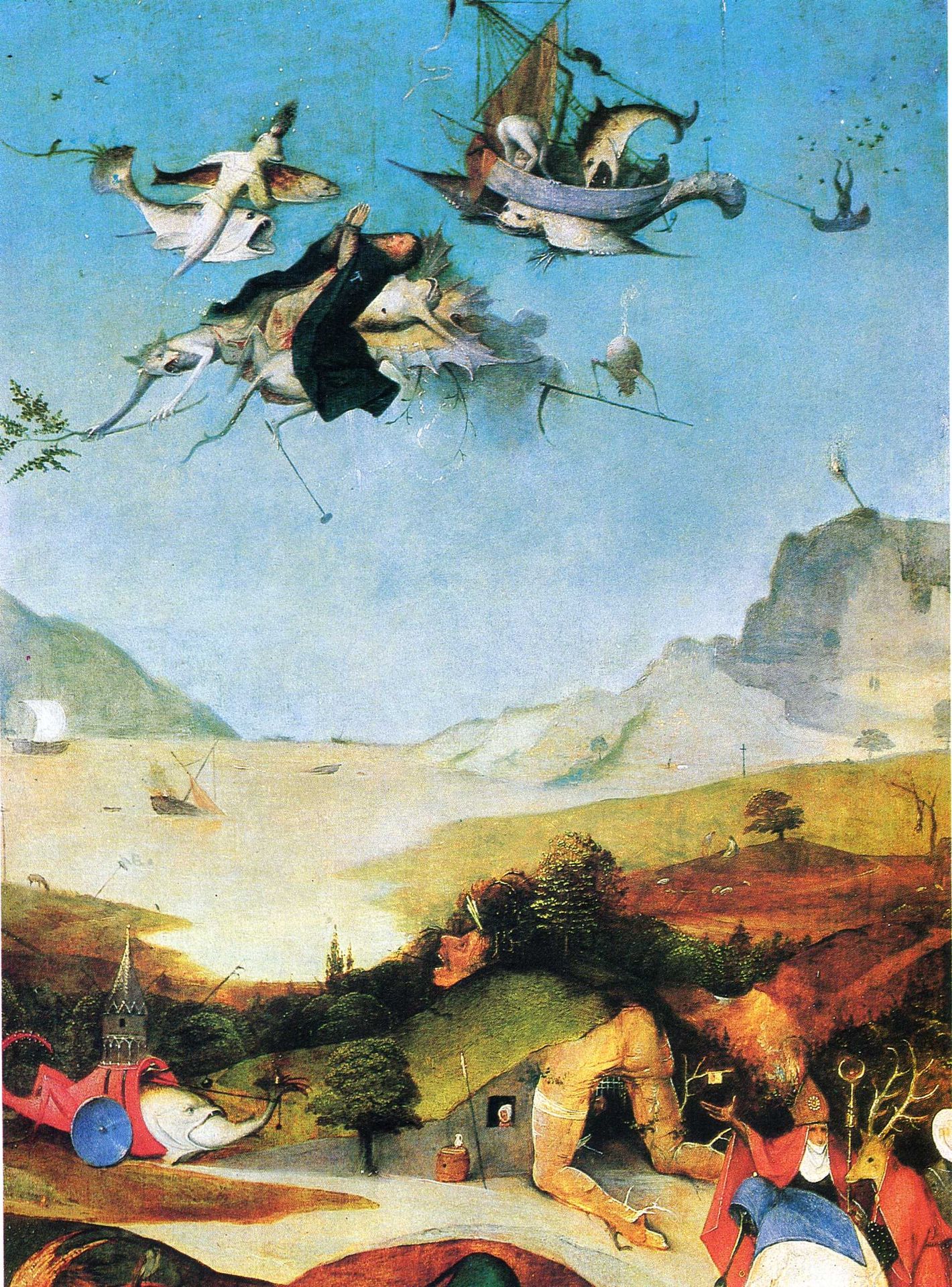
Editor: So, this is Hieronymus Bosch's "Temptation of Saint Anthony," painted around 1506, an oil on wood panel. What immediately strikes me is the sheer...strangeness of the forms. These bizarre creatures dominate the landscape. How do you interpret this work? Curator: For me, this work is deeply rooted in its materiality and the means of its production. Consider the oil paint itself – a relatively new medium at the time, allowing Bosch to build up these incredibly detailed, almost hallucinatory surfaces. The very act of layering paint, of painstakingly rendering each creature, each distorted face, becomes a crucial part of the work's meaning. What does it mean to depict religious struggle using such laborious, detailed methods? Editor: That's interesting. I was thinking about the religious aspect more from a symbolic perspective, about temptation and faith... Curator: But think about the context. Who was commissioning such works? What kind of labor went into acquiring the materials, grinding the pigments? And how would those factors shape the kind of message the painting conveyed to its intended audience? It is also challenging traditional boundaries between high art and craft by examining labor, materiality, and consumption. How does labor speak to moral righteousness or divine presence here? Editor: I hadn’t considered that perspective before. The materials and the act of making itself are integral to its meaning and context, especially for the intended audience. It moves beyond simply illustrating religious concepts. Curator: Precisely. The painting, as an object made, bought and beheld is intrinsically bound to it's creation. We get more insight into society, economy, and craft, not only spiritual beliefs. Editor: That gives me a totally new way of looking at Bosch and his contemporaries. Thanks.
Temptation of St. Anthony
1506

Hieronymus Bosch
1450 - 1516
MNAA National Museum of Ancient Art
National Museum of Ancient Art (MNAA), Lisbon, PortugalArtwork details
- Location
- National Museum of Ancient Art (MNAA), Lisbon, Portugal
- Copyright
- Public domain
Comments
Share your thoughts
About this artwork
Editor: So, this is Hieronymus Bosch's "Temptation of Saint Anthony," painted around 1506, an oil on wood panel. What immediately strikes me is the sheer...strangeness of the forms. These bizarre creatures dominate the landscape. How do you interpret this work? Curator: For me, this work is deeply rooted in its materiality and the means of its production. Consider the oil paint itself – a relatively new medium at the time, allowing Bosch to build up these incredibly detailed, almost hallucinatory surfaces. The very act of layering paint, of painstakingly rendering each creature, each distorted face, becomes a crucial part of the work's meaning. What does it mean to depict religious struggle using such laborious, detailed methods? Editor: That's interesting. I was thinking about the religious aspect more from a symbolic perspective, about temptation and faith... Curator: But think about the context. Who was commissioning such works? What kind of labor went into acquiring the materials, grinding the pigments? And how would those factors shape the kind of message the painting conveyed to its intended audience? It is also challenging traditional boundaries between high art and craft by examining labor, materiality, and consumption. How does labor speak to moral righteousness or divine presence here? Editor: I hadn’t considered that perspective before. The materials and the act of making itself are integral to its meaning and context, especially for the intended audience. It moves beyond simply illustrating religious concepts. Curator: Precisely. The painting, as an object made, bought and beheld is intrinsically bound to it's creation. We get more insight into society, economy, and craft, not only spiritual beliefs. Editor: That gives me a totally new way of looking at Bosch and his contemporaries. Thanks.
Comments
Share your thoughts