About this artwork
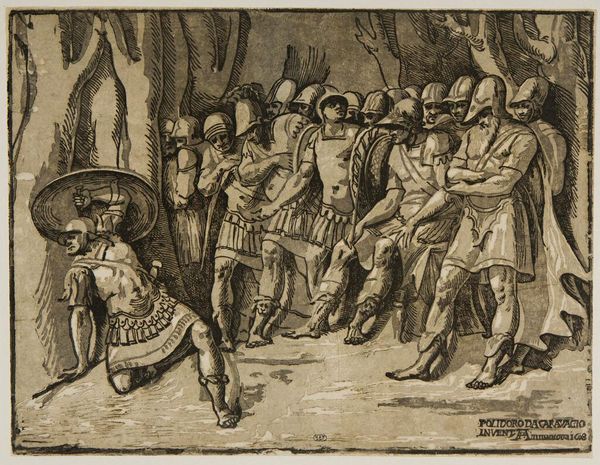
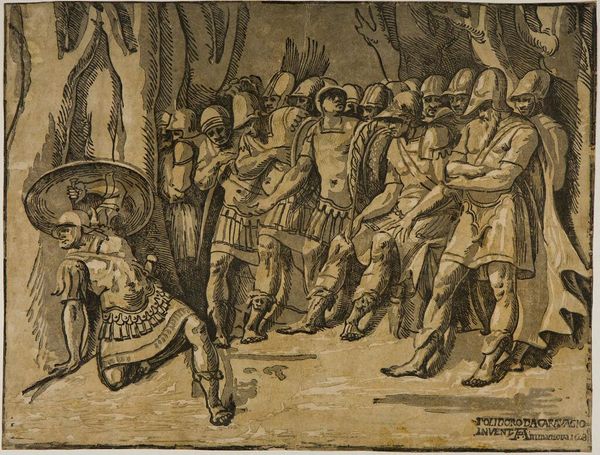
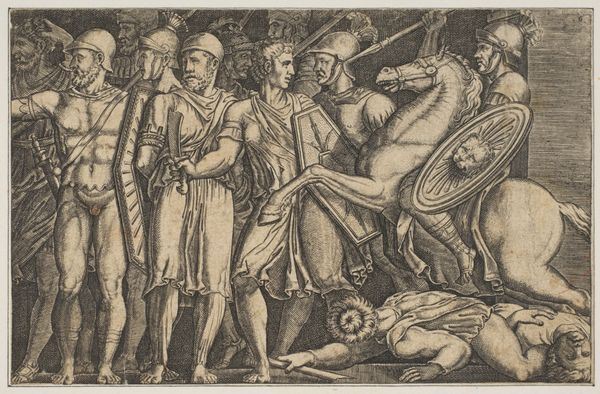
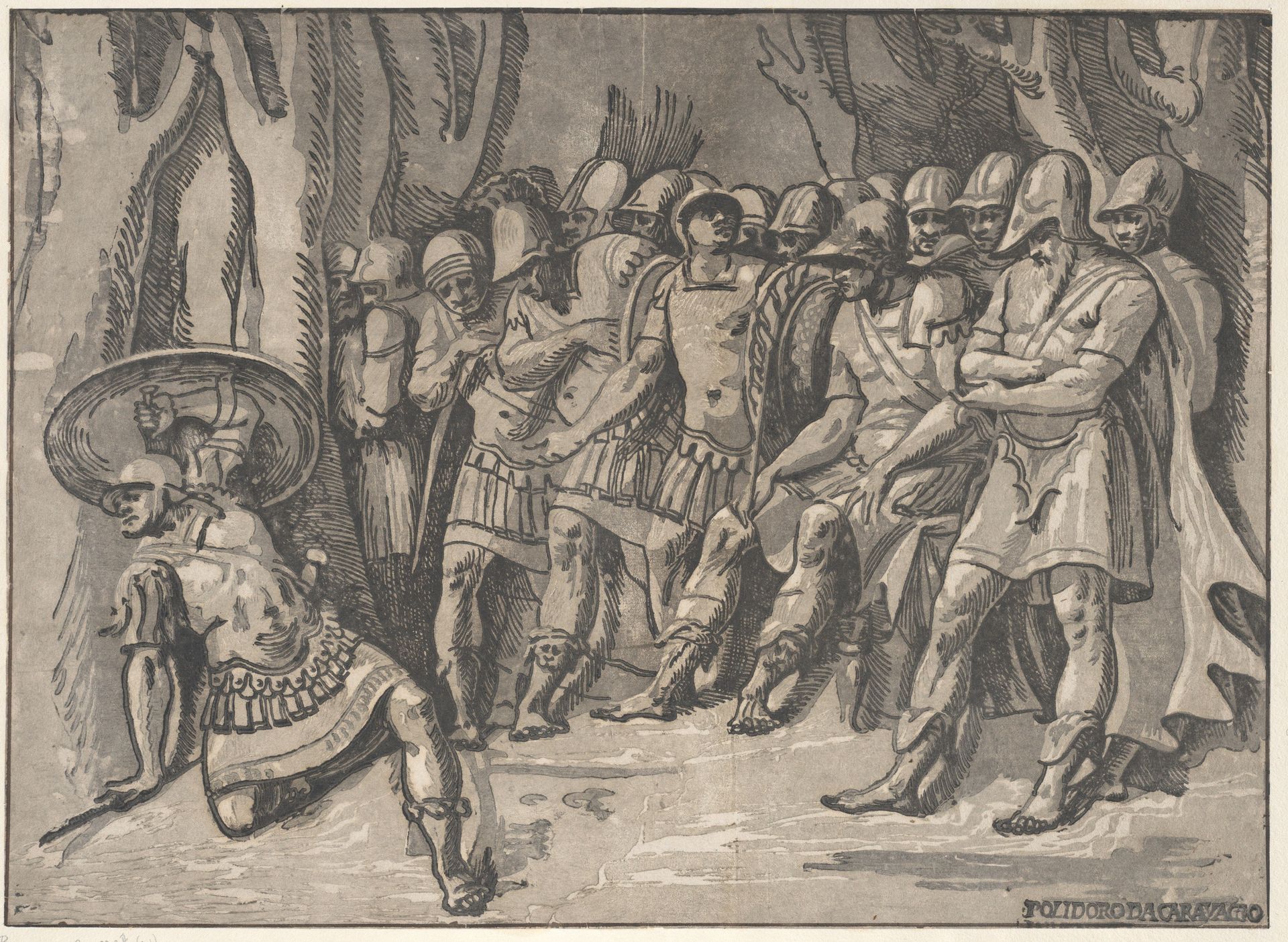
Niccolò Vicentino made this print, depicting Ajax and Agamemnon, sometime in the first half of the 16th century, using a woodblock. Look closely, and you’ll notice the image is made up of many thin lines, carved into the surface of the block. The artist would have used specialized knives and gouges to remove the wood around each line, leaving the design raised. Ink was then applied to this surface, and the image transferred to paper. This was a laborious, skilled process. But printmaking allowed images to be reproduced and disseminated widely. Vicentino was part of a wave of artisans who helped to make art more accessible, catering to a growing market for visual culture. The story of Ajax and Agamemnon, once confined to elite circles, could now reach a broader audience, thus blurring the lines between high art and popular consumption. This print demonstrates how a traditional craft could be used for wider social distribution.
Ajax lower left holding a shield aloft, at the right stands Agamemnon surrounded by his soldiers
1540 - 1550


Artwork details
- Medium
- drawing, print, ink, engraving
- Dimensions
- Sheet: 12 in. × 16 1/2 in. (30.5 × 41.9 cm)
- Location
- Metropolitan Museum of Art, New York, NY
- Copyright
- Public Domain
Tags
Comments
Share your thoughts
About this artwork
Niccolò Vicentino made this print, depicting Ajax and Agamemnon, sometime in the first half of the 16th century, using a woodblock. Look closely, and you’ll notice the image is made up of many thin lines, carved into the surface of the block. The artist would have used specialized knives and gouges to remove the wood around each line, leaving the design raised. Ink was then applied to this surface, and the image transferred to paper. This was a laborious, skilled process. But printmaking allowed images to be reproduced and disseminated widely. Vicentino was part of a wave of artisans who helped to make art more accessible, catering to a growing market for visual culture. The story of Ajax and Agamemnon, once confined to elite circles, could now reach a broader audience, thus blurring the lines between high art and popular consumption. This print demonstrates how a traditional craft could be used for wider social distribution.
Comments
Share your thoughts