drawing
#
portrait
#
drawing
#
romanticism
#
nude
Dimensions: height 626 mm, width 484 mm
Copyright: Rijks Museum: Open Domain
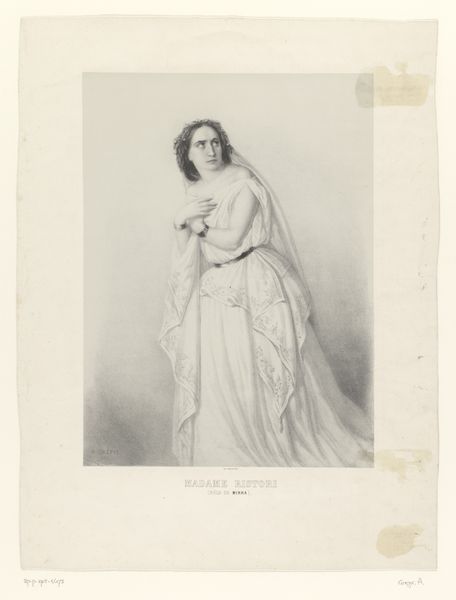
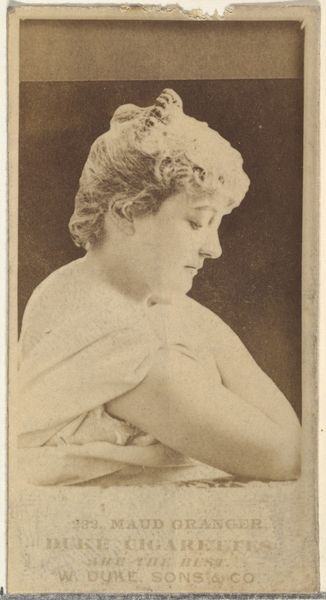
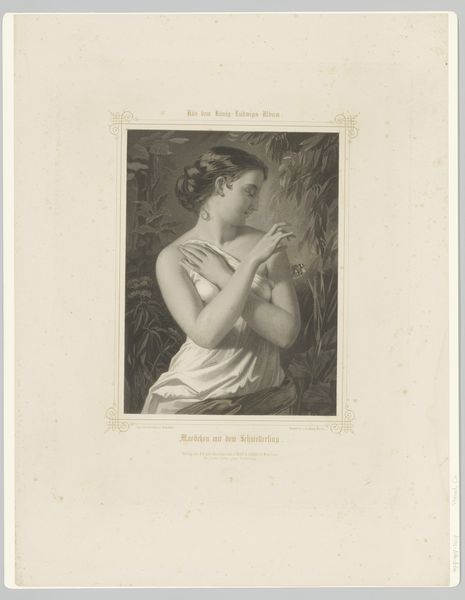
Curator: Look closely at this drawing by Émile Lassalle, crafted around 1844. It's a captivating portrayal of a young woman shielding herself, currently residing at the Rijksmuseum. Editor: The first thing that strikes me is the almost palpable sense of vulnerability. The averted gaze, the way she clutches the fabric… it feels both intimate and subtly melancholic. Curator: Absolutely. Lassalle captures that Romantic era fascination with emotional intensity. We have a partial nude portrayed in a drawing. Her nudity in conjunction with a bracelet shaped as a snake all point to Lassalle positioning this within certain societal power dynamics between men and women. Editor: Yes, and the serpent bracelet is doing quite a bit of heavy lifting, isn't it? Snakes are so multivalent – temptation, healing, danger. In this context, it almost feels like a commentary on societal constraints placed upon women and perhaps on their supposed roles as temptresses. Curator: It is hard not to draw those conclusions! One of the other challenges here is who would have encountered this piece in this era? Would it have been for a small group of viewers, an audience limited to the salon, etc? If so, we must consider how its circulation impacted the broader societal values being created in Western European culture. Editor: It makes you wonder what sort of statement Lassalle was aiming to make. Is it a sympathetic portrayal, or something more critical? The softness of the lines is key as it conveys a romantic aesthetic with this classical motif. Curator: It's fascinating how the meaning shifts depending on who's looking and when, and which sociopolitical ideas they're carrying. Art history, is constantly reassessing itself to get past these assumptions. Editor: It's interesting how these pieces speak through symbols and invite dialogue even across centuries. A silent visual language with stories buried within. Curator: Ultimately, a piece like this makes us ask how are we all, as viewers, complicit in the society of its time. Editor: True. Looking through the art helps us also understand ourselves in the present, with these shifting dialogues across time.
Comments
No comments
Be the first to comment and join the conversation on the ultimate creative platform.
 Collect
 React
React Comment
More like this