

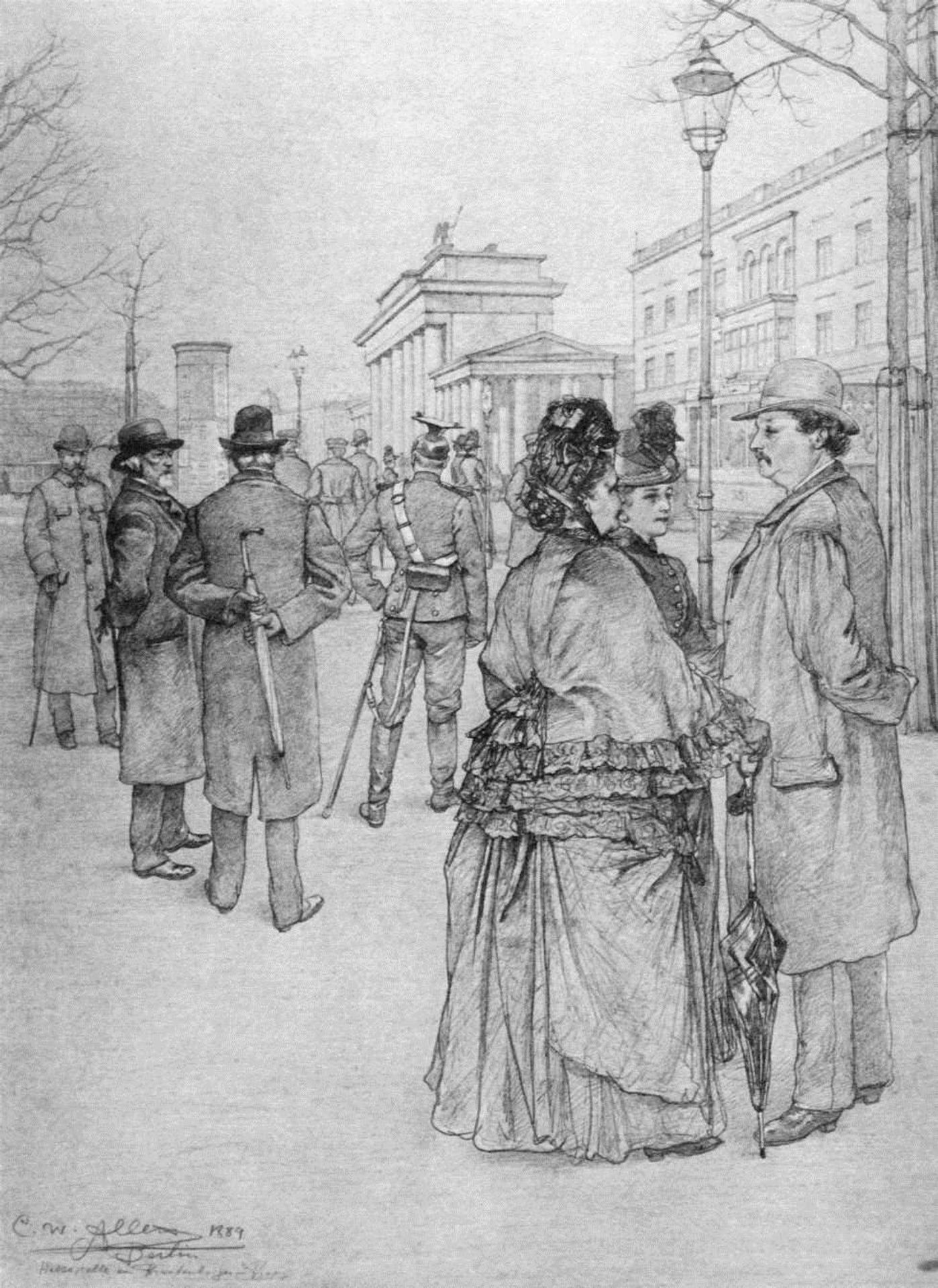
1889
At the Brandenburg Gate

Listen to curator's interpretation
Curatorial notes
Editor: Here we have Christian Wilhelm Allers's "At the Brandenburg Gate," created in 1889 using pencil and graphite. The detailed rendering of the figures gives a real sense of bustling city life, but the monument in the background feels somewhat distant and austere. What catches your eye in this piece? Curator: The placement of the Brandenburg Gate in the background is interesting, isn't it? It raises questions about whose history is centered here. Are we meant to focus on the grandeur of the Prussian empire represented by the gate, or on the everyday lives of the people populating the foreground? Notice the mix of classes depicted. What stories do you imagine for each of them and their relationship with the power structure in late 19th-century Berlin? Editor: That's a great point – the people *do* become the subject more than the landmark. Perhaps it's a subtle commentary on society itself? Curator: Precisely. Allers, intentionally or not, presents a snapshot of social dynamics at play. The military figure, for example, stands slightly apart, visually connecting the people to the state, yet simultaneously highlighting a potential distance or tension. The detailed attention paid to the clothing of the women could signify how deeply intertwined the era was with defining women via fashion. Do you see a sense of the individual, or are they swallowed up by societal expectations? Editor: I see both, actually. Their fashionable attire places them in a particular societal bracket, but their expressions suggest individual thoughts and concerns. Thank you! That's given me a whole new perspective. Curator: And for me, thinking about this piece has solidified how art serves as an amazing time capsule, reflecting power dynamics that continue to resonate today.