

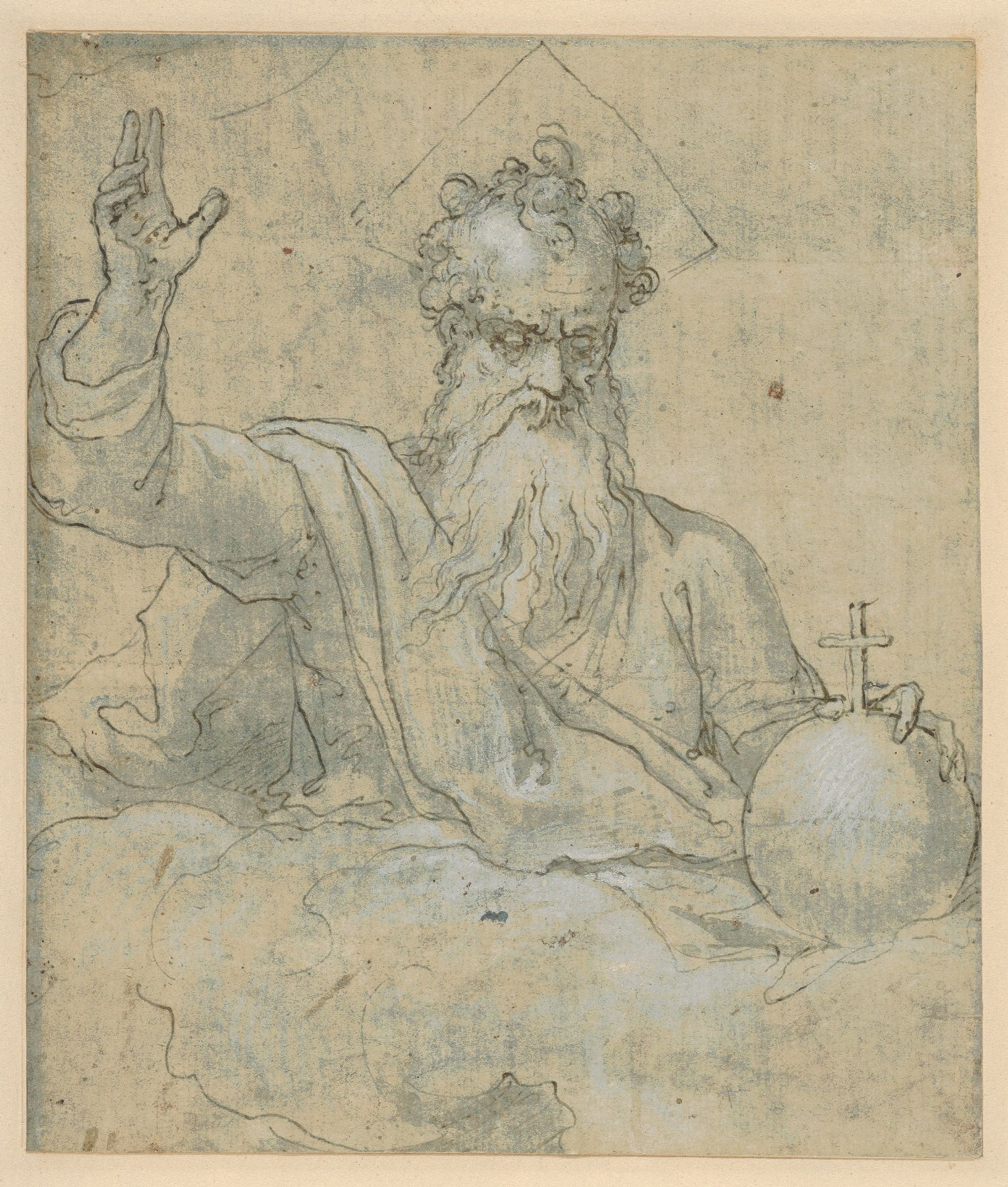
1570 - 1580
God the Father

Federico Zuccaro (Zuccari)
1540 - 1609The Metropolitan Museum of Art
Metropolitan Museum of Art, New York, NYListen to curator's interpretation
Curatorial notes
Editor: Here we have Federico Zuccaro's drawing, "God the Father," created sometime between 1570 and 1580. I'm struck by the figure's commanding presence despite being rendered in such delicate lines. What symbolism do you see embedded in this Renaissance drawing? Curator: Note how Zuccaro uses line not just to define form, but to imbue this figure with authority. Observe the triangle behind God’s head. What geometric shape resonates with ideas of divinity in our cultural memory? Editor: A triangle suggests the Holy Trinity, right? Is it common to associate geometric shapes with divinity in Renaissance art? Curator: Precisely! The Renaissance saw a renewed interest in classical ideals, which included the symbolic power of geometry. Now consider the orb in God’s left hand topped with a cross. How does that specific object add to the image's symbolic weight? Editor: It’s like God's claiming dominion over the world... or at least a Christianized world. What effect would this type of iconography have had at that time? Curator: During the Counter-Reformation, these images reinforced the Catholic Church's authority, visually asserting its divinely ordained power at a time of intense religious questioning and the rise of Protestantism. Notice that while God gestures, it doesn’t seem forceful. Almost a placid permission to live. Does this alter the overall emotional feeling conveyed? Editor: Yes, it gives an overwhelming impression of acceptance. It brings another perspective to that period. I hadn’t really considered the effect of historical context. Thanks for sharing that insight. Curator: Exploring the history of symbols is always about tracing continuities, discovering shifts in meaning, and unveiling the rich tapestry of cultural memory that images embody.