photography, sculpture
#
portrait
#
sculpture
#
photography
#
sculpture
#
realism
#
statue
Dimensions: height 84 mm, width 51 mm
Copyright: Rijks Museum: Open Domain
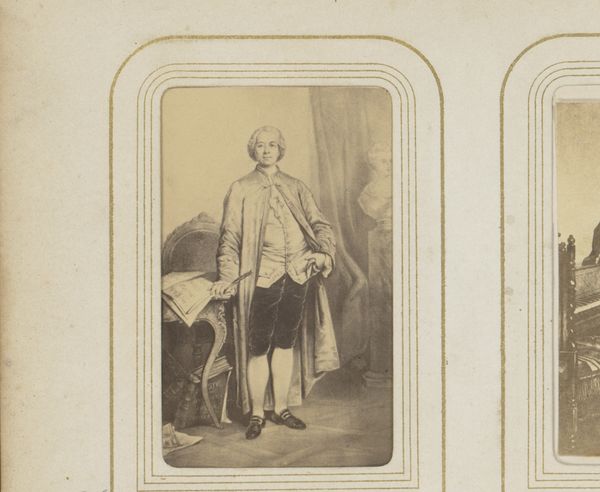
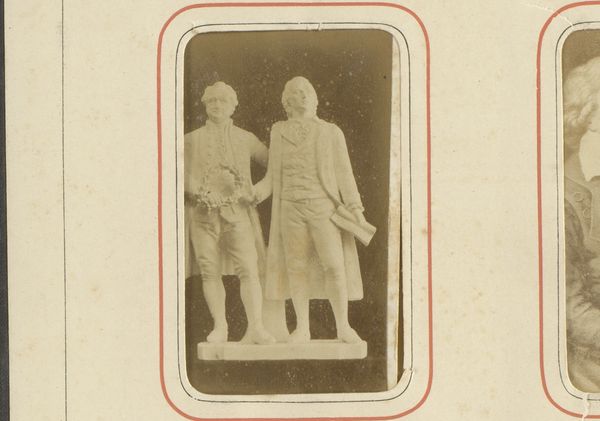
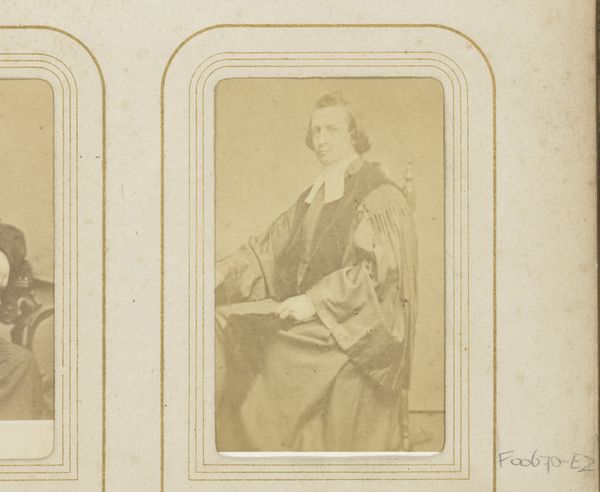
Curator: Today, we're looking at a photograph titled "Beeld van Johann Sebastian Bach," which translates to "Statue of Johann Sebastian Bach." It's estimated to have been made between 1860 and 1890. The medium is photography capturing a sculpture of the famous composer. Editor: My initial impression is one of formality, even a touch of coldness. The statue appears very structured and static against the dark backdrop, lacking a certain warmth. It looks quite like a plaster cast. Curator: It's intriguing how the realism sought in both the sculptural form and the photographic reproduction can convey that sense of detachment. The artist is prioritizing the faithful depiction of form and detail. We see the precise folds in Bach's clothing, the carefully rendered features of his face, all serving the representation. Editor: But consider the context in which this image was produced. A sculpture of Bach in the mid-19th century is an act of memorialization, solidifying his legacy within a particular cultural framework. The choice to depict him holding a book, most likely scores, reinforces his intellectual contributions. The piece speaks volumes about how musical genius is culturally canonized, and by whom. Who is included in that 'great man' narrative, and why? Curator: I agree, it's impossible to ignore the canonization aspect. But before even considering Bach’s placement in music history, I'm also struck by the interplay between the statue itself and the photographic medium. The sculpture, originally a three-dimensional object, is rendered again as a two-dimensional representation. We, as the viewer, become increasingly separated from the true, tactile existence of the subject and artwork, interpreting only through reproduction. Editor: True, that layering is key. Also, by photographing it, the artist arguably democratizes the image, making Bach’s likeness available for wider dissemination. Think of how many people would have access to the photo as opposed to seeing the statue in person. This could fuel further adoration for Bach’s musical contributions among those with increasingly expanding access. Curator: So, it acts as both a signifier of Bach's established status and a tool for further cultural diffusion of his image. A fascinating dichotomy, don't you think? It reveals the tensions between historical representation and cultural consumption. Editor: Indeed, looking at it this way highlights the work’s cultural and historical functions while providing context on access to this memorialized sculpture through photography.
Comments
No comments
Be the first to comment and join the conversation on the ultimate creative platform.
 Collect
 React
React Comment
More like this