#
round frame
#
boat
#
photo restoration
#
ship
#
oil painting
#
portrait reference
#
animal portrait
#
circular
#
remaining negative space
#
portrait character photography
#
fine art portrait
#
celebrity portrait
Dimensions: 43.8 x 47.7 cm
Copyright: Public domain
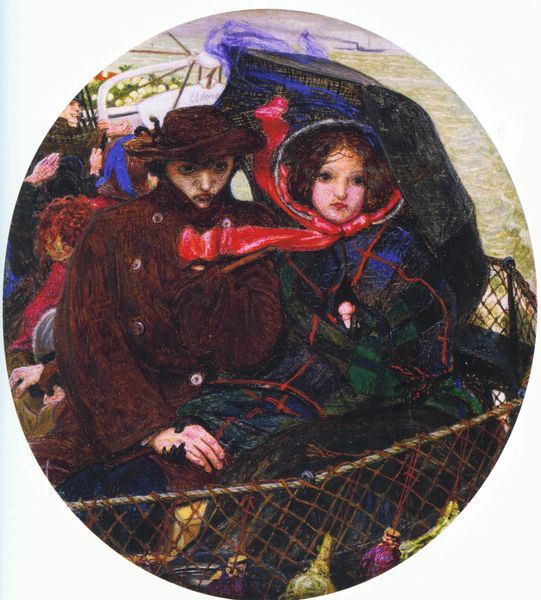
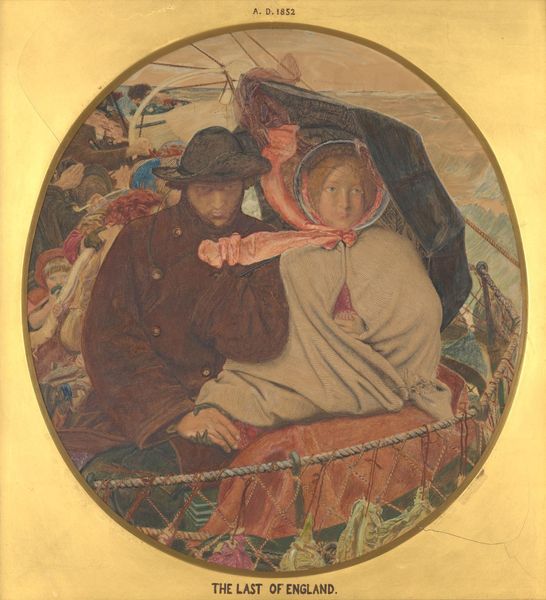
Curator: Ford Madox Brown’s “The Last of England,” painted in 1860, captures a profoundly moving scene. Editor: It’s immediately striking. A sense of palpable grief, almost claustrophobia. The round frame presses the figures forward, forcing the viewer into an intimate encounter with their despair. Curator: Indeed. This piece immortalizes the wave of emigration from England during that period, fueled by economic hardship. Brown himself experienced similar anxieties. Look at the faces: such meticulously rendered sorrow. Their fixed gazes speak volumes about the weight of their decision. He emphasizes the eyes as a "mirror of the soul." Editor: But the materials speak too. The thick application of paint, the almost rough texture. It feels like a working-class scene, despite the Pre-Raphaelite detail. Even the meticulously painted cabbages are commodities! Curator: Certainly. Notice the hands, clasped tightly. A symbol, perhaps, of resilience or perhaps quiet desperation. He’s using a very recognizable visual cue to suggest emotional resolve even when circumstances feel overwhelming. And consider the symbolism of the swirling ocean – chaos, uncertainty... a departure from everything known. Editor: The way light hits those cabbages at the bottom is really odd; like this hope amid the general dark tones coming from the couple; almost literally ‘earthly’ but useful stuff at the base of this big endeavor! A means of survival during the travel, painted with incredible detail. But they are there almost ‘hanging’ in there. Curator: The details tell us much about Brown’s world. Consider the bonnet worn by the woman; the fashions, the period details speak to a loss that also has cultural repercussions: it is as though they're forced to say goodbye not only to people, but also habits. A collective trauma! Editor: The piece seems to me both highly controlled, crafted but with a real rawness of feeling seeping through the surface. It is about a great rupture between an individual, material present and an unknowable, intangible future. Curator: Ultimately, “The Last of England” acts as a poignant symbol of resilience amid displacement. Brown used both historical imagery, and a style deeply entrenched with tradition, to invite each of us to witness an era, its visual vocabulary, its ethos. Editor: For me, the real beauty is in the tension between the carefully crafted aesthetic and the almost unbearable emotional weight carried within the materials themselves.
Comments
No comments
Be the first to comment and join the conversation on the ultimate creative platform.
 Collect
 React
React Comment
More like this