engraving
#
figuration
#
ink line art
#
line
#
history-painting
#
italian-renaissance
#
nude
#
engraving
Dimensions: height 407 mm, width 605 mm
Copyright: Rijks Museum: Open Domain
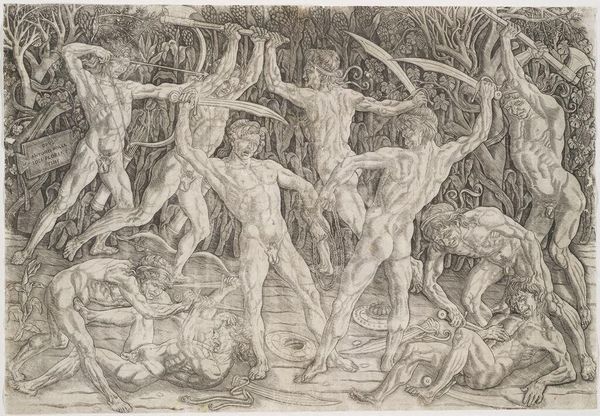
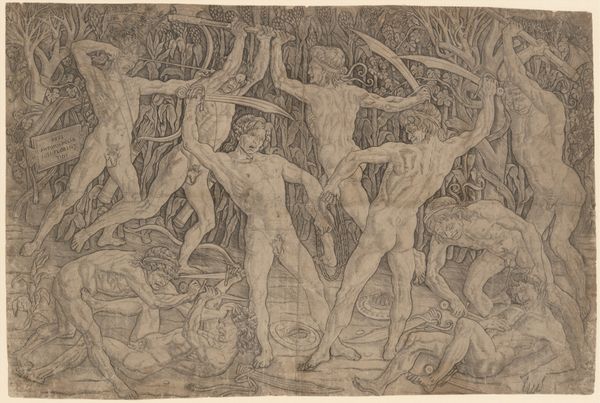
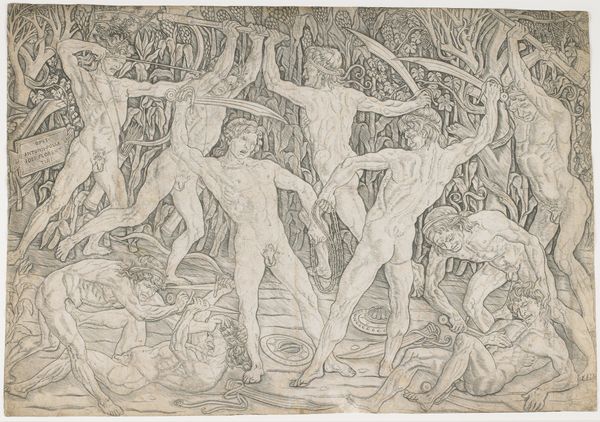
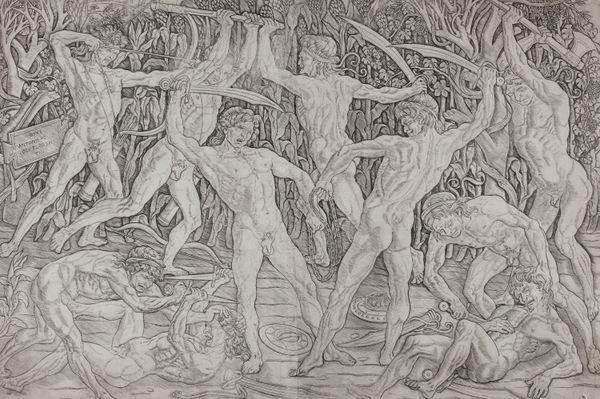
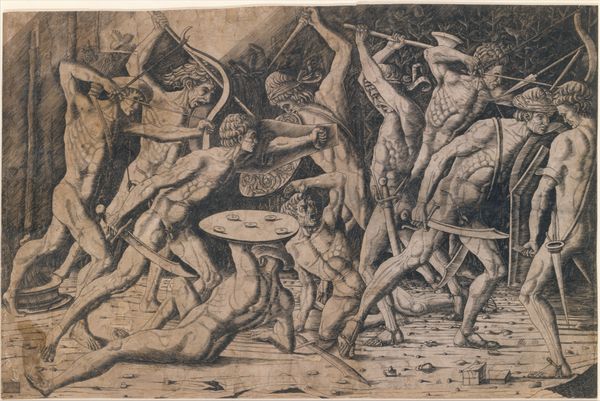
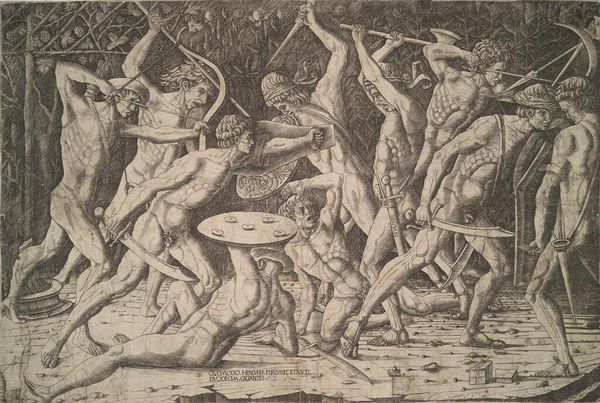
Editor: Here we have Antonio Pollaiuolo’s "Battle of the Nudes," an engraving dating back to around 1470 to 1475. There's so much energy in this print, so many figures intertwined, almost bursting out of the frame. It’s quite intense. What do you see in this piece? Curator: I see a deliberate display of classically inspired bodies, yes, but also an assertion of Florentine artistic power. Remember, Pollaiuolo operated a workshop. He was less interested in singular genius and more interested in systematizing artistic practice. The print allowed his aesthetic to circulate widely. Do you notice the prominence of the musculature? Editor: Yes, the emphasis on the musculature is quite striking! It’s almost like an anatomical study, but in a chaotic battle scene. Curator: Precisely. Consider how anatomy itself was becoming increasingly important to artistic training. This isn’t just about depicting figures; it’s about demonstrating a command of human form, and linking it to virtue and power. This print functioned almost as a visual manifesto. It made a statement about Florence and the place of artists in civic society. How do you think the context would have influenced the perception of the work? Editor: That's interesting... knowing that it was a 'manifesto' definitely shifts my understanding. It is like the artist is battling, demonstrating their understanding of the human form, instead of simply depicting combat. So much more at stake than just figures fighting in the nude. Curator: Exactly! Understanding the historical context, like the rise of artistic workshops and anatomical studies, completely transforms how we perceive the artwork. It ceases to be just a ‘battle,’ and becomes a cultural assertion. Editor: I never considered art making as such an assertive action. I definitely learned a lot looking at Pollaiuolo's piece. Curator: Me too, reflecting on artistic intentions opens new views on the making of the art, and that always changes the dialogue on viewership.
Comments

rijksmuseum over 2 years ago
⋮
Florentine goldsmith, painter and sculptor Antonio Pollaiulo made only one print during his career, which was intended to showcase his skills. For his subject, he chose a fierce battle, in which he portrayed combatants in various poses. The central two swordsmen are mirror images, as if representing the same sculpted figure simultaneously from different sides. The result is one of the most ambitious engravings of the Renaissance.


Join the conversation
Join millions of artists and users on Artera today and experience the ultimate creative platform.
 Collect
More like this