

About this artwork
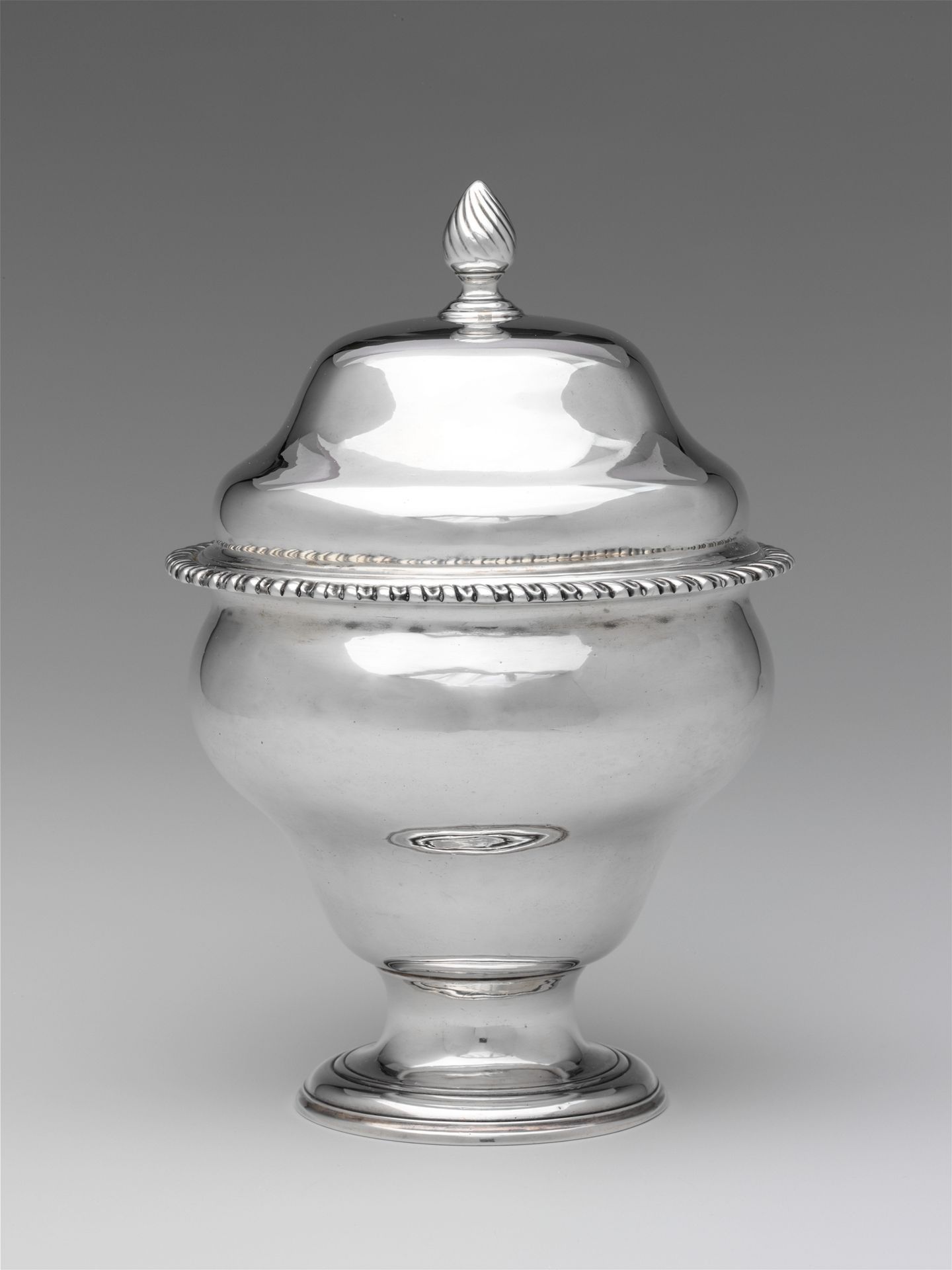
This sugar bowl was made by Philip Syng Jr., a Philadelphia silversmith, sometime in the 18th century. Its gleaming surface results from careful hammering and polishing, coaxing the metal into this elegant form. Think about what sugar meant at this time. It was a luxury product, harvested by enslaved people in the Caribbean. So, an object like this speaks volumes. The silversmith would have had a personal relationship with this material. The repetitive action of hammering and polishing would have imbued the object with social meaning. Consider, too, the form of the bowl itself. It recalls ancient Greek and Roman pottery, updated for a new world of commerce and consumption. The spiraling finial is particularly lovely, requiring great skill to create. Ultimately, this sugar bowl is more than just a pretty object. It’s a reminder of the complex history behind everyday things, and how the choices we make as consumers are always embedded in larger social and cultural systems.
Sugar Bowl
1765 - 1770


Artwork details
- Medium
- silver, metal, sculpture
- Dimensions
- Overall: 6 13/16 in. (17.3 cm); 13 oz. 15 dwt. (427 g) Lip: Diam. 4 3/4 in. (12.1 cm) Foot: Diam. 2 13/16 in. (7.1 cm) Body: 4 1/8 in. (10.5 cm); 9 oz. 7 dwt. (290.6 g) Cover: 2 3/4 x 4 1/8 in. (7 x 10.5 cm); 4 oz. 8 dwt. (136.4 g)
- Location
- Metropolitan Museum of Art, New York, NY
- Copyright
- Public Domain
Tags
Comments
Share your thoughts
About this artwork
This sugar bowl was made by Philip Syng Jr., a Philadelphia silversmith, sometime in the 18th century. Its gleaming surface results from careful hammering and polishing, coaxing the metal into this elegant form. Think about what sugar meant at this time. It was a luxury product, harvested by enslaved people in the Caribbean. So, an object like this speaks volumes. The silversmith would have had a personal relationship with this material. The repetitive action of hammering and polishing would have imbued the object with social meaning. Consider, too, the form of the bowl itself. It recalls ancient Greek and Roman pottery, updated for a new world of commerce and consumption. The spiraling finial is particularly lovely, requiring great skill to create. Ultimately, this sugar bowl is more than just a pretty object. It’s a reminder of the complex history behind everyday things, and how the choices we make as consumers are always embedded in larger social and cultural systems.
Comments
Share your thoughts