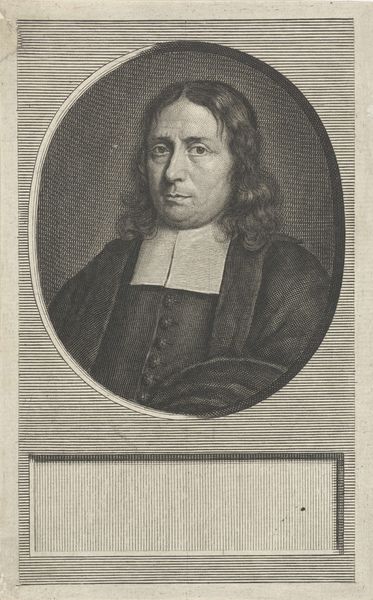
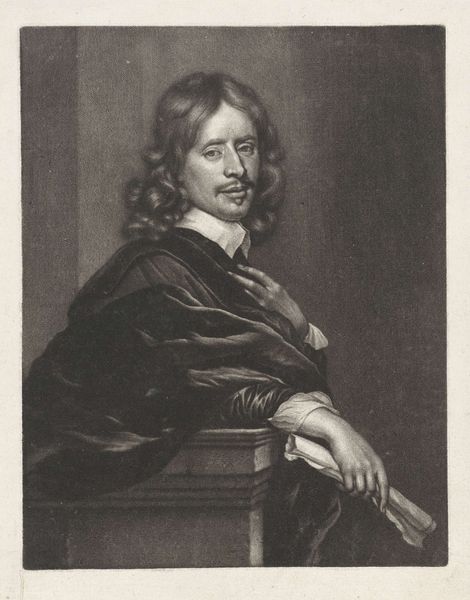
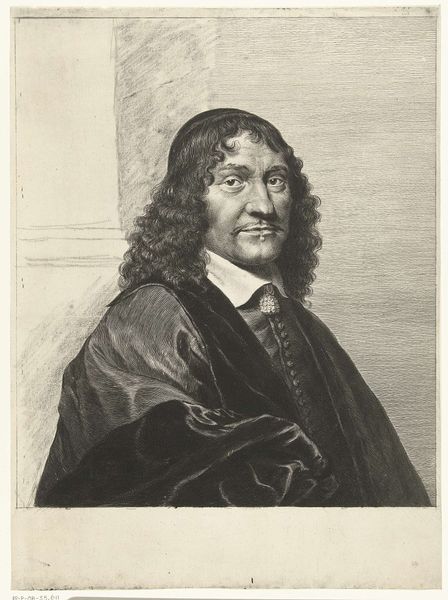
Portret van een man, mogelijk de predikant Hendrick Blancheteste 1658 - 1677
0:00
0:00

wallerantvaillant
Rijksmuseum
drawing, print, engraving
#
portrait
#
drawing
#
baroque
# print
#
charcoal drawing
#
portrait drawing
#
engraving
#
portrait art
Dimensions: height 224 mm, width 173 mm
Copyright: Rijks Museum: Open Domain
Curator: Before us, we have "Portret van een man, mogelijk de predikant Hendrick Blancheteste," created between 1658 and 1677. The artist is Wallerant Vaillant, and it is currently housed at the Rijksmuseum. It’s an engraving, a print, utilizing the techniques of chiaroscuro. Editor: My immediate reaction is to the subject's direct gaze; it feels like a weight, imbued with both gentleness and solemn authority. The somber colors certainly enhance this contemplative mood. Curator: Yes, let's consider the composition. The use of light and shadow, the distribution of tonal values—these create a visual hierarchy that leads the eye directly to the man's face. This engraving shows clear attention to structure. Editor: The contrast of his stark white collar against the dark robe is striking, and traditionally symbolizes purity, honesty, or spiritual authority within religious contexts, so considering it potentially depicts a preacher, it underscores his commitment. And look closer. The subtle shadows playing across his face, almost concealing it. Curator: True, there is a certain play with concealing and revealing within its pictorial space, particularly in relation to the manipulation of shadows which sculpt the face, thus enhancing depth. It speaks volumes about the surface and interiority. Editor: The way his hair softly frames his face also humanizes the sitter—lending him approachability and, perhaps, emphasizing earthly knowledge merging with the Divine, something often portrayed in the 17th century in relation to prominent men of religion. Curator: Interesting. One could argue the framing accentuates formal constraints characteristic of the Baroque period, and of portraiture as a form. However, your reading certainly incorporates sociocultural facets. Editor: I find the somber tonal range speaks of spiritual interiority, and moral strength so representative of leaders in that epoch. His portrait encapsulates an emotional complexity which transcends formal representation. Curator: Looking closely at Vaillant’s methods and structure, it seems there is evidence here that illustrates tension between external representation, the social role of the personage portrayed, and personal introspection, so typical for Dutch masters in the Golden Age. Editor: Vaillant captured that complexity deftly through accessible symbolic messaging and an accessible medium—a man in devotion but also of the world, ready to usher others in with him. Curator: Indeed, this examination underscores the multilayered discourse embedded in art, weaving together structural elements and sociocultural significations. Editor: Precisely; understanding how an artwork intertwines both symbolic messaging with materiality brings richness to our appreciation of pieces such as these.
Comments
No comments
Be the first to comment and join the conversation on the ultimate creative platform.
 Collect
 React
React Comment
More like this