

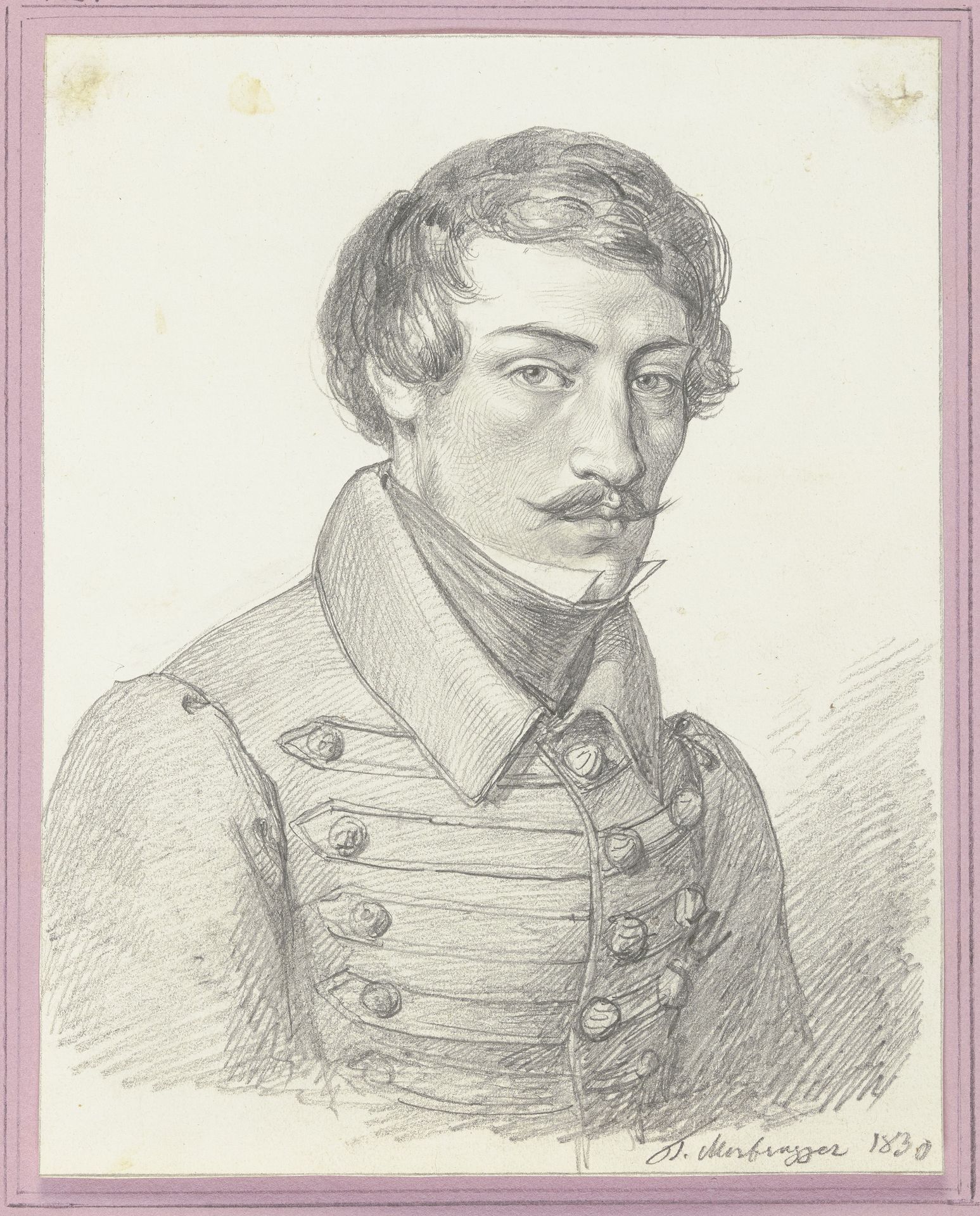
1830
Brustbild eines jungen Mannes


Listen to curator's interpretation
Curatorial notes
Curator: Friedrich Moosbrugger’s "Brustbild eines jungen Mannes," created in 1830, is a striking example of Romantic-era portraiture rendered in pencil on paper. It resides here at the Städel Museum. What strikes you first about it? Editor: An undeniable air of melancholic resolve hangs about this young man. It's in his eyes, in the slight downturn of his mouth. This isn't a portrait of exuberance, but rather of quiet contemplation, wouldn't you agree? Curator: Precisely. Moosbrugger masterfully employs chiaroscuro, a play of light and shadow, to enhance the subject's facial features. Notice the intricate detailing in the hair and the delicate cross-hatching used to define the contours of his face and uniform. The linearity creates a wonderful sense of form. Editor: And what of that uniform? The subject's rigid pose and the detailed rendering of his military garb hint at a broader social context. Were these portraits typically commissioned for family display, as symbols of status? I'd be interested in understanding what a military bearing communicated to contemporary audiences. Curator: It’s likely the portrait was a commission, yes. The subtle romanticism evident in his slightly dishevelled hair is certainly arresting when placed against the formal cut of the jacket and bearing of our young man. It disrupts what would be, otherwise, quite a stiff composition. Editor: Disruption indeed! His intense gaze pierces the distance, directly challenging the viewer, prompting one to speculate what’s in his head at this crucial, and rapidly changing, period in European history. The Napoleonic wars were close at hand... perhaps this work captures a certain anxiety about the future? Curator: An intriguing interpretation, especially if one considers it within the period’s sociopolitical anxieties. Regardless, it's a remarkable showcase of Moosbrugger's talent and draughtsmanship. The texture achieved with just a simple pencil is remarkable. Editor: It’s amazing how the starkness of the pencil almost amplifies the sitter's humanity. "Brustbild eines jungen Mannes" really urges us to consider portraiture’s ability to freeze and immortalize crucial moments, for both individual sitters, as well as broader populations and identities.