

1874 - 1945
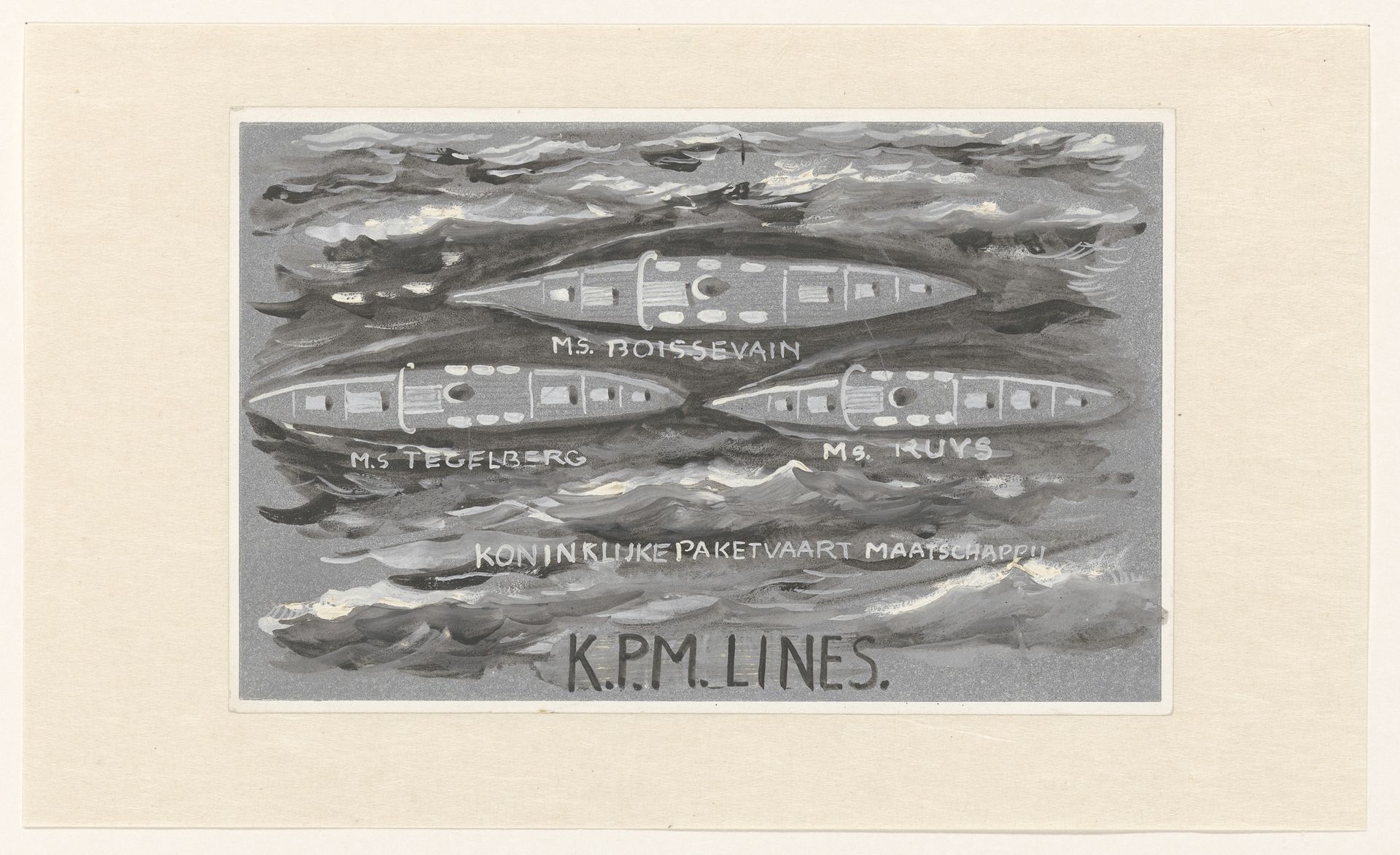
Ontwerp voor vignet van de Koninklijke Paketvaart Maatschappij, K.P.M. Lines

Carel Adolph Lion Cachet
1864 - 1945Location
RijksmuseumListen to curator's interpretation
Curatorial notes
Curator: Here we have a monochrome work by Carel Adolph Lion Cachet. It's a design for a vignette titled "Ontwerp voor vignet van de Koninklijke Paketvaart Maatschappij, K.P.M. Lines," dating from sometime between 1874 and 1945. It’s a drawing made with ink on paper. Editor: It's evocative. Stark and powerful despite the simplicity of its tones. Those stylized ships cutting through what feels like very turbulent water – it definitely captures a sense of movement and perhaps a touch of risk, a sense of modern maritime transport. Curator: Absolutely. The imagery seems to reference older symbolic conventions while serving the branding needs of a modern company. Note how the three ships – the *Boissevain*, the *Tegelberg*, and the *Ruys* – are elevated almost to icons. Their repetition implies not just transport, but an expanding network. Editor: That use of repetition makes me think about propaganda imagery as well, the visual reinforcement of presence. The K.P.M. Lines aimed to dominate the sea trade; the artwork communicates their ambitions quite clearly. And there is that stark tonal contrast. Curator: A tension echoed, I think, in the subject itself. Maritime transport speaks to expanding horizons but also to the anxieties around globalization at the time this piece was designed. Travel to unknown places with some degree of risk is what ships do. What sort of emotional baggage can that image then bring to viewers across its history? Editor: Interesting point. Given the timeframe, the design's modernity perhaps represents the optimism around technological advancement but is also juxtaposed with the reality of two World Wars. It makes you consider how commercial art carries unspoken ideological weight. Were I seeing this as a passenger during a war I'd definitely find some hope in its implied expansion of human achievement through innovation, in its almost futurist optimism. Curator: Exactly. These designs were intended for distribution and had a communicative task but, as you point out, are layered with symbolic and historical implications beyond their initial purpose. A memory of the ships that did this vital task. Editor: This exploration reminds us of the power of images to negotiate meaning through design, production, and historical events. Thanks for this view. Curator: And thank you; it highlights the complex dance between art, history, and cultural memory in what might seem, on the surface, like a straightforward commercial image.