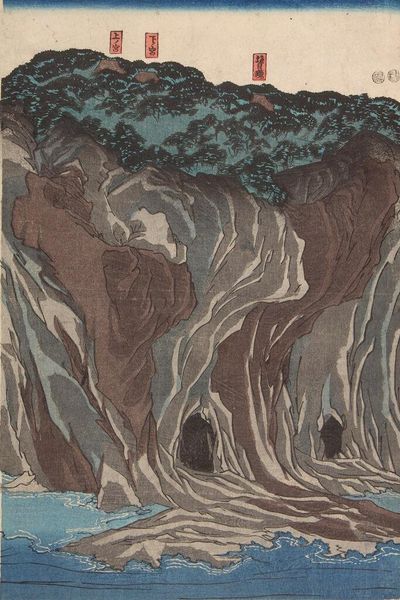
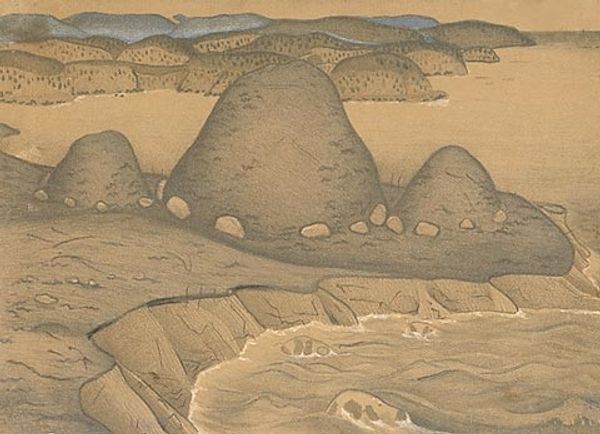
![Volcanic Landscape [right of a pair] by Irie Shikai](/_next/image?url=https%3A%2F%2Fd2w8kbdekdi1gv.cloudfront.net%2FeyJidWNrZXQiOiAiYXJ0ZXJhLWltYWdlcy1idWNrZXQiLCAia2V5IjogImFydHdvcmtzLzcyMTQzZjVhLWZhY2ItNGUyYy1hZDllLWJmNGFmNTIxN2VlMS83MjE0M2Y1YS1mYWNiLTRlMmMtYWQ5ZS1iZjRhZjUyMTdlZTFfZnVsbC5qcGciLCAiZWRpdHMiOiB7InJlc2l6ZSI6IHsid2lkdGgiOiAxOTIwLCAiaGVpZ2h0IjogMTkyMCwgImZpdCI6ICJpbnNpZGUifX19&w=1920&q=75)


impasto
asian-art
landscape
impressionist landscape
japan
handmade artwork painting
impasto
acrylic on canvas
geometric
expressionism
naive art
expressionist
Dimensions: 67 3/8 × 147 × 3/4 in. (171.13 × 373.38 × 1.91 cm) (image)68 7/8 × 148 1/2 × 3/4 in. (174.94 × 377.19 × 1.91 cm) (outer frame)
Copyright: No Copyright - United States
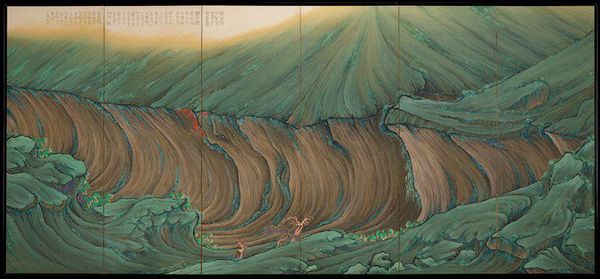
Irie Shikai made this Volcanic Landscape screen, one of a pair, with ink and color on silk. What strikes me is the layered approach, building up the forms with delicate marks and washes. You can see the artist really thinking through the process. Looking closely, the material qualities are pretty evident. There's a thin, watery quality to the paint, especially in those mossy greens of the upper slopes. And then, the dry brushwork in the cliff faces, giving them texture and depth. The brown strokes, repeated, feel performative, like the artist is building up the form stroke by stroke. See how a few of the lines break off. It's almost like the artist is inviting the viewer to contemplate the material's ability to evoke the feeling of earth. It reminds me a bit of some of the Hudson River School painters, like Church or Bierstadt, who were also interested in capturing the sublime power of nature. But Shikai brings a different sensibility, a more intimate and contemplative approach.
Comments

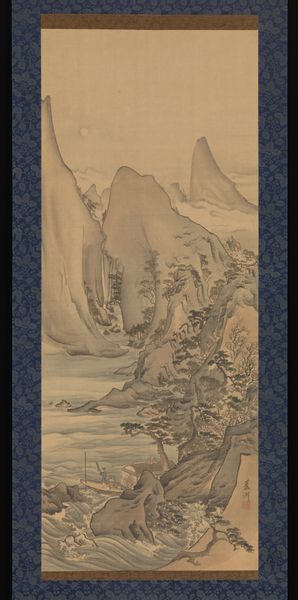
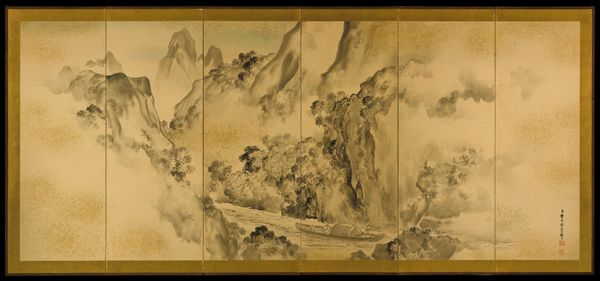
Across the 12 panels of this pair of folding screens, a wide channel cuts through wavelike emerald-green mountains brought to life through an abundance of expensive mineral and metallic pigments—malachite, azurite, and gold. In the lengthy inscription—written in Chinese and brushed in ancient script—Irie Shikai cites the enigmatic opening lines of Chapter 28 (“Returning to Simplicity”) of the Dao De Jing (also Tao Te Ching), the ancient Chinese text, as the inspiration for this magical composition: “Who knows how white attracts, Yet always keeps himself within black’s shade." Shikai first studied painting with local artists in his native Fukuoka before briefly joining an ultra-right-wing nationalist movement in midlife. During this time, he became familiar with that movement’s leader, Tōyama Mitsuru, and the coal barons from Fukuoka who funded Tōyama (the kind of wealthy patrons who might have commissioned a deluxe painting like this pair of screens). Shikai eventually drifted away from right-wing politics and devoted himself again to painting, finding inspiration in the works of the earlier Japanese literati painter Tanomura Chikuden (1777–1835).


Join the conversation
Join millions of artists and users on Artera today and experience the ultimate creative platform.