etching
#
etching
#
old engraving style
#
landscape
#
etching
#
genre-painting
#
realism
Dimensions: height 105 mm, width 170 mm
Copyright: Rijks Museum: Open Domain
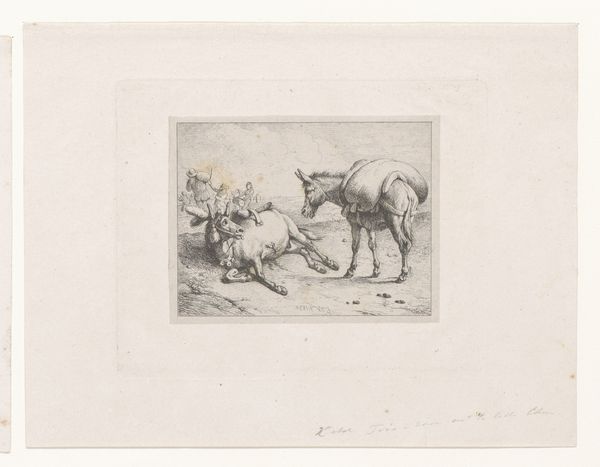
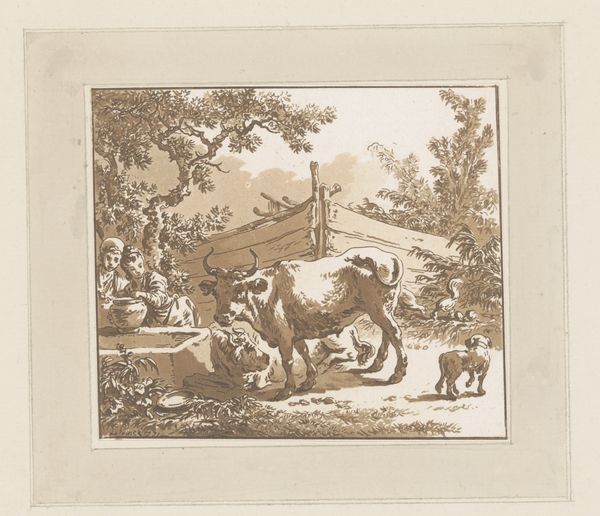
Editor: This is "Twee ezels en een vrouw bij een waterpomp," or "Two Donkeys and a Woman at a Water Pump," by Jean Louis Demarne, likely created between 1762 and 1829. It’s an etching, and I'm struck by the overall composition—it’s like a snapshot of everyday rural life. What details do you observe, focusing on the form and technique used here? Curator: The power of this etching lies primarily in its structural clarity. Observe the use of line – Demarne employs varied densities of hatching and cross-hatching. These carefully controlled marks articulate form and shadow, creating a tactile experience for the viewer. How would you say the contrast and the light interact? Editor: I see how the light seems to skim across the figures of the donkeys, giving them depth, while the background figures fade a little more. It directs my attention. Curator: Precisely. And consider the placement of the well on the edge of the picture plane. It serves as an anchor, framing the space and containing the figures within a defined field. How do you read that contrast in textures from the solid stone to the organic subjects? Editor: The contrast adds dynamism. The roughness of the stone contrasts with the soft rendering of the donkeys' fur, making the image more engaging. I like the effect created through contrasting values to emphasize three-dimensionality! Curator: Agreed. It reveals an engagement with creating the formal elements. What impact do you feel you got from analyzing the technique? Editor: Seeing how carefully the composition is constructed really deepens my appreciation of Demarne’s artistic intention beyond the depicted subject matter! Curator: Indeed. The relationship between line, light, and composition underscores how formal analysis can reveal depth within seemingly simple scenes.
Comments
No comments
Be the first to comment and join the conversation on the ultimate creative platform.
 Collect
 React
React Comment
More like this