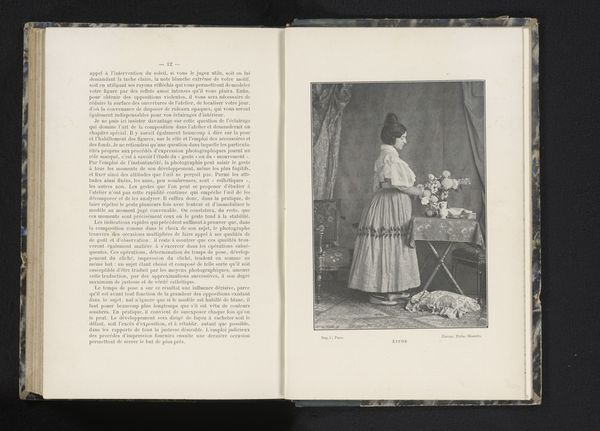
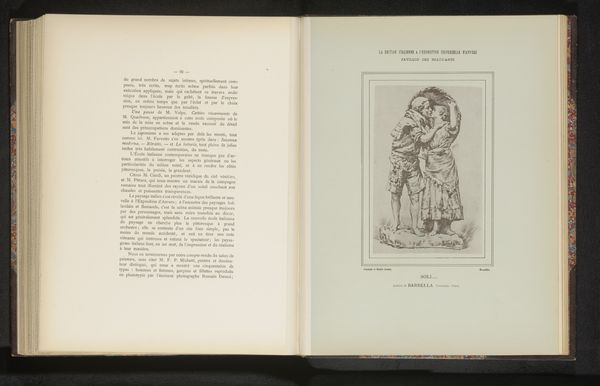
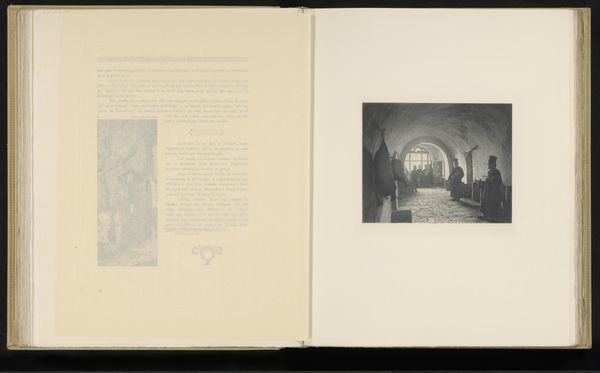
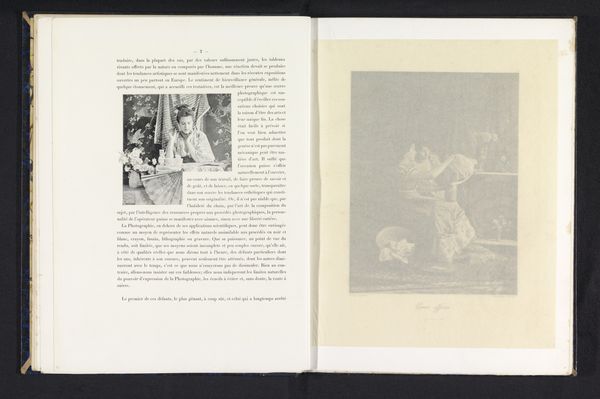
Reproductie van een geschilderd portret van een onbekend meisje door Friedrich August von Kaulbach before 1901
0:00
0:00

Dimensions: height 293 mm, width 215 mm
Copyright: Rijks Museum: Open Domain
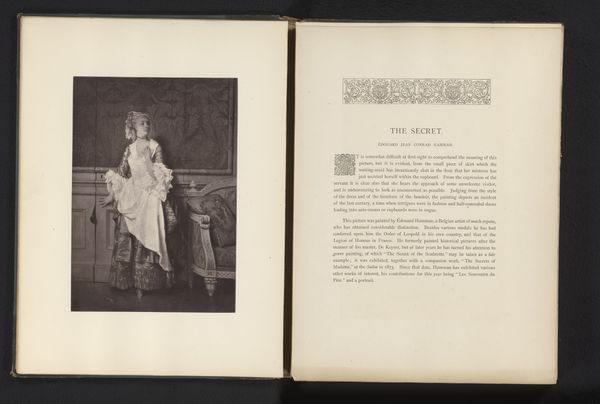
Editor: This is a reproduction of a painted portrait of an unknown girl by Friedrich August von Kaulbach, created before 1901, from the Goupil publishing house. The girl appears solemn, almost doll-like herself. What historical and cultural context can you tell me about this type of genre-painting? Curator: This image offers a fascinating window into the role of childhood portraiture and its connection to social aspirations during the late 19th century. Goupil, known for art reproductions, made art accessible to a broader public, thus shaping tastes. Consider the politics embedded in the idealized representation of childhood innocence, aimed at bourgeois families aspiring for social mobility. Why do you think such portraits became popular at that time? Editor: Maybe it had something to do with a romanticized view of childhood, a sentimental longing? Also, these prints may have democratized the practice of family portraiture to those who were perhaps unable to afford it before, but wished to signal elevated taste. Curator: Exactly. The mass production and distribution of such images, through firms like Goupil, reinforced social norms, constructing a shared visual language about family values, domesticity, and the cultivation of virtue. Look at the girl's posture and expression. It evokes a certain decorum, doesn't it? Editor: It does. Though I see how sweet the painting is, it also gives off a vague unsettling air; like a miniature adult is being paraded for the audience, perhaps subtly commenting on issues of class. Thank you; now I understand more clearly how such portraits operated within their specific historical moment! Curator: My pleasure! Considering artworks within the contexts of production and circulation deepens our understanding of their cultural role and impact. Always keep asking about "who benefits" from an image and "how" they benefit.
Comments
No comments
Be the first to comment and join the conversation on the ultimate creative platform.
 Collect
 React
React Comment
More like this