About this artwork
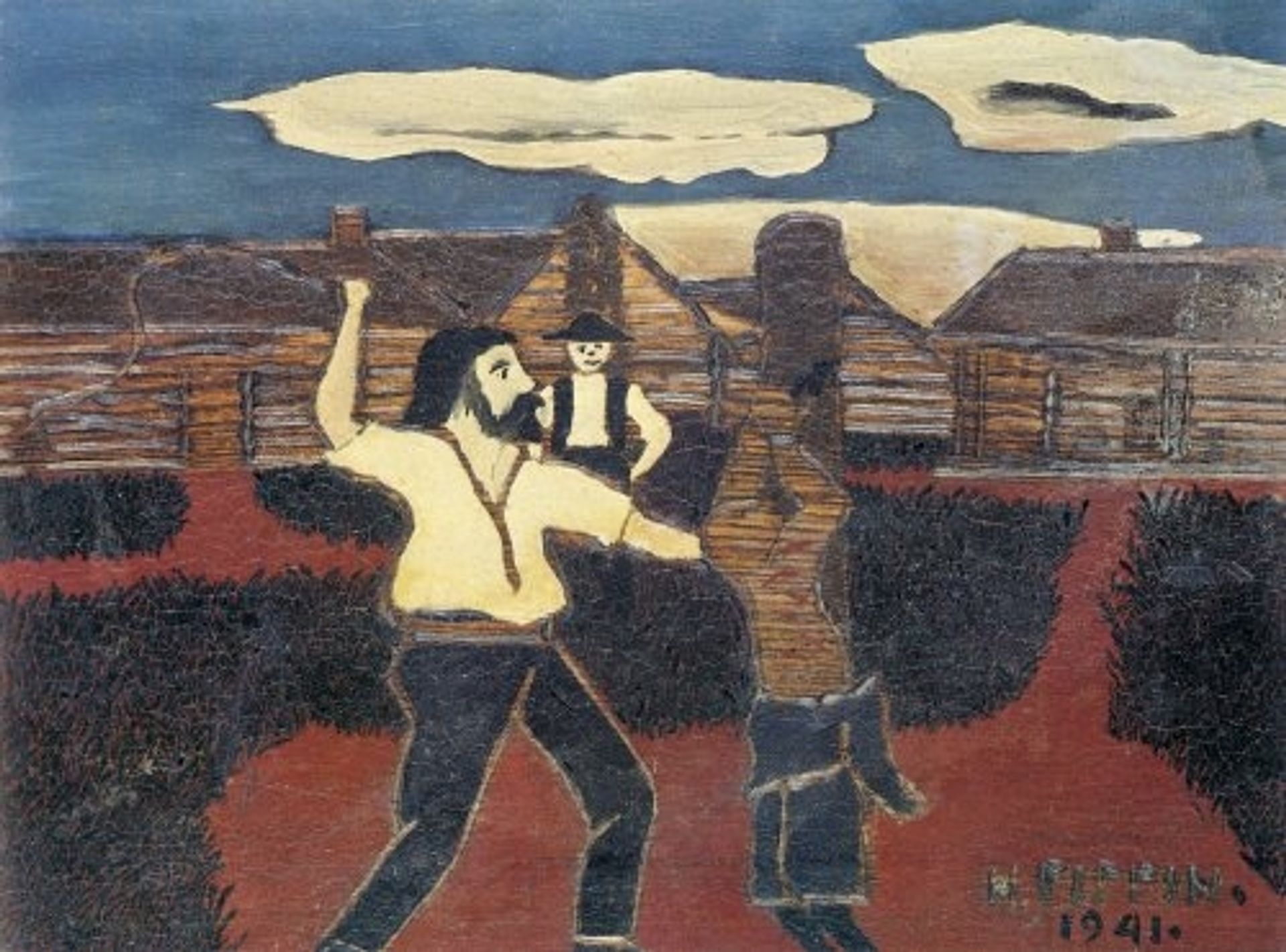
Editor: So here we have Horace Pippin's 'The Whipping,' painted in 1941. There's a rawness to it, a starkness that hits you right away. The composition is so direct, almost primitive in a way. What leaps out at you when you look at this piece? Curator: Primitive, yes, in the best possible sense. Pippin cuts to the bone, doesn't he? I see a brutal moment, but rendered with an almost childlike clarity. Notice how the figures are defined by strong, unwavering outlines. It reminds me a bit of folk art traditions, of storytellers using images to convey narratives directly. And consider the palette – it's earthy, but there are jolts of harsher colour. Editor: Right, that stark contrast! The sky feels almost serene, even with everything happening below. It creates this really unsettling feeling, like a calm indifference to the violence. Do you think Pippin was deliberately using that juxtaposition? Curator: I suspect so. Pippin experienced considerable suffering himself – injured in WWI, and dealing with racial prejudice throughout his life. Perhaps that stark juxtaposition you observed is meant to convey a profound truth: life's beauty exists even, perhaps especially, in proximity to unimaginable cruelty. Consider the log cabin as well. Is it a source of security? Is it a trap? Editor: That makes the piece so much more complex. What first appears simple suddenly becomes heavy with layers of meaning, his war experience infusing this moment of violence with a far deeper history. Thanks, I am learning so much! Curator: And I in return. Art reminds us not of all that we have figured out, but what remains to be discovered.
The Whipping
1941

Horace Pippin
1888 - 1946Location
Reynolda House Museum of American Art, Winston-Salem, NC, USArtwork details
- Location
- Reynolda House Museum of American Art, Winston-Salem, NC, US
- Copyright
- Public domain
Tags
Comments
Share your thoughts
About this artwork
Editor: So here we have Horace Pippin's 'The Whipping,' painted in 1941. There's a rawness to it, a starkness that hits you right away. The composition is so direct, almost primitive in a way. What leaps out at you when you look at this piece? Curator: Primitive, yes, in the best possible sense. Pippin cuts to the bone, doesn't he? I see a brutal moment, but rendered with an almost childlike clarity. Notice how the figures are defined by strong, unwavering outlines. It reminds me a bit of folk art traditions, of storytellers using images to convey narratives directly. And consider the palette – it's earthy, but there are jolts of harsher colour. Editor: Right, that stark contrast! The sky feels almost serene, even with everything happening below. It creates this really unsettling feeling, like a calm indifference to the violence. Do you think Pippin was deliberately using that juxtaposition? Curator: I suspect so. Pippin experienced considerable suffering himself – injured in WWI, and dealing with racial prejudice throughout his life. Perhaps that stark juxtaposition you observed is meant to convey a profound truth: life's beauty exists even, perhaps especially, in proximity to unimaginable cruelty. Consider the log cabin as well. Is it a source of security? Is it a trap? Editor: That makes the piece so much more complex. What first appears simple suddenly becomes heavy with layers of meaning, his war experience infusing this moment of violence with a far deeper history. Thanks, I am learning so much! Curator: And I in return. Art reminds us not of all that we have figured out, but what remains to be discovered.
Comments
Share your thoughts