#
rough brush stroke
#
sculpture
#
sculptural image
#
possibly oil pastel
#
oil painting
#
derelict
#
acrylic on canvas
#
sculpting
#
underpainting
#
mixed media
Copyright: Public domain
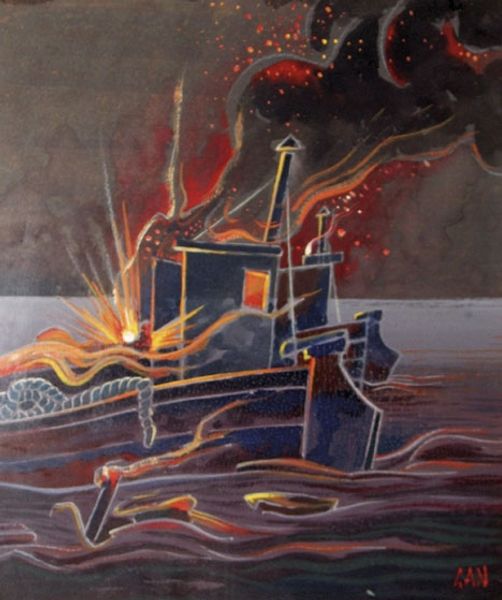
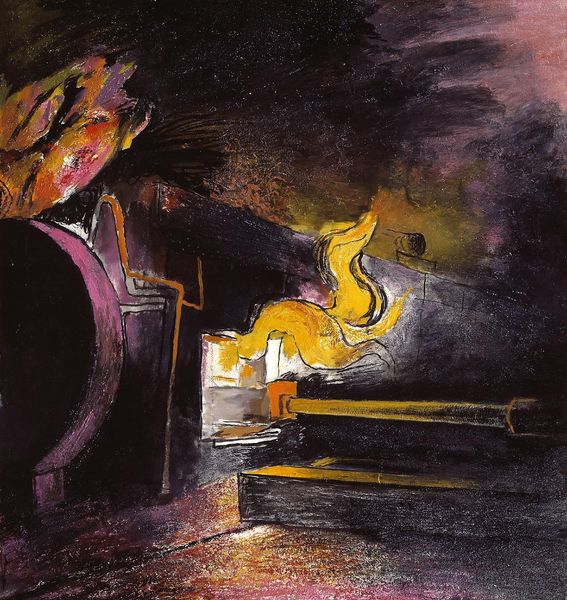
Curator: Immediately striking, isn't it? Somber yet dramatic. It really does capture a moment of intense activity. Editor: Yes, very atmospheric. We are looking at "HMS Ark Royal in Action" by Eric Ravilious, completed in 1940. Ravilious was actually a war artist during the Second World War, and sadly, he was lost at sea just two years after creating this piece. Curator: His deployment and training as a war artist are important context here. His artwork shows the manufacturing of munitions and conveys the importance of morale, it really showcases an almost socialist-realist aesthetic. How might this relate to the work in front of us? Editor: It's difficult to be sure what specific materials Ravilious employed. What stands out to me, though, is the treatment of light – the stark contrast between the fiery sky, likely the bursting of anti-aircraft shells, and the dark hull of the ship and the inky waves below. The overall composition utilizes strong horizontal and diagonal lines which contribute to a feeling of movement, pushing forward—away from the chaos above. Curator: Agreed, and to me this work showcases process and how labor is romanticized during periods of war. In some sense the sleek, gray form cutting through the dark waves, acts as a site of industry where the machinery of war churns and consumes. This machinery includes raw materials, of course, but more importantly, men at war. Editor: Interesting perspective. The textures achieved are quite intriguing, considering. There's a clear sense of materiality with the rough, almost scratchy strokes giving the work a nervous quality. The overall impression, again, is one of dynamism and uncertainty. There's not much sense of security despite the apparent steadfastness of the ship. Curator: Precisely. It portrays the complicated experience for working class laborers that, at the same time, glorifies war as they become enmeshed as the key actors inside these state-supported industries and, in this case, the active violence that surrounds them. The materiality matters because, without these processes in place, the ship would not be able to move forward. Editor: Indeed. By dissecting the formal components, from color choices to textual marks and spatial compositions, we're better prepared to perceive how an artwork’s meaning comes to form for each one of us, the viewers. Curator: I see the war machine as the primary point of analysis. In its socio-historic circumstances this painting of a Royal Navy ship signifies far more about war industries that are the root of such enterprises.
Comments
No comments
Be the first to comment and join the conversation on the ultimate creative platform.
 Collect
 React
React Comment
More like this