

About this artwork
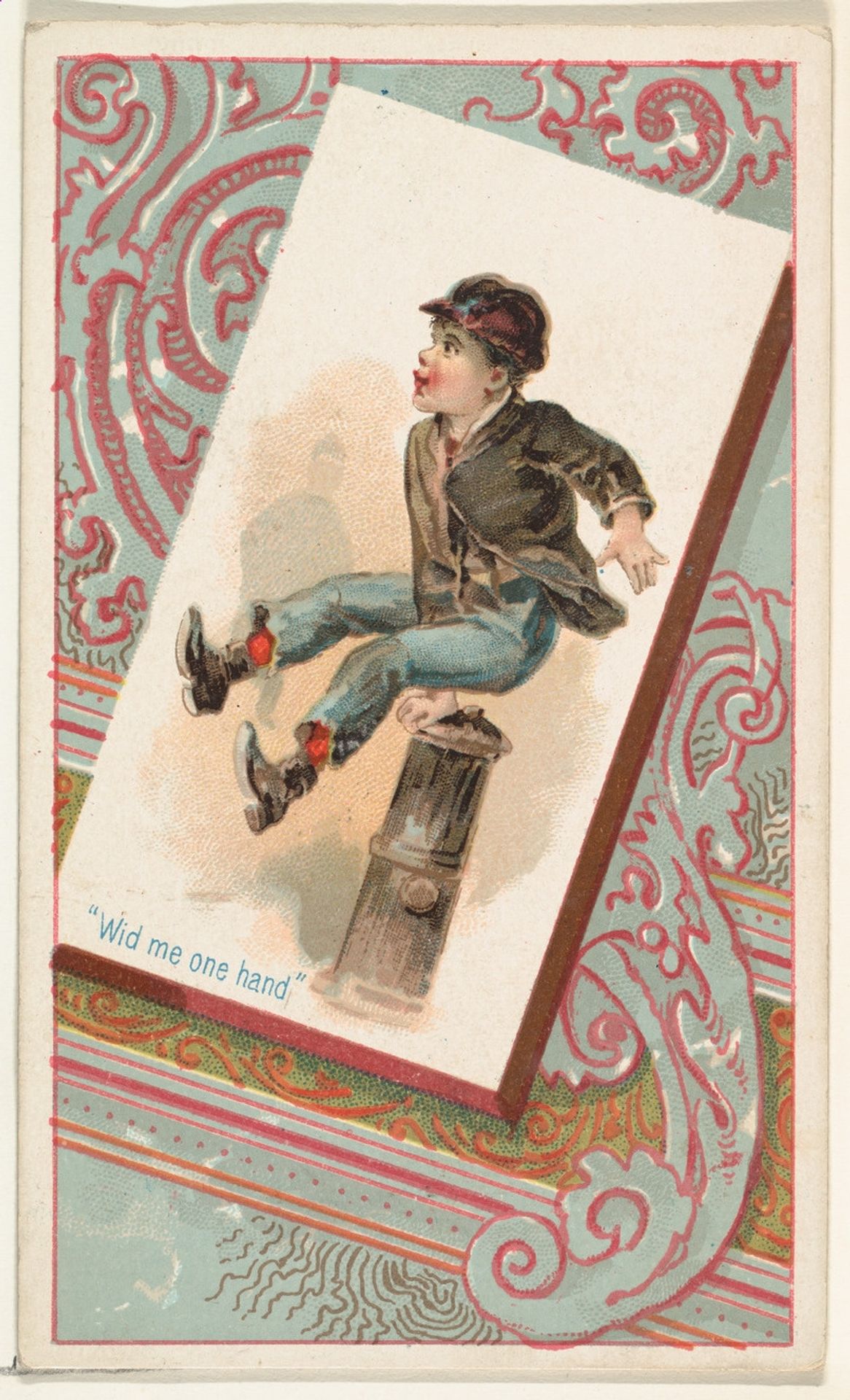
Curator: This curious print, dating from between 1888 and 1889, belongs to a series titled "Terrors of America." It was issued by W. Duke, Sons & Co. to promote their Honest Long Cut Tobacco. The piece before us is called "\"Wid me one hand.\"" Editor: Immediately, the odd composition strikes me. A chimney sweep, or a boy dressed as one, perched rather precariously. The palette, all pastels and faded jewel tones, reinforces this dreamlike impression. Curator: Indeed. The materials employed are modest – it is merely a print, meant for mass consumption tucked into packages of tobacco. However, this very disposability speaks to the broader social context: the burgeoning industrial age, marketing's increasing influence, and the commodification of even childhood itself. Editor: Observe the figure’s posture – he strains, one hand extended for balance. The composition tilts, heightening the sense of precariousness. And there's the visual rhyming of curves and lines: the sweeping curves in the decorative background that lead towards the cylinder of the chimney, echoed by the arch of his legs and back. It lends a certain dynamism to this small rectangular object. Curator: This type of visual commodity speaks volumes about social hierarchies, urban life, and the romanticized, even exoticized, portrayals of labor. The boy, precariously positioned, becomes a symbol, I believe, of the working class itself – their lives often balancing on a razor’s edge. Editor: I would add that there's the fascinating semiotics of costume: the tattered clothing, the patched knees – clear visual markers of the subject's social standing. The artist’s choices regarding line, tone, and perspective emphasize a particular type of fragility in this small print. Curator: What started as disposable ephemera provides so many opportunities to reflect on the means of production and, further, the human cost exacted by progress. Editor: I leave this encounter captivated by the careful construction and odd beauty present in something mass produced and commercially minded, offering unique perspective into social strata.
"Wid me one hand," from the Terrors of America set (N136) issued by Duke Sons & Co. to promote Honest Long Cut Tobacco
1888 - 1889

W. Duke, Sons & Co.
1870 - 1920
The Metropolitan Museum of Art
Metropolitan Museum of Art, New York, NYArtwork details
- Medium
- drawing, print
- Dimensions
- Sheet: 2 3/4 x 1 1/2 in. (7 x 3.8 cm)
- Location
- Metropolitan Museum of Art, New York, NY
- Copyright
- Public Domain
Tags
portrait
drawing
caricature
genre-painting
Comments
Be the first to share your thoughts about this work.
About this artwork
Curator: This curious print, dating from between 1888 and 1889, belongs to a series titled "Terrors of America." It was issued by W. Duke, Sons & Co. to promote their Honest Long Cut Tobacco. The piece before us is called "\"Wid me one hand.\"" Editor: Immediately, the odd composition strikes me. A chimney sweep, or a boy dressed as one, perched rather precariously. The palette, all pastels and faded jewel tones, reinforces this dreamlike impression. Curator: Indeed. The materials employed are modest – it is merely a print, meant for mass consumption tucked into packages of tobacco. However, this very disposability speaks to the broader social context: the burgeoning industrial age, marketing's increasing influence, and the commodification of even childhood itself. Editor: Observe the figure’s posture – he strains, one hand extended for balance. The composition tilts, heightening the sense of precariousness. And there's the visual rhyming of curves and lines: the sweeping curves in the decorative background that lead towards the cylinder of the chimney, echoed by the arch of his legs and back. It lends a certain dynamism to this small rectangular object. Curator: This type of visual commodity speaks volumes about social hierarchies, urban life, and the romanticized, even exoticized, portrayals of labor. The boy, precariously positioned, becomes a symbol, I believe, of the working class itself – their lives often balancing on a razor’s edge. Editor: I would add that there's the fascinating semiotics of costume: the tattered clothing, the patched knees – clear visual markers of the subject's social standing. The artist’s choices regarding line, tone, and perspective emphasize a particular type of fragility in this small print. Curator: What started as disposable ephemera provides so many opportunities to reflect on the means of production and, further, the human cost exacted by progress. Editor: I leave this encounter captivated by the careful construction and odd beauty present in something mass produced and commercially minded, offering unique perspective into social strata.
Comments
Be the first to share your thoughts about this work.