

18th century
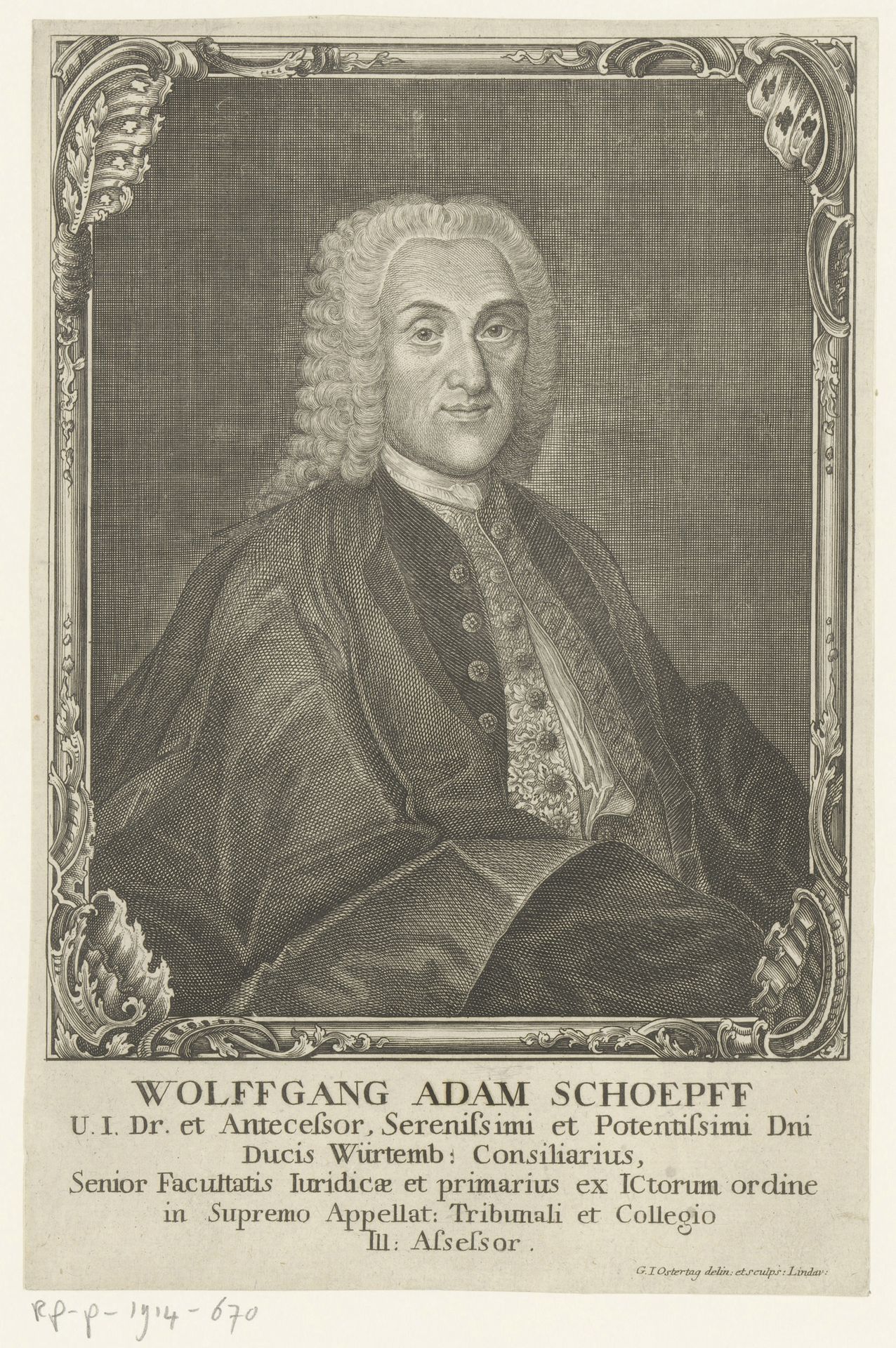
Portret van Wolfgang Adam Schöpff

Listen to curator's interpretation
Curatorial notes
Curator: This print is an 18th-century engraving, a portrait of Wolfgang Adam Schöpff. The print, signed G.I. Ostertag, presents Schöpff in a formal pose, framed within an ornate border. Editor: There's a rather somber, almost severe, mood emanating from the piece, even within the decorative frame. The details are remarkably fine; look at the delicacy in the rendering of the wig. Curator: Consider the historical context. Schöpff, as indicated by the text below the portrait, held significant legal and academic positions within Württemberg. This engraving therefore represents more than just an individual; it embodies the authority and power associated with his role in society. Think about who might commission such a piece and why. Editor: Precisely. The composition directs our gaze immediately to Schöpff's face, but observe the textures—the velvet of his coat, the lace at his chest, the powdered wig. Semiotically, each detail reinforces his status. There's a meticulous attention to texture achieved solely through line work. Curator: The decision to use print as the medium also speaks volumes. Prints are reproducible, democratic even. By creating multiples of his image, Schöpff ensures that his image and status were visible and cemented within broader social spheres. It's about image-making in service to social position. Editor: Absolutely, it underscores the performative aspect of identity. Ostertag's skill allows Schöpff to perform authority for future audiences through calculated visual symbolism and skillful technique. It becomes a lasting symbol. Curator: Looking at it through this lens gives insight into 18th-century systems of power and the construction of identity within elite circles. A great testament of its time! Editor: A stunning showcase of the intersection of craft, class, and calculated visual presentation, wouldn't you say?