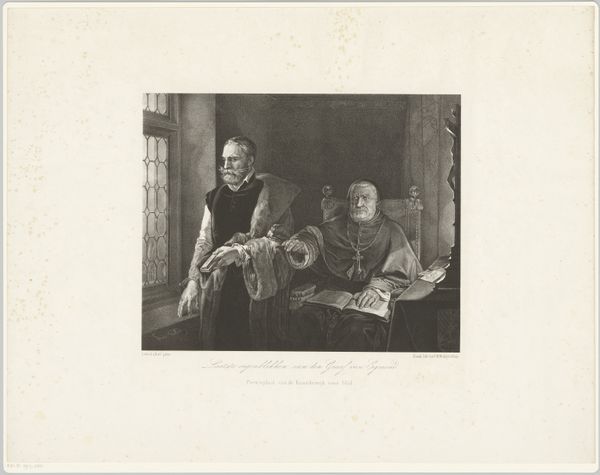
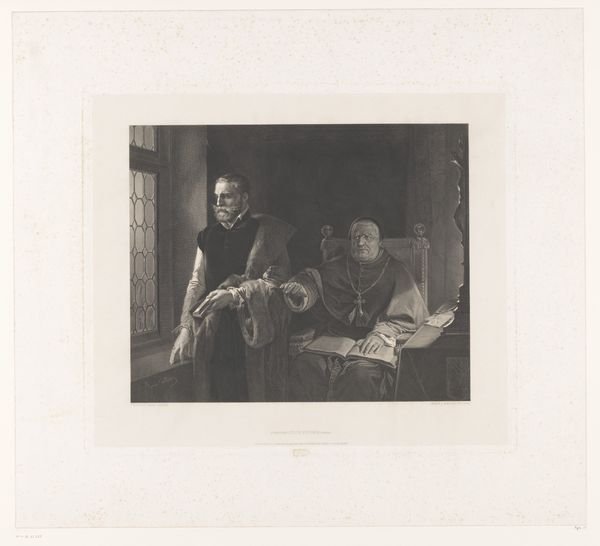
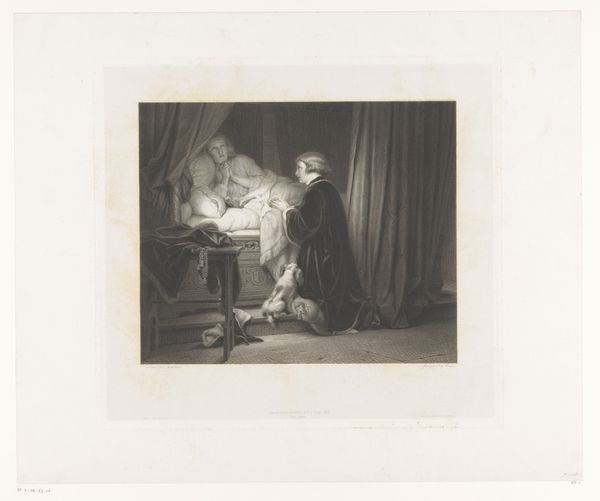
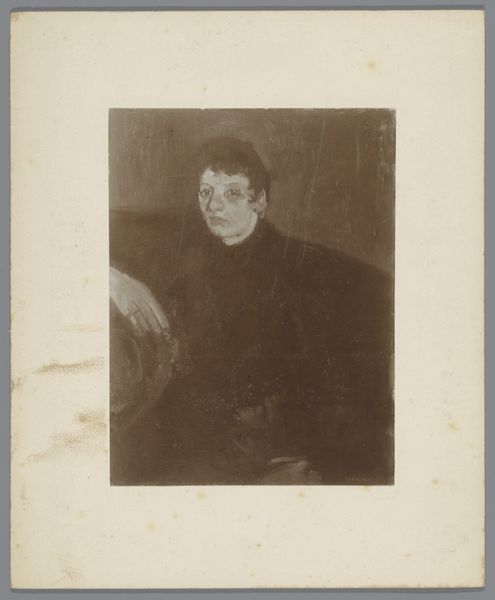
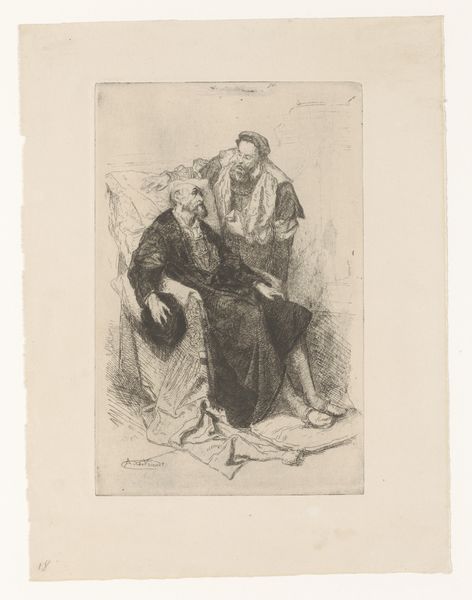
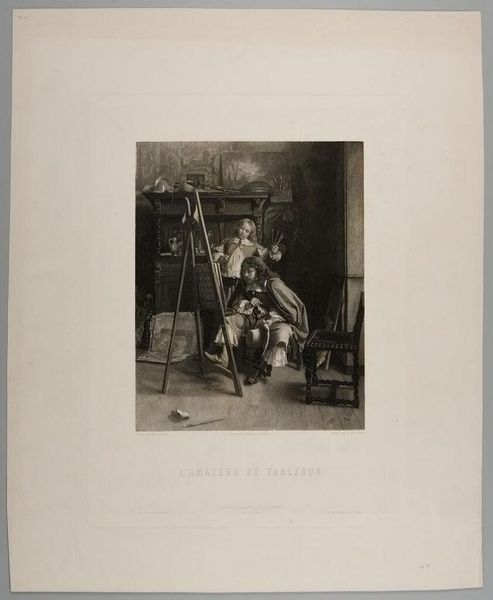
Fotoreproductie van een gravure naar een schilderij van de graaf van Egmond bijgestaan door de bisschop van Ieperen in de nacht voor zijn executie op 5 juni 1568, door Louis Gallait 1850 - 1900
0:00
0:00

anonymous
Rijksmuseum
Dimensions: height 56 mm, width 68 mm, height 62 mm, width 106 mm
Copyright: Rijks Museum: Open Domain
Here, we see a photograph of a print rendering Louis Gallait’s depiction of the Count of Egmond, assisted by the Bishop of Ypres, on the night before his execution in 1568. Note the window: a potent symbol, often representing a threshold between worlds. Egmond gazes through it, perhaps contemplating the unknown. The bishop, adorned with his cross, sits with an open book, a symbol of knowledge and divine guidance. The window motif appears in various contexts, from Renaissance paintings to modern cinema, each time bearing a similar connotation of transition. Think of Caspar David Friedrich’s wanderers contemplating nature, or even prisoners looking out of cell windows. The open book is a recurring symbol, seen across different religious traditions, representing enlightenment. These symbols carry an emotional weight, engaging us on a deep, subconscious level. This image—charged with pathos—speaks to our collective memory, reflecting the anxieties and hopes we project onto such moments of uncertainty and spiritual reckoning. These motifs are non-linear, cyclical, resurfacing, evolving, and taking on new meanings in different historical contexts.
Comments
No comments
Be the first to comment and join the conversation on the ultimate creative platform.
 Collect
 React
React Comment
More like this