

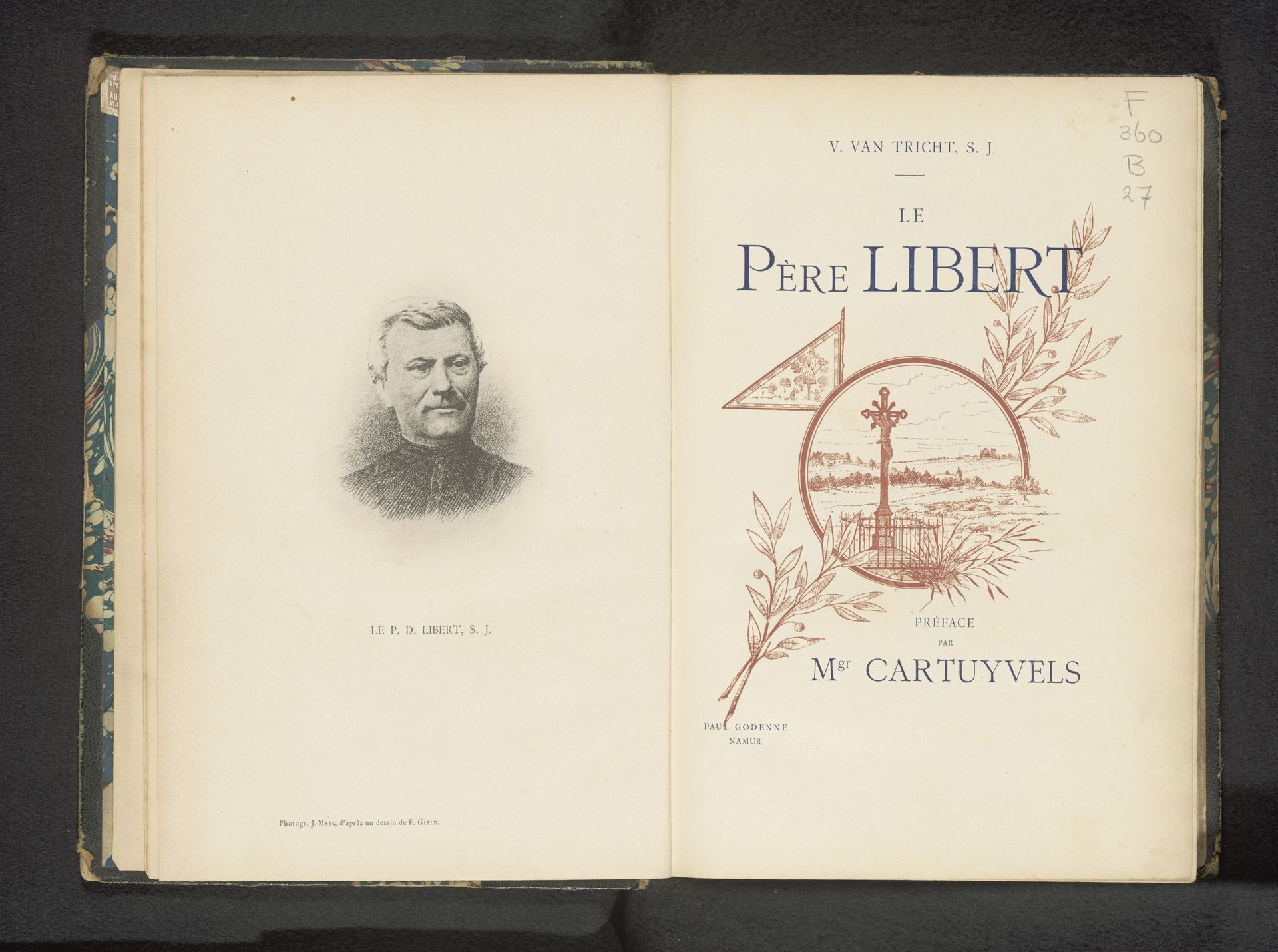
c. 1896
Le Père Libert / V. van Tricht; préface par Mgr. Cartuyvels

Listen to curator's interpretation
Curatorial notes
Curator: This is the title page of "Le Père Libert," a print from around 1896 by Victor van Tricht. My immediate impression is its muted solemnity. The limited palette creates a serious tone. Editor: Indeed, a work very much of its time. When we examine "Le Père Libert," we can interpret it as existing at the intersection of religious identity, colonial history, and perhaps even emerging Belgian nationalism. Consider that Libert was a Jesuit priest who later became embroiled in controversies regarding his role in the Congo Free State. Curator: But let’s examine the formal aspects more closely. We see the stark contrast between the somber portrait on the left page and the symbolic landscape with the cross on the right. Editor: It’s difficult to divorce this symbolism from its socio-political reality, however. The cross within a landscape cannot be extracted from its role as a justification for colonial conquest and the conversion of indigenous populations. The image, then, becomes laden with meaning related to power, subjugation, and cultural imperialism. Curator: True, but there’s also an undeniable serenity conveyed through the print’s composition, even a romanticised portrayal of religious virtue. Look how the olive branches seem to gesture towards peace, while the low horizon of the landscape underscores its scale. Editor: That romanticized serenity also helped to obscure, and therefore perpetuate, deep-seated inequalities. Art is not created in a vacuum. A work such as this begs us to engage with its implicit ideologies and consider how they shape historical and present-day power relations. The figure himself must be contextualized. Curator: It highlights the complexities, the ever present and simultaneous beauty and terror... Editor: A call to remember. A piece to look back at for insight.