1870
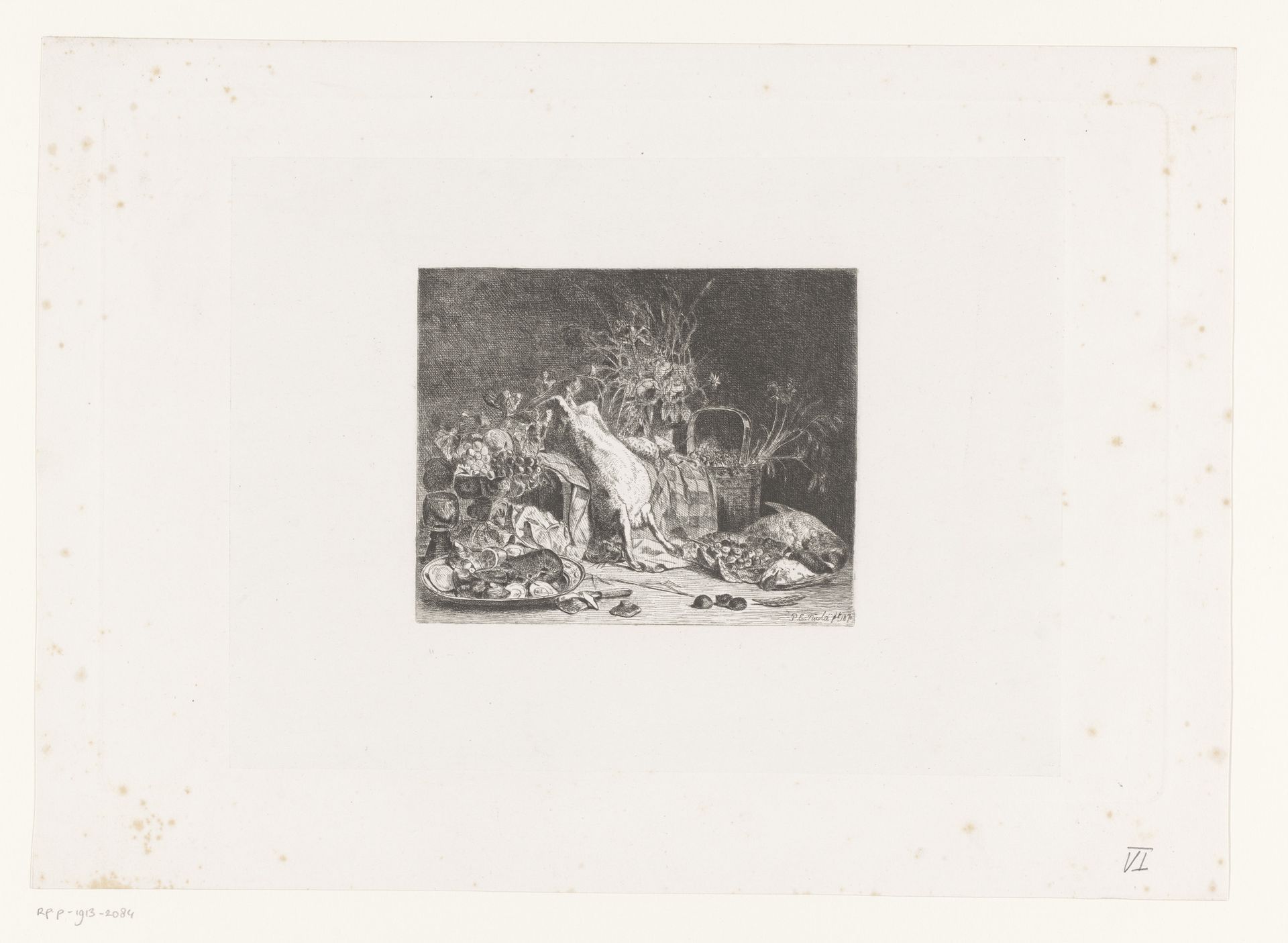
Stilleven van bloemen, vruchten en wild

Paul Emile Nicolié
1828 - 1894Location
RijksmuseumListen to curator's interpretation
Curatorial notes
Curator: At first glance, it feels like a forgotten feast, or perhaps a hunter's bounty laid out…slightly unsettling. Editor: We're looking at "Stilleven van bloemen, vruchten en wild," a still life etching on paper created around 1870 by Paul Emile Nicolie, currently held at the Rijksmuseum. Curator: "Still life"... seems a bit of a euphemism considering the 'wild' element includes what appears to be a deceased hare! The romantic style adds to the drama, like a stage set. What strikes me most is the symbolic weight – the flowers juxtaposed with the dead game, beauty with mortality. It's a traditional vanitas motif, I think. Editor: Absolutely, the arrangement echoes centuries of symbolic language. The wilting flowers, the ripe fruit... all hinting at the ephemeral nature of beauty and life itself. But I wonder if the inclusion of wild game introduces another layer. There's a certain brutality alongside the elegance. Do you think that introduces a comment on humanity’s role? Curator: Precisely! Hunting, a traditional privilege of nobility, is implicated in this grand symbolic theatre. This speaks to the Romantic period and it´s concern with themes like our troubled relation with nature or social inequalities. But I'm equally captivated by the etching technique. The precision, the delicate lines. Editor: There is something undeniably refined about the method itself, offering a tension against the artwork's subject. Perhaps that contrast elevates it past mere morbidity – the technical execution almost redeems the morbid elements by transmuting decay into meticulously detailed beauty? A captivating piece on many levels. Curator: Indeed, from the individual elements of decay to the commentary on the relationship of life, nobility, and nature this print holds a lot more to unravel than one would think from its presentation! Editor: True; this reminds us how artistic expression, even through familiar imagery, carries on prompting diverse contemplations about life’s fleeting nature.