weaving, textile
#
allegory
#
baroque
#
weaving
#
landscape
#
textile
#
mixed medium
#
mixed media
Dimensions: height 126.0 cm, width 209.0 cm
Copyright: Rijks Museum: Open Domain
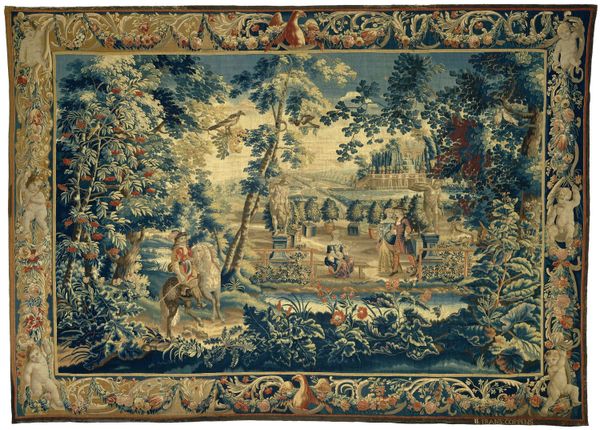
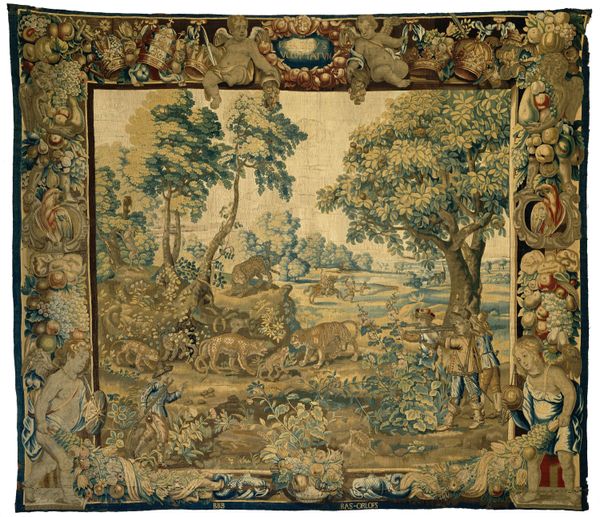
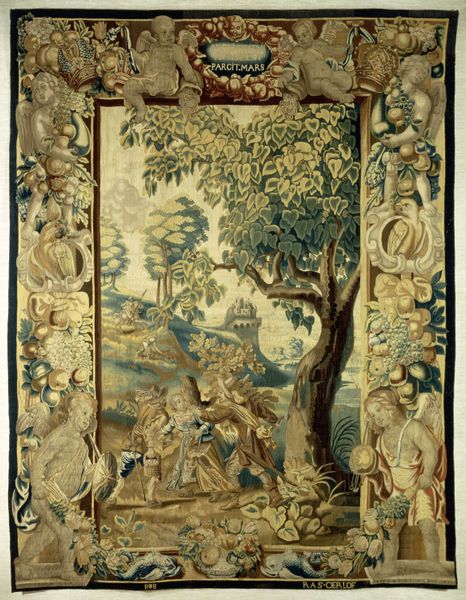
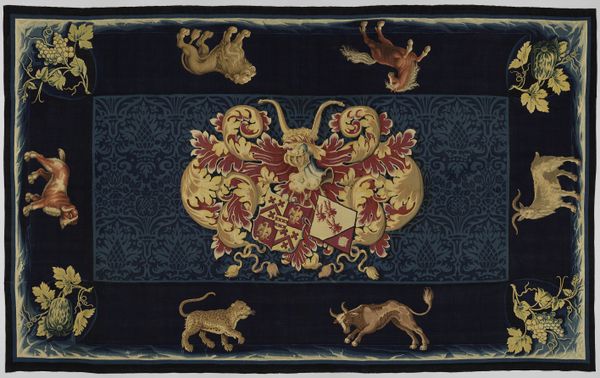
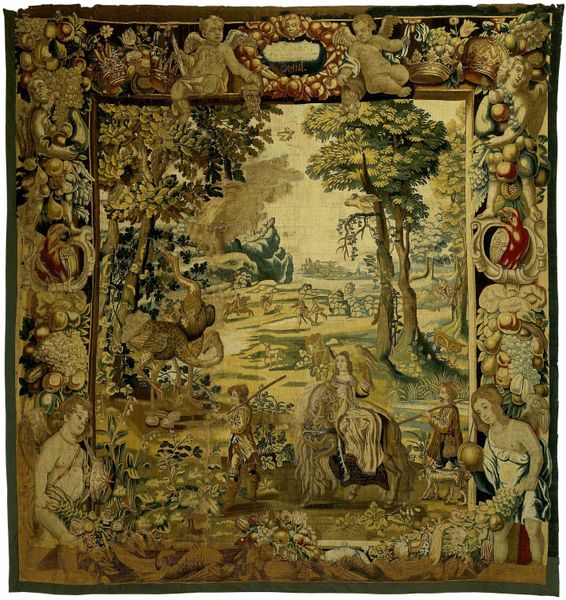
Editor: This is an Anonymous weaving, likely from between 1672 and 1700, titled "Landscape with the coats of arms of Ortt and Pergens." It feels like a really grand gesture, a stately portrait but in textile form. What sort of symbolism were these landscapes used for? Curator: The coats of arms themselves are rich in symbolism, but the tapestry acts as a cultural signifier beyond that. Heraldry displayed in landscapes does more than denote familial pride. Look at how the lion, a traditional symbol of strength and courage, faces the fleur-de-lis, associated with French royalty and purity. What meaning might arise from their placement alongside each other? Editor: Maybe a union of some kind? Or perhaps the juxtaposition highlights a specific alliance or even a tension between the families? Curator: Precisely. And consider the landscape backdrop. It’s not just decorative; it evokes a sense of place, heritage, and dominion. Textiles, due to their cost and durability, also suggested lasting power. It speaks of a desire to root these symbols into the very fabric of the world, making the legacy literally woven into existence. Does this give you any thoughts regarding cultural memory? Editor: I guess it suggests a desire to make a mark, a kind of… immortalization through art, linking the families to the land, their values and even perhaps to each other? It also serves as a really practical tool, not easily discarded and readily seen on a daily basis, therefore more readily and consistently prompting those memories. Curator: Yes, the tapestry becomes a constant, visual reinforcement of the family's narrative, weaving their story into the collective memory through repeated viewing. That's the powerful role that images play in cultural history. Editor: It’s interesting to think about how an image, especially one as durable as a tapestry, could shape not just individual but collective identity over generations. Thanks for shining some light on that!
Comments
No comments
Be the first to comment and join the conversation on the ultimate creative platform.
 Collect
 React
React Comment
More like this