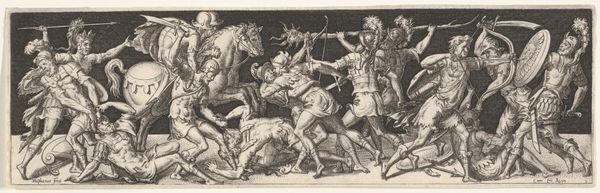
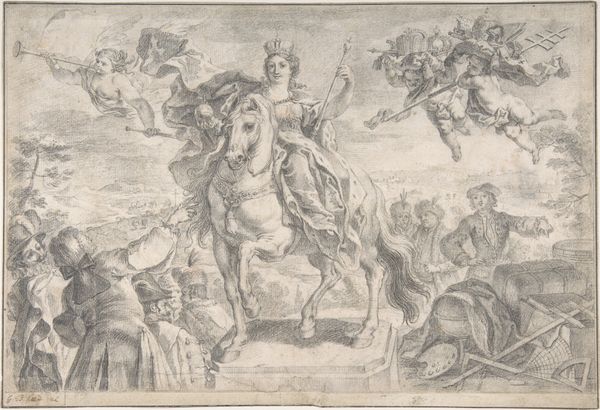
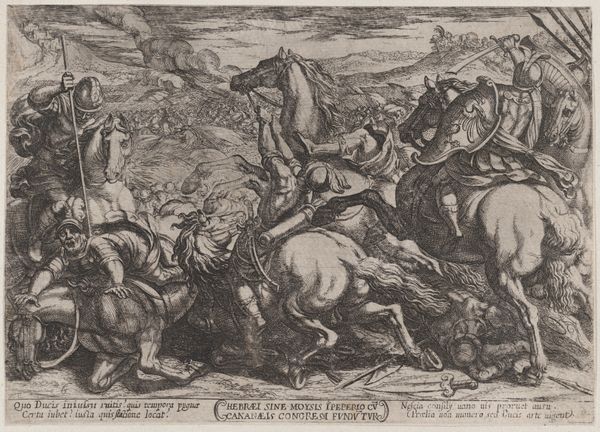
The Triumph of Two Roman Emperors (left-hand side) with a Roman Emperor riding in a triumphal chariot 1570 - 1615
0:00
0:00


drawing, print, engraving
#
drawing
#
allegory
# print
#
figuration
#
11_renaissance
#
romanesque
#
horse
#
men
#
history-painting
#
engraving
Dimensions: Sheet: 6 5/16 × 16 1/4 in. (16 × 41.3 cm)
Copyright: Public Domain
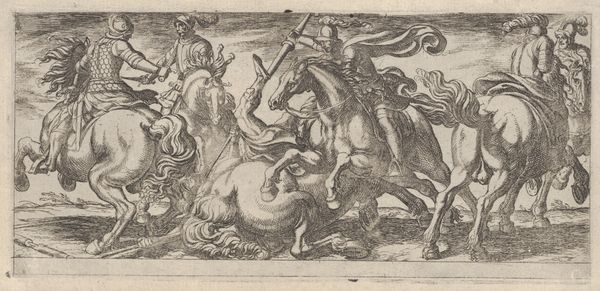
Curator: This engraving, held at the Metropolitan Museum of Art, presents “The Triumph of Two Roman Emperors (left-hand side) with a Roman Emperor riding in a triumphal chariot." Cherubino Alberti executed this print sometime between 1570 and 1615. Editor: Immediately, I’m struck by its rigid formality, the high contrast, and overall impression of relentless power and movement. There’s something almost…oppressive about this meticulously ordered procession. Curator: Alberti, steeped in Roman art and architecture, translated the grand spectacles of imperial victory into print. Engravings such as these circulated widely, shaping the perception of Roman history. We must remember the impact of printmaking on society's understanding of politics during the Renaissance and the visual manipulation by the Church. Editor: Yes, and consider how such images, brimming with classical allusions, legitimized contemporary rulers by linking them visually and ideologically to the grandeur of Rome. The triumphal chariot becomes a vehicle not only for the Emperor, but for power itself, projecting his divine right to rule. Also, look at the complete absence of female representation, furthering hegemonic narratives. Curator: Absolutely. We need to unpack how images like this helped create and maintain hierarchical social structures. The historical context illuminates that there's likely more significance that is yet unknown to modern viewers. Who, for example, was Barberino, who is referenced in Latin on the artwork? What type of propaganda did this engraving support? Editor: These engravings circulated, influencing tastes, styles, and even political thought. Understanding their journey—from Alberti’s workshop to the hands of collectors and even ordinary citizens—allows us to appreciate their impact on the formation of early modern visual culture. And it also brings up important conversations surrounding the impact on power in society when the "elites" are dictating this "visual culture". Curator: By studying how art constructs these ideas, we can start deconstructing these historical narratives. Editor: Exactly, revealing how artistic practices are woven into a historical and ongoing process of empowerment and disenfranchisement.
Comments
No comments
Be the first to comment and join the conversation on the ultimate creative platform.
 Collect
 React
React Comment
More like this