

1902
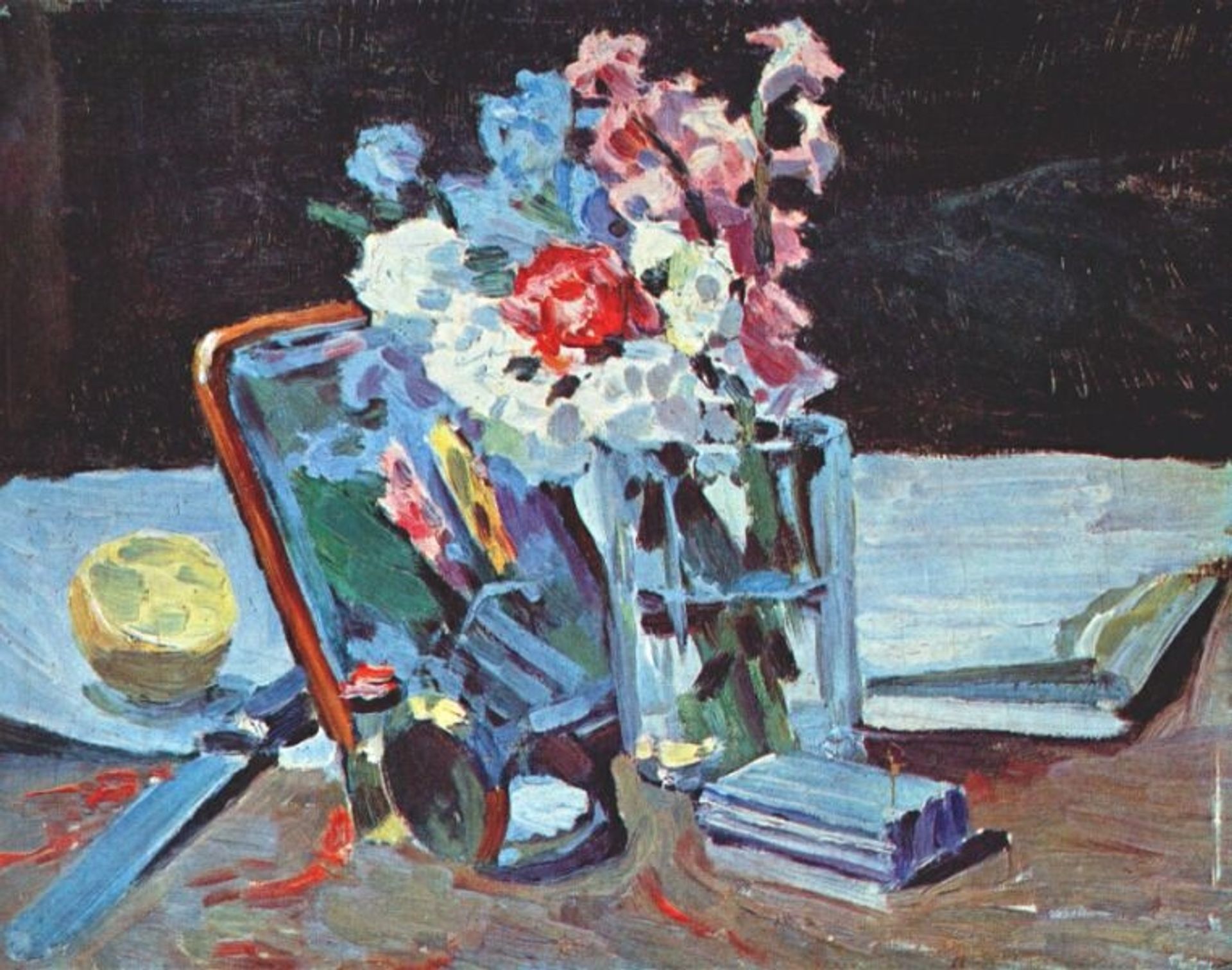
Still Life with Flowers

Victor Borisov-Musatov
1870 - 1905Location
National Gallery of Armenia, Yerevan, ArmeniaListen to curator's interpretation
Curatorial notes
Curator: Allow me to introduce Victor Borisov-Musatov's "Still Life with Flowers," a stunning oil on canvas completed in 1902. Editor: My first impression is one of subdued vibrancy. The blurred edges create a soft, almost dreamlike atmosphere, yet the flowers themselves explode with colour. Curator: The composition is quite deliberate. Borisov-Musatov’s positioning of the vase and flowers draws the eye directly to the heart of the canvas, orchestrating a play of light and shadow, especially evident in the contrasting darkness behind the blooms. Do you find his color choices unconventional for a still life? Editor: Perhaps, and that’s what interests me. By imbuing everyday objects with a heightened sensitivity, Borisov-Musatov, a key figure in the Russian Symbolist movement, transcends mere representation, using flowers as symbols of ephemeral beauty. How do you interpret his stylistic choices? Curator: His brushwork is gestural, almost impulsive, which contradicts the formality of academic painting, placing him squarely in the realm of Post-Impressionism. One may decode the semiotic signs and argue for a personal narrative encoded within the arrangement, or even a comment on the broader sociopolitical milieu of the Russian fin de siècle. Editor: Indeed, such a delicate painting emerging in the turbulent era leading up to the Russian Revolution certainly speaks to the escapist tendencies prevalent within artistic circles at the time. It raises important questions regarding the function of art within such conditions. Was it meant as a means of transcending the brutality, or was it just ignorance of those realities? Curator: The very act of creating and exhibiting art is often a social statement. By depicting the flowers in a domestic setting, he arguably brings them into conversation with concerns like intimacy, mortality, beauty... Editor: It serves as a testament to the power of aesthetic refinement amidst an atmosphere of societal upheaval. Seeing how even mundane objects such as flowers are imbued with rich cultural connotations helps one understand the symbolic values inherent in paintings beyond immediate visual details. Curator: Precisely, it is through examining these elements, whether at surface level, like paint texture and colours, or historical frameworks, that a richer engagement with such works can emerge. Editor: I concur. It allows one to perceive the multi-faceted nature of art. It's a dance between surface allure and deeper contexts.