About this artwork
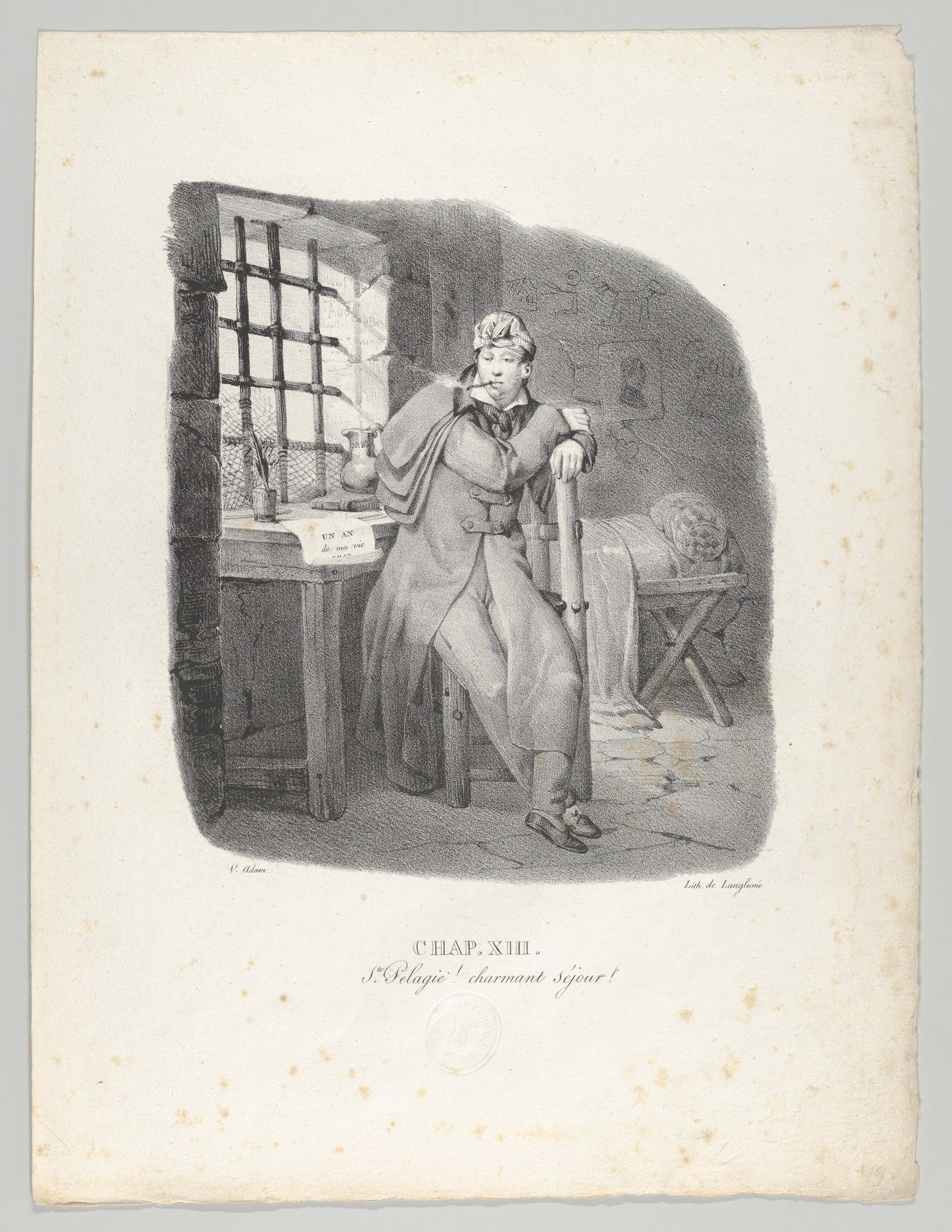
Victor Adam's lithograph captures a scene from Sainte-Pélagie Prison, presenting what the title ironically calls a 'charming stay'. The composition divides the space into zones: the stark reality of imprisonment and the individual's response to confinement. Adam uses light and shadow to create a visual hierarchy. Notice how the light falling through the barred window illuminates the prisoner, drawing the viewer's eye to his contemplative figure. The bars create a grid, a structural motif symbolizing confinement, while the figure leans jauntily. The man's relaxed posture and elegant attire clash with the prison setting, challenging the perceived meaning of incarceration. Consider how Adam uses the lithographic medium to create texture and tone, adding depth to the psychological narrative. The artist destabilizes the values associated with prison life, prompting us to question the social and political structures of the time. The formal qualities of the artwork offer an ongoing dialogue about the relationship between the individual and society.
Chap. XIII: Ste. Pelagie! charmant séjour! (Sainte-Pélagie Prison, a charming stay!) 1824


Artwork details
- Medium
- drawing, print, engraving
- Dimensions
- 14 1/4 × 10 1/16 in. (36.2 × 25.5 cm)
- Location
- Metropolitan Museum of Art, New York, NY
- Copyright
- Public Domain
Tags
portrait
drawing
narrative-art
romanticism
engraving
Comments
No comments
About this artwork
Victor Adam's lithograph captures a scene from Sainte-Pélagie Prison, presenting what the title ironically calls a 'charming stay'. The composition divides the space into zones: the stark reality of imprisonment and the individual's response to confinement. Adam uses light and shadow to create a visual hierarchy. Notice how the light falling through the barred window illuminates the prisoner, drawing the viewer's eye to his contemplative figure. The bars create a grid, a structural motif symbolizing confinement, while the figure leans jauntily. The man's relaxed posture and elegant attire clash with the prison setting, challenging the perceived meaning of incarceration. Consider how Adam uses the lithographic medium to create texture and tone, adding depth to the psychological narrative. The artist destabilizes the values associated with prison life, prompting us to question the social and political structures of the time. The formal qualities of the artwork offer an ongoing dialogue about the relationship between the individual and society.
Comments
No comments