drawing
#
tree
#
drawing
#
garden
#
impressionism
#
landscape
#
sketch
#
line
#
park
#
post-impressionism
#
realism
Copyright: Public domain
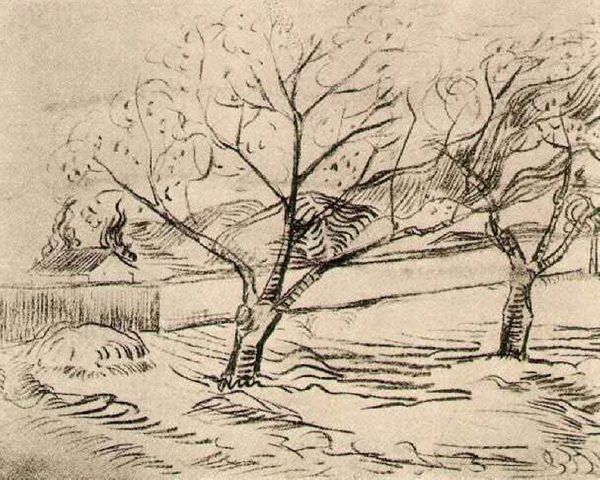
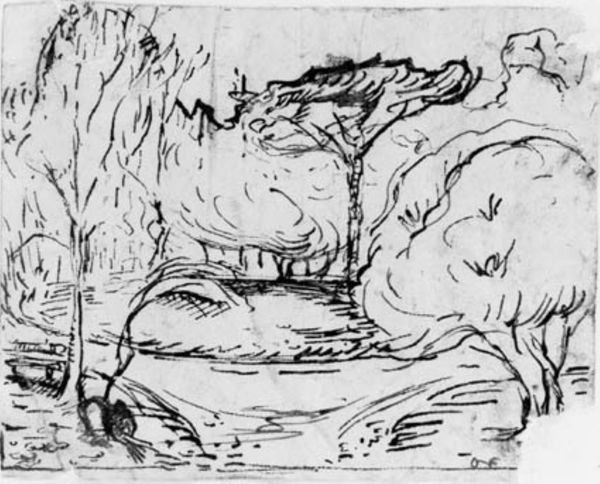
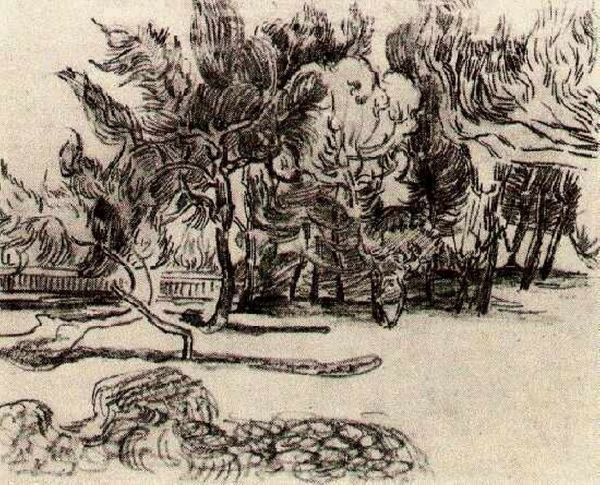
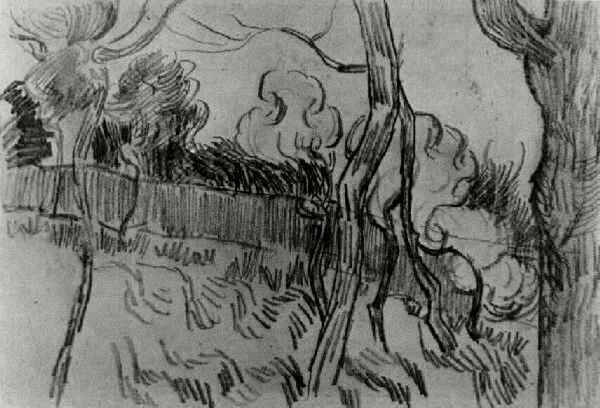
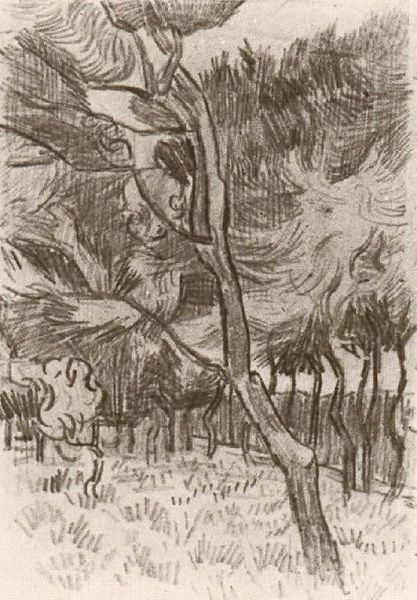
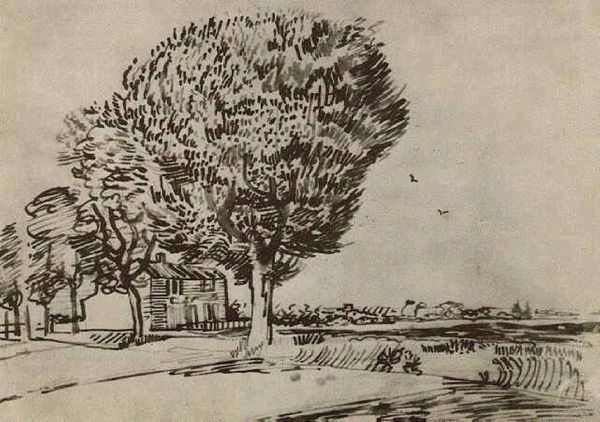
Curator: The starkness here is captivating, almost unsettling. Editor: Indeed. What we're seeing is Vincent van Gogh's drawing, "Garden of the Asylum and Tree Trunks and a Stone Bench," created in 1889. It’s a pencil and ink work depicting a scene he observed while at the Saint-Paul-de-Mausole asylum in Saint-Rémy. Curator: That setting profoundly informs my interpretation. The raw lines sketching the trees feel like bars – a cage around the bench and the faint figures beyond. Are they fellow patients, ghosts of the artist’s mind, or simply echoes of his isolation? Editor: The lack of color amplifies that sense of confinement and perhaps even his internal struggle. Yet, look at the composition – the strong verticals of the trees, the horizontals of the bench and ground. The formal structure is quite deliberate, even controlled, in stark contrast to the perceived emotional chaos. Curator: Control amidst chaos – that's a compelling dichotomy! To me, those trees aren’t just botanical forms, but symbols of endurance, maybe even a perverse sort of comfort. Rooted and gnarled, bearing witness, and reaching for the sky. Van Gogh's work constantly blends observed reality and psychological projection. Editor: Agreed. The density of lines around the trunks contrasting with the lighter strokes used to depict the background suggests a push and pull – a tension that mirrors his documented inner state. The sketchy execution further strips down the representation to its essential form. Curator: The bench – a place of rest – is vacant. Did he see it as sanctuary or another reminder of his solitary confinement? Its very ordinariness becomes a symbol laden with complex emotions. Editor: I see a quiet resilience. Even in an asylum garden, rendered in stark lines, there’s a visual framework trying to maintain order. The artwork provides a controlled space that frames and reduces complex emotions, giving the viewer a singular and compelling image of his emotional struggle. Curator: A struggle beautifully and tragically etched for posterity. A reminder of the profound weight of mental illness, visualized. Editor: A testament to the artist's enduring talent to use stark forms and semiotic cues to express internal emotionality.
Comments
No comments
Be the first to comment and join the conversation on the ultimate creative platform.
 Collect
 React
React Comment
More like this