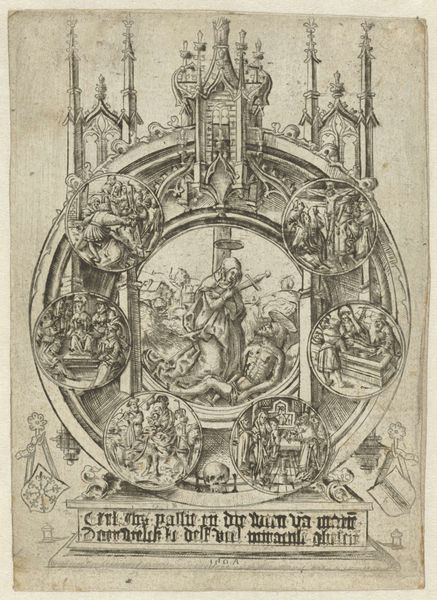
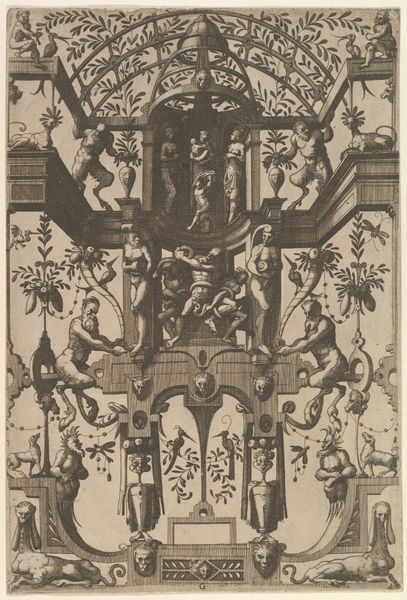
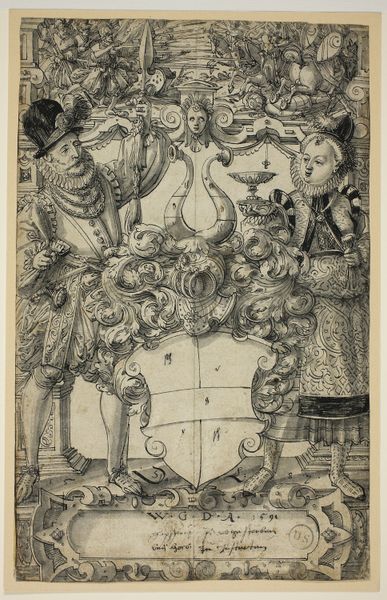
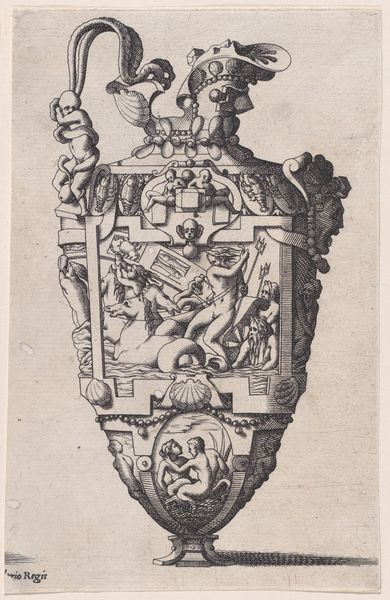
Triumph of Death with three fates in an architectural frame above a wheel of fortune flanked by skeletons; a skull and an hour glass at top and with wheel intended to spin at center 1588
0:00
0:00


drawing, print, metal, ink, engraving, architecture
#
drawing
#
allegory
#
pen drawing
# print
#
metal
#
mannerism
#
figuration
#
11_renaissance
#
vanitas
#
ink
#
geometric
#
line
#
history-painting
#
engraving
#
architecture
Dimensions: Sheet: 15 11/16 × 11 11/16 in. (39.9 × 29.7 cm)
Copyright: Public Domain
Curator: So, looking at "Triumph of Death with three fates in an architectural frame above a wheel of fortune flanked by skeletons," dating back to 1588, by Andrea Andreani, what's your immediate sense? Editor: Whoa, overwhelming. Like a Hieronymus Bosch garage sale. A little terrifying, honestly, with all the skeletons and the implication of impending doom. It's…loud. Curator: Loud, yes, in its visual rhetoric. Andreani creates this intricate construction that is rooted in a deep understanding of "vanitas" and the allegorical representation of death in the Renaissance. We should remember how deeply ingrained mortality was in the cultural mindset of the time. Editor: Mortality, sure, but it’s more than just skulls, right? The Wheel of Fortune element makes me think of fate and destiny... like everyone, regardless of status, is just a puppet on death's stage. Curator: Exactly. The wheel acts as a socio-political leveler. The figures around the wheel symbolize different social stations. The spinning illustrates life's instability and that the high might be brought low. Notice how the Fates are placed right above, reinforcing this weaving and cutting of lives. It plays with philosophical concepts of fortune and the human condition, right? Editor: Absolutely, it's darkly humorous, and in a weird way, empowering. Knowing we're all in the same sinking boat lets you laugh at the absurdity of it all. And look at the detail, how it creates such depth with only lines. The artist even put in an hourglass at the top – a real blunt reminder of the passage of time. Curator: I agree. And this intricate linework connects it to other engravings of its time. It also speaks to an intersectional social critique where visual art could engage in political and social commentary regarding life, class, death, gender. This isn't mere morbidity; it’s a dialogue on social justice. Editor: It's one of those pieces you could stare at for hours and still discover something new. Its complexities echo life in general, like there’s beauty even within a rather bleak depiction. Curator: Indeed. Its richness invites conversation about the transience of life, which hopefully is what people see when looking at works such as this.
Comments
No comments
Be the first to comment and join the conversation on the ultimate creative platform.
 Collect
 React
React Comment
More like this