About this artwork
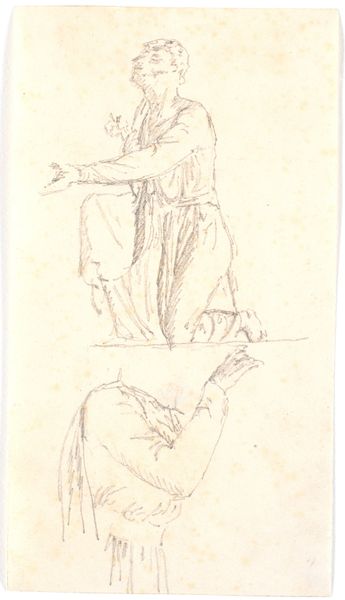
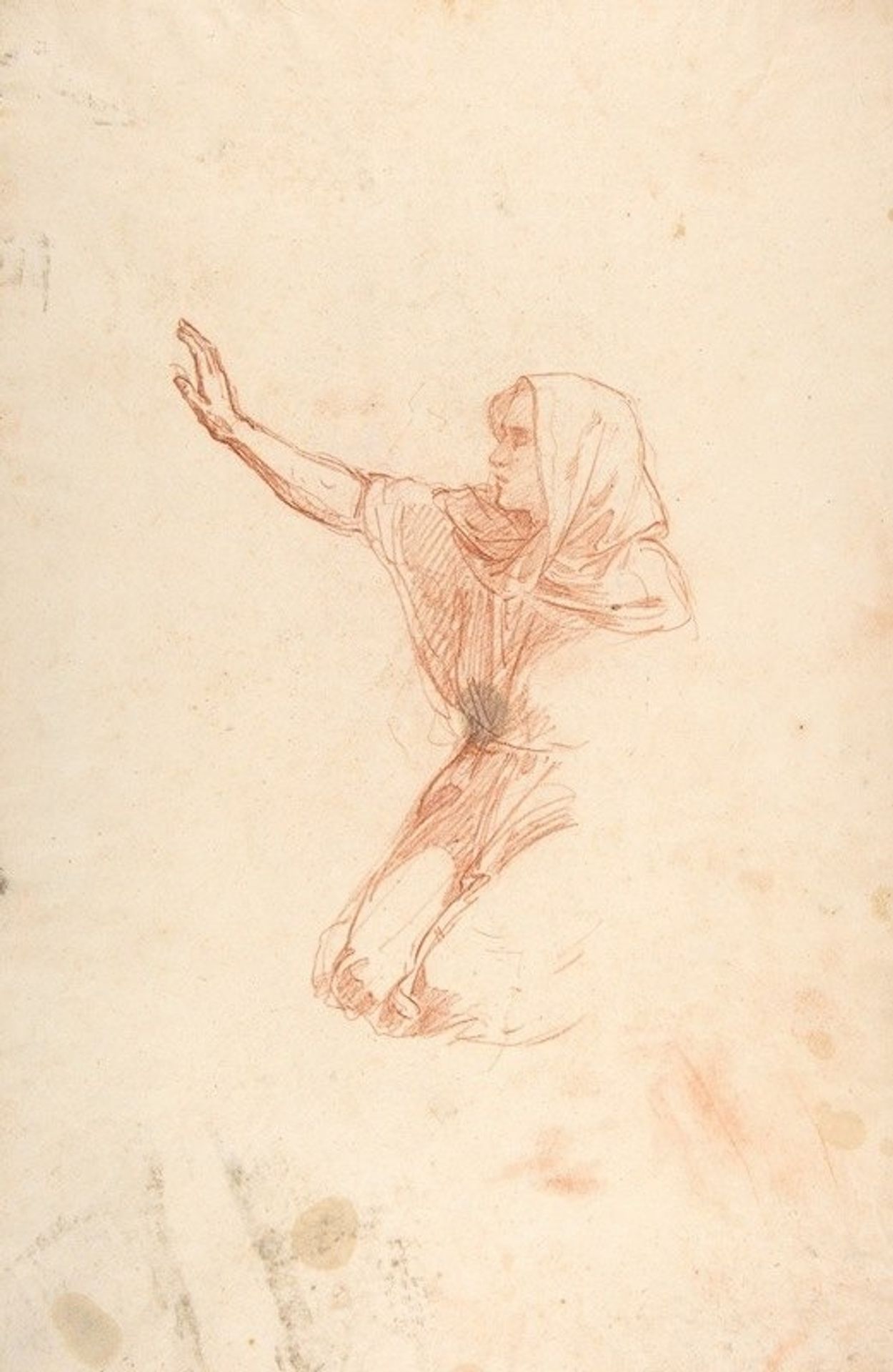
Curator: I’m drawn to the supplicating posture; there’s a palpable vulnerability that the artist captures so directly. Editor: And a skillful economy of line to achieve it. This work, attributed to Isidore Pils and known as "Kneeling Woman," seems to be a preliminary sketch, dating back to the 19th century. The medium appears to be primarily red chalk on paper, judging by its color and texture. Curator: The title, though simple, brings to mind numerous intersectional interpretations, doesn't it? I can't help but see it through a lens of gendered power dynamics, the historical expectations of female piety and submission... Who is she praying to, or perhaps even begging? Editor: Indeed, it would be fascinating to trace Pils’ influences and examine the labor that produced this image, because I see this image as more likely connected to the labor of devotion and the act of kneeling. The very act of sketching suggests rapid execution; how does the artist work to evoke those meanings? Curator: Perhaps, but also consider how the woman's pose invites readings beyond pure devotion. Her raised hand, for instance – is it a plea, or a gesture of defiance? Is she seeking divine intervention, or pushing back against earthly constraints? Her covered head is also of note; where does the constraint become tradition or custom? Editor: It also invites us to speculate on the material and the artist's approach: the relative cost of the red chalk, the type of paper used…was this sketch for personal edification or something destined for a larger work that might then engage industrial processes? The line-work feels intentionally unfinished, as well, creating an ambiguity of both process and intention. Curator: The ambiguity is definitely key here; there is so much that we are left to question. Looking at the figure within a broader socio-political context really adds weight to even these spare lines, even these underpinnings of this artwork. Editor: Absolutely. It is the connection between the sketch, materials, and social implication of the "underpainting" process that fascinates me the most. Curator: Thank you for sharing your thoughts; it’s enlightening to reexamine pieces such as this through your insight. Editor: Likewise; this conversation enriches the layers of meaning behind it for me, and prompts new questions for consideration.

Artwork details
- Medium
- drawing
- Copyright
- Public Domain: Artvee
Tags
Comments
Share your thoughts
About this artwork
Curator: I’m drawn to the supplicating posture; there’s a palpable vulnerability that the artist captures so directly. Editor: And a skillful economy of line to achieve it. This work, attributed to Isidore Pils and known as "Kneeling Woman," seems to be a preliminary sketch, dating back to the 19th century. The medium appears to be primarily red chalk on paper, judging by its color and texture. Curator: The title, though simple, brings to mind numerous intersectional interpretations, doesn't it? I can't help but see it through a lens of gendered power dynamics, the historical expectations of female piety and submission... Who is she praying to, or perhaps even begging? Editor: Indeed, it would be fascinating to trace Pils’ influences and examine the labor that produced this image, because I see this image as more likely connected to the labor of devotion and the act of kneeling. The very act of sketching suggests rapid execution; how does the artist work to evoke those meanings? Curator: Perhaps, but also consider how the woman's pose invites readings beyond pure devotion. Her raised hand, for instance – is it a plea, or a gesture of defiance? Is she seeking divine intervention, or pushing back against earthly constraints? Her covered head is also of note; where does the constraint become tradition or custom? Editor: It also invites us to speculate on the material and the artist's approach: the relative cost of the red chalk, the type of paper used…was this sketch for personal edification or something destined for a larger work that might then engage industrial processes? The line-work feels intentionally unfinished, as well, creating an ambiguity of both process and intention. Curator: The ambiguity is definitely key here; there is so much that we are left to question. Looking at the figure within a broader socio-political context really adds weight to even these spare lines, even these underpinnings of this artwork. Editor: Absolutely. It is the connection between the sketch, materials, and social implication of the "underpainting" process that fascinates me the most. Curator: Thank you for sharing your thoughts; it’s enlightening to reexamine pieces such as this through your insight. Editor: Likewise; this conversation enriches the layers of meaning behind it for me, and prompts new questions for consideration.
Comments
Share your thoughts