

1920 - 1935
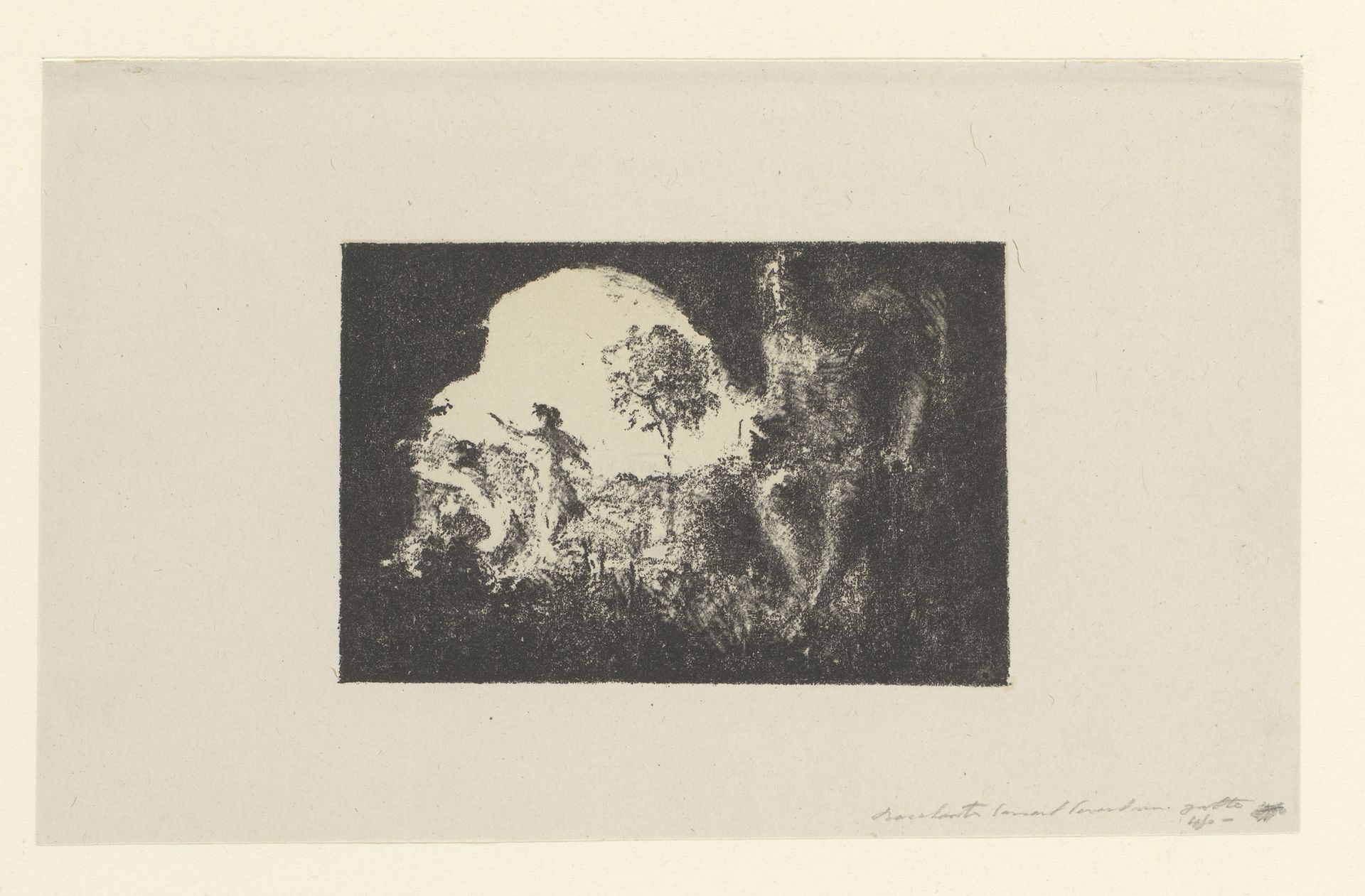
Man in grot met voor de ingang twee wezens

Listen to curator's interpretation
Curatorial notes
Curator: So, here we have a rather intriguing piece. It's a print, made with ink on paper, created sometime between 1920 and 1935 by Ker Xavier Roussel. It's titled "Man in grot met voor de ingang twee wezens"— "Man in a cave with two creatures at the entrance." Editor: My first thought is… enigmatic. There’s a darkness, almost a primal quality to it, that contrasts oddly with what looks like a rather bucolic scene inside the cave. Is it comforting or ominous, this darkness? Curator: It’s interesting you say that, because Roussel often depicted idyllic scenes. Here, though, the monochrome and somewhat crude lines certainly give it a darker edge. The figures themselves seem almost mythical, don’t they? They’re certainly not portraiture as we know it! Editor: Definitely not! They seem less like humans and more like embodiments of… well, I'm not sure. The wildness in the textures could echo a world before reason, you know? Curator: That tension between the classical and the chaotic seems characteristic of Roussel’s generation as they dealt with new socio-political models and the effects of the First World War. There’s an anxiety there, a return to darker, more primitive symbols that is more than unsettling. This piece departs from Roussel’s sun-drenched mythologies. He exhibited at the Salon des Indépendants. Those were important settings for debating the course of modern art at the time. Editor: Maybe it's the stark monochrome. Perhaps Roussel felt those traditional color palettes simply couldn't capture the complexities he was exploring here. Curator: Precisely! Perhaps he's inviting us to question our own relationship with the natural world. Maybe that primordial darkness outside is a reflection of what we’re trying to repress in ourselves. Editor: Well, it certainly got me thinking! A curious shadow play in a small space. Curator: And it serves as a powerful reminder of how artists can express deeply personal anxieties even through seemingly simple scenes.