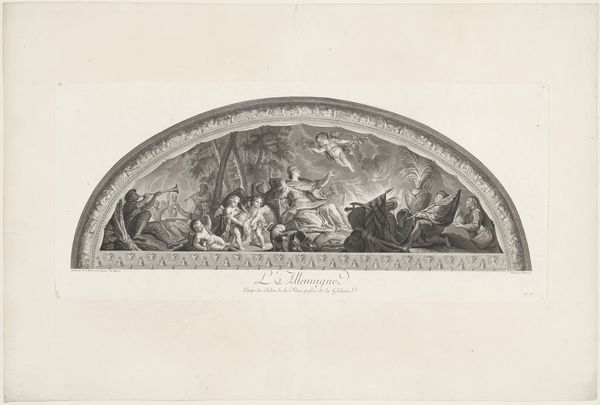
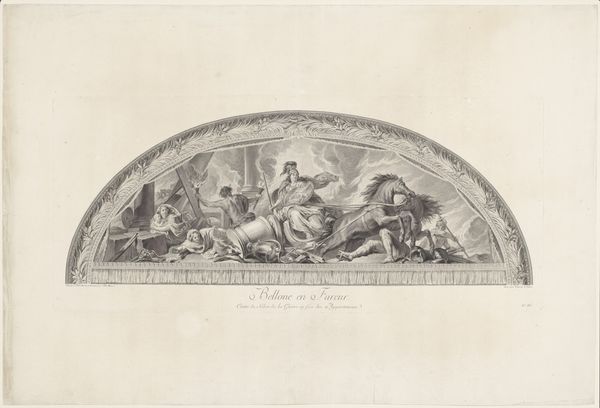
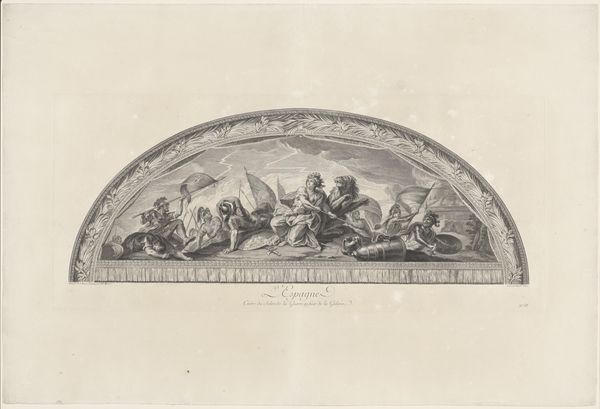
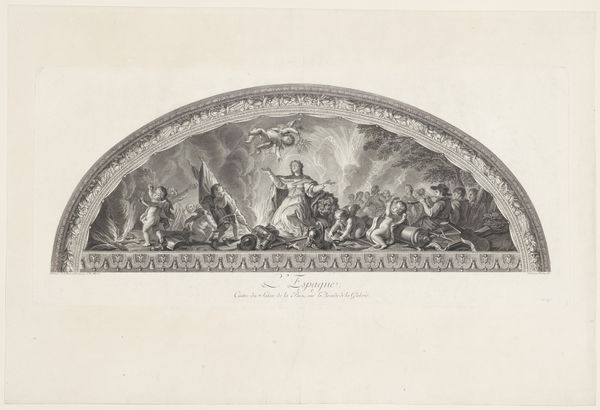
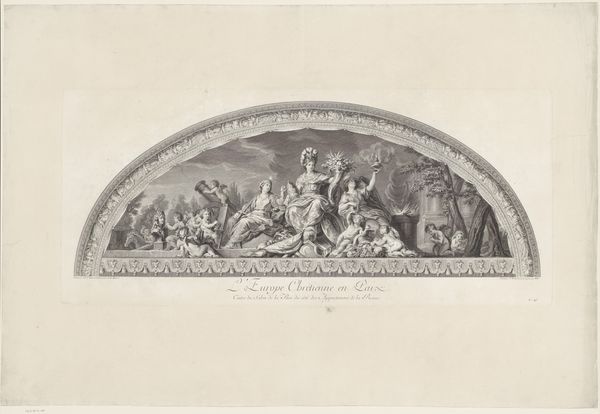
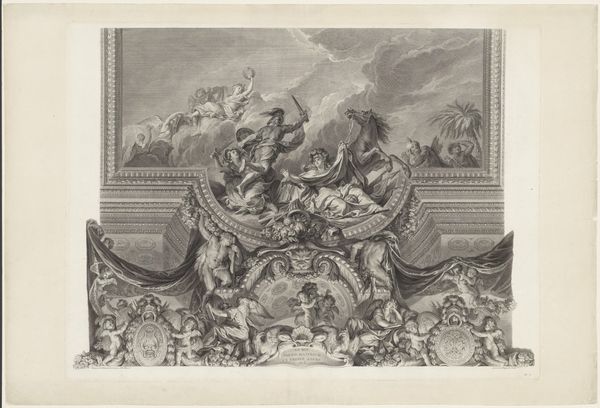
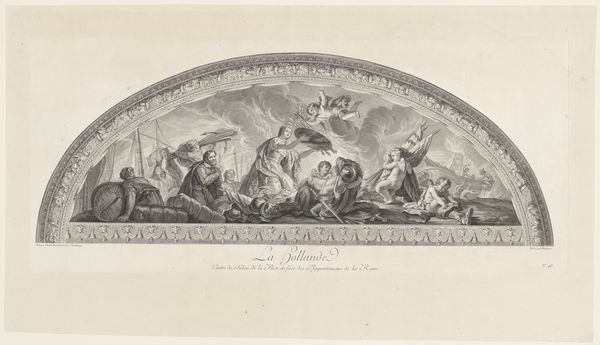
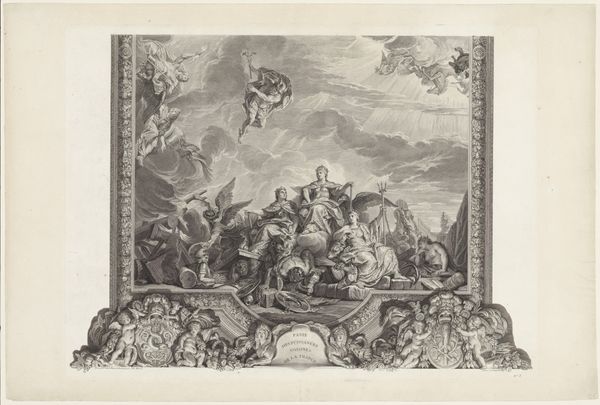
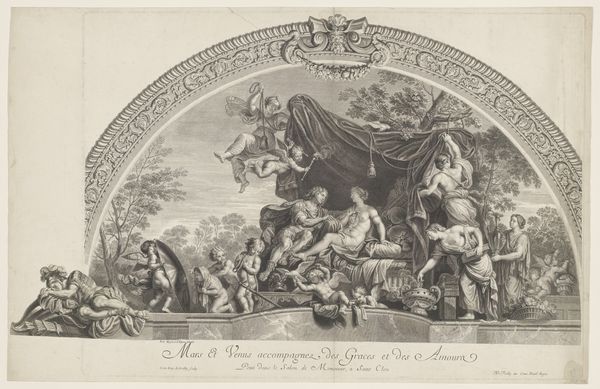
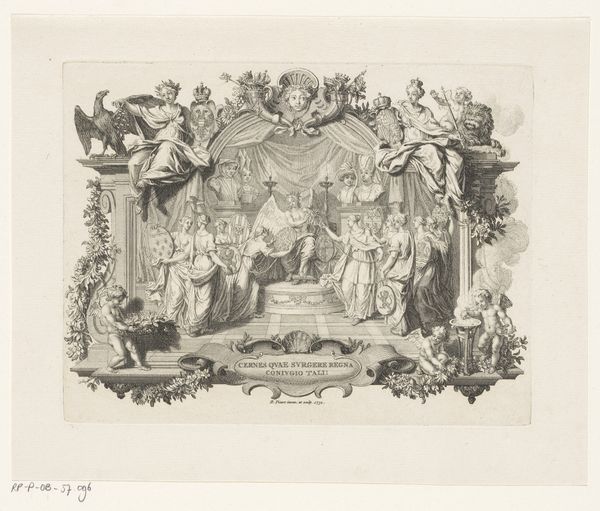
Plafondschildering in de Grande Galerie van Versailles met het bondgenootschap tussen Spanje, het Heilige Roomse Rijk en Nederland 1752
0:00
0:00

engraving
#
allegory
#
baroque
#
old engraving style
#
history-painting
#
engraving
Dimensions: height 404 mm, width 791 mm
Copyright: Rijks Museum: Open Domain
Editor: This is a 1752 engraving by Laurent Cars, depicting a ceiling painting in the Grande Galerie of Versailles; the full title is rather a mouthful. It seems to capture an allegorical moment, possibly relating to an alliance. What strikes me most is how it captures so much movement and drama in what must have been a very ornate architectural setting. What are your thoughts when you look at this piece? Curator: What I find compelling is the composition itself. Note the semi-circular frame, mirroring the architecture, creating a contained yet dynamic space. How does the artist’s choice of lines, the contrasts between light and shadow, impact your reading of this political allegory? Editor: I notice the sharp contrasts, yes. They guide my eye from the figures at the top, seemingly deities, down to the laborers below. It's all quite stylized, very Baroque. Curator: Exactly. The formal structure dictates the thematic interpretation. Notice how the artist employs classical figures in the service of contemporary power. Consider the lines, the masses; everything is geared toward grandeur, toward legitimizing authority through artistic technique. Is this an effective choice? Editor: I think so, the stylistic choices give it a monumental feel, despite being an engraving. I suppose that reinforces the message. It's interesting how technique can amplify the intent behind the artwork. Curator: Precisely. We can examine this image and appreciate Cars’ astute ability to distill complex relations into visual terms. His use of engraving techniques to translate a painted ceiling into a new, reproducible form further extends its significance. It enables the ceiling to resonate on a grander scale, exceeding its physical site and persisting in cultural memory. Editor: I see, it’s about not just what is represented, but how that representation is achieved and distributed. Thanks, that gives me a completely new perspective. Curator: My pleasure.
Comments
No comments
Be the first to comment and join the conversation on the ultimate creative platform.
 Collect
 React
React Comment
More like this