Copyright: Public Domain: Artvee
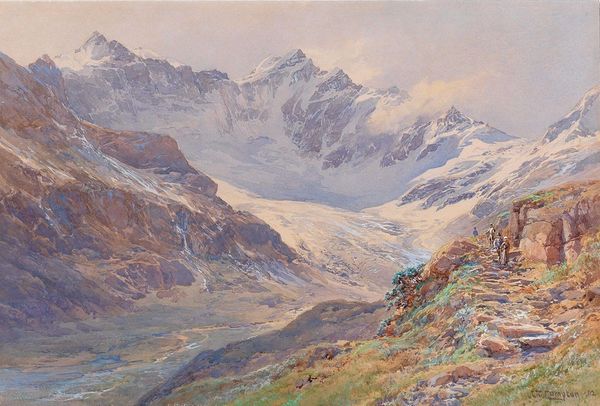
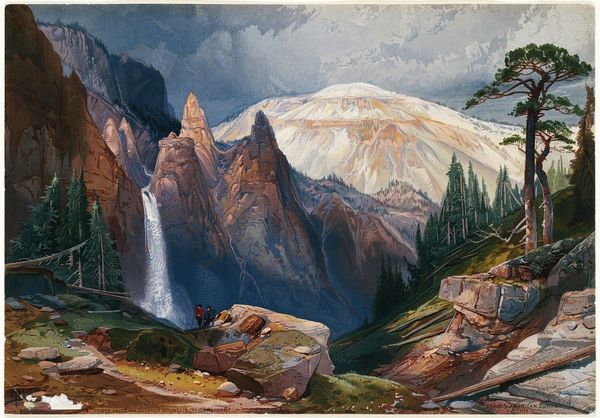
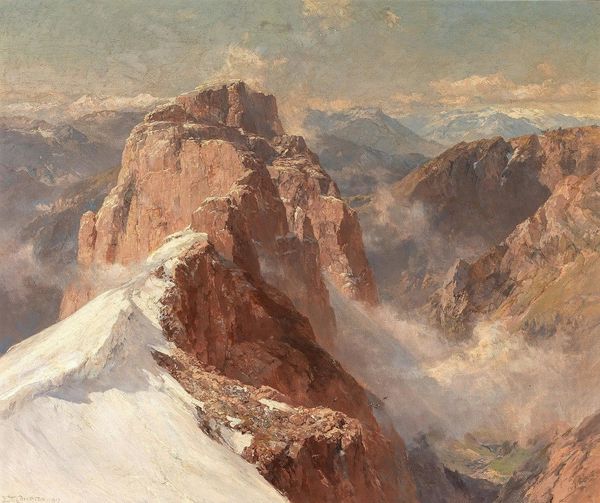
Editor: So, this watercolor by Thomas Moran, "The Mosquito Trail, Rocky Mountains of Colorado, Elevation 12,000 Feet," from around 1875, evokes a real sense of the sublime, doesn't it? The sheer scale and the tiny figures… it’s quite breathtaking. What stands out to you when you look at it? Curator: I am struck by the artist’s masterful control of the medium. Observe how Moran constructs space through a sophisticated layering of washes, manipulating tone to articulate depth. Note the strategic placement of dark, angular forms in the foreground which create a spatial anchor, contrasting beautifully with the atmospheric rendering of the distant peaks. Do you notice how line and shape create a sense of visual tension? Editor: Yes, definitely. The foreground is quite defined, almost rugged, which leads your eye into the softer, almost hazy, mountains in the distance. It’s a compelling contrast. Do you think the details he included impacts the work, particularly the figure in the foreground? Curator: Absolutely. While the grand vista captivates, consider how the diminutive human figure subtly alters our reading of the work. Its presence acts as a crucial indexical sign, both emphasizing the scale of nature and implicating the viewer within the pictorial space. Editor: It certainly brings the viewer into the experience! I initially just saw a beautiful landscape. But your focus on the visual structure and use of elements has provided a new way to examine Moran’s technique. Curator: And examining those aspects yields not just the visual understanding of landscape but deep contemplation about our own physical, spiritual, and mental being.
Comments
No comments
Be the first to comment and join the conversation on the ultimate creative platform.
 Collect
 React
React Comment
More like this