About this artwork
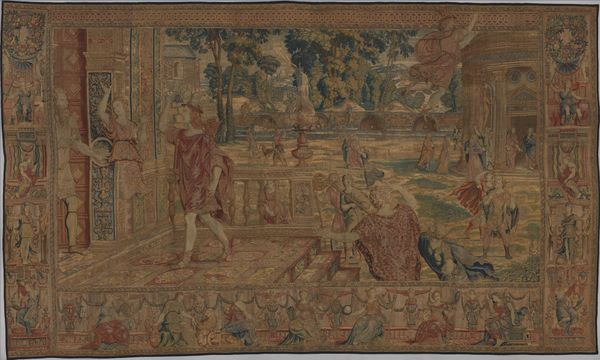
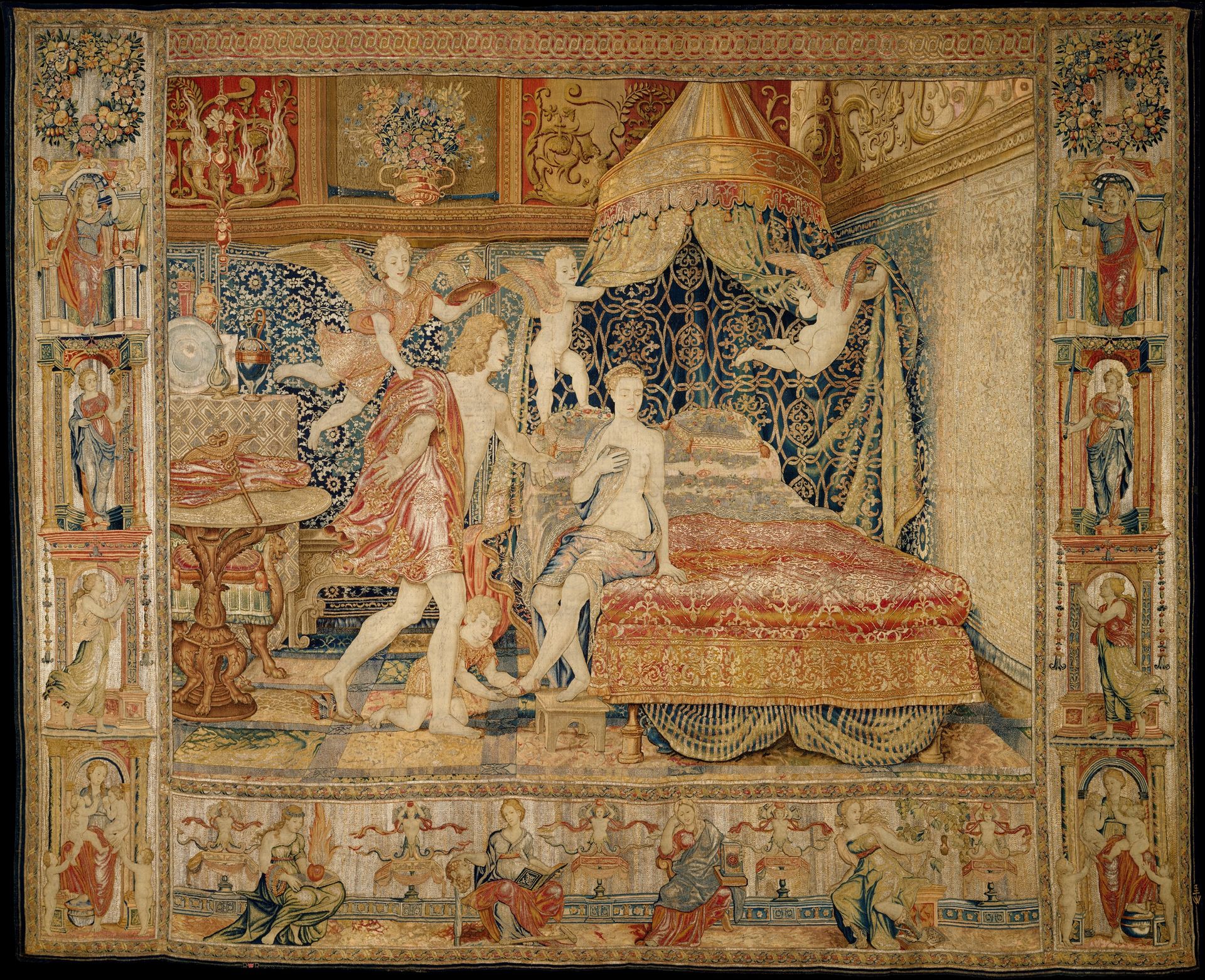
Curator: Welcome. Today, we’re exploring “Aglauros’s Vision of the Bridal Chamber of Herse, from the Story of Mercury and Herse." It’s a textile, made sometime between 1535 and 1575. It is currently held at the Metropolitan Museum of Art. Editor: It strikes me immediately as opulent and, dare I say, claustrophobic. The heavy drapes, the ornate bed, it all seems very enclosed and weighty. What story is being depicted? Curator: This piece visualizes a scene from Ovid’s *Metamorphoses*, focusing on the moment Aglauros, driven by envy, spies on her sister Herse’s bridal chamber. Mercury, the messenger god, is there to court her. Editor: It’s interesting to see this classical myth rendered in textile. The material itself speaks to a kind of labor and artistry, not unlike the very gods at play here. The threads used to make the fabric seem so labor-intensive, so meticulously crafted. It stands in stark contrast to how divinities act, as these gods create drama with such nonchalance and power, compared to what seems required here to weave such scene.. Curator: Yes, tapestries like these often served a dual purpose. While decorative and beautiful, they also served as a visual narrative of the elite's cultural and social aspirations. Owning something like this communicated status and intellect. What seems nonchalant could be the intent to emulate power. Editor: Do you find the scale remarkable? As it hangs on display, do you feel its materiality competes or works harmoniously with its intended display context? Curator: It has been proposed that the scale does work harmoniously. Its function of spatial creation goes hand in hand with communicating status to a guest, allowing one to understand and be wowed by the tapestry as they move around the setting, adding value. The fact it is now held at the Met, as one of the many highlights from such a prestigious setting, furthers that image. Editor: Food for thought! As we wrap up, I'm left thinking about the artist's choices of materiality. Curator: And I’m left contemplating the politics embedded within this scene. It gives insight to cultural elitism of 16th-century society.
Aglauros’s Vision of the Bridal Chamber of Herse, from the Story of Mercury and Herse
1535 - 1575

Giovanni Battista Lodi da Cremona
1540 - 1552
The Metropolitan Museum of Art
Metropolitan Museum of Art, New York, NYArtwork details
- Medium
- textile, sculpture
- Dimensions
- weight confirmed, includes tube: 14 ft. 4 in. × 17 ft. 9 in., 173 lb. (436.9 × 541 cm, 78.5 kg)
- Location
- Metropolitan Museum of Art, New York, NY
- Copyright
- Public Domain
Tags
Comments
Share your thoughts
About this artwork
Curator: Welcome. Today, we’re exploring “Aglauros’s Vision of the Bridal Chamber of Herse, from the Story of Mercury and Herse." It’s a textile, made sometime between 1535 and 1575. It is currently held at the Metropolitan Museum of Art. Editor: It strikes me immediately as opulent and, dare I say, claustrophobic. The heavy drapes, the ornate bed, it all seems very enclosed and weighty. What story is being depicted? Curator: This piece visualizes a scene from Ovid’s *Metamorphoses*, focusing on the moment Aglauros, driven by envy, spies on her sister Herse’s bridal chamber. Mercury, the messenger god, is there to court her. Editor: It’s interesting to see this classical myth rendered in textile. The material itself speaks to a kind of labor and artistry, not unlike the very gods at play here. The threads used to make the fabric seem so labor-intensive, so meticulously crafted. It stands in stark contrast to how divinities act, as these gods create drama with such nonchalance and power, compared to what seems required here to weave such scene.. Curator: Yes, tapestries like these often served a dual purpose. While decorative and beautiful, they also served as a visual narrative of the elite's cultural and social aspirations. Owning something like this communicated status and intellect. What seems nonchalant could be the intent to emulate power. Editor: Do you find the scale remarkable? As it hangs on display, do you feel its materiality competes or works harmoniously with its intended display context? Curator: It has been proposed that the scale does work harmoniously. Its function of spatial creation goes hand in hand with communicating status to a guest, allowing one to understand and be wowed by the tapestry as they move around the setting, adding value. The fact it is now held at the Met, as one of the many highlights from such a prestigious setting, furthers that image. Editor: Food for thought! As we wrap up, I'm left thinking about the artist's choices of materiality. Curator: And I’m left contemplating the politics embedded within this scene. It gives insight to cultural elitism of 16th-century society.
Comments
Share your thoughts