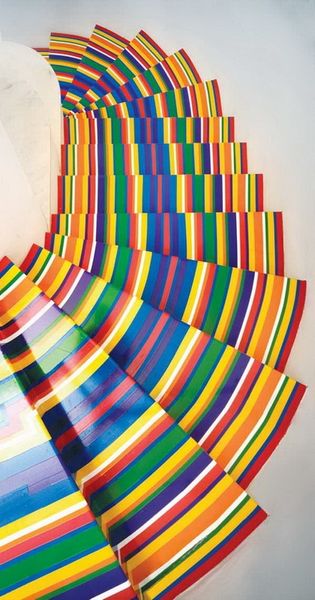
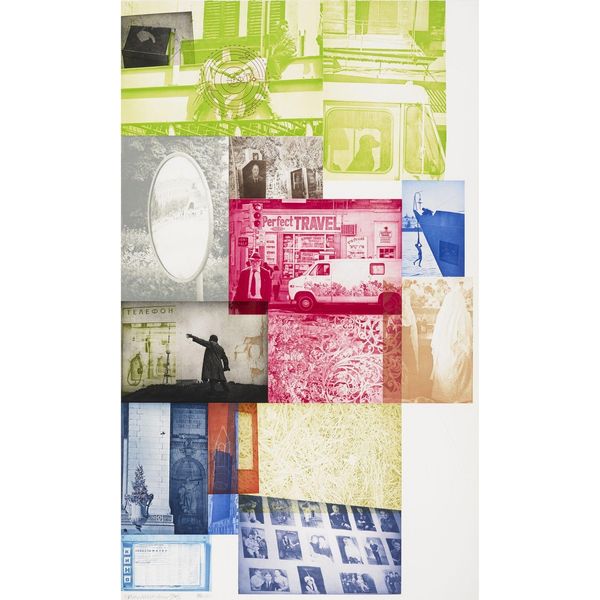
Prose of the Trans-Siberian and of Little Jehanne of France 1913
0:00
0:00

soniadelaunay
Museum of Modern Art (MoMA), New York City, NY, US
mixed-media, collage, painting, print, paper, watercolor
#
cubism
#
mixed-media
#
abstract painting
#
collage
#
painting
# print
#
paper
#
text
#
geometric pattern
#
watercolor
#
abstract pattern
#
geometric
#
abstraction
#
orphism
Copyright: Public domain US
Editor: Here we have Sonia Delaunay’s 1913 mixed-media artwork, "Prose of the Trans-Siberian and of Little Jehanne of France," which unfurls in front of us like an illuminated manuscript. The colors and shapes feel almost musical, but it's the incorporation of text that really piques my interest. What do you see in this piece, particularly regarding its use of symbolic imagery? Curator: The text *is* crucial. Think of illuminated manuscripts—the word, especially sacred words, were visually amplified, given weight and power through decoration. Delaunay uses text as a rhythmic element, yes, but also to embed memory, a sense of journey. The text isn’t just *words*; it’s a marker of shared cultural experience, the Trans-Siberian railway representing progress, movement, the pulse of a changing world. Editor: So, the colors and shapes… are they just decorative, or do they contribute to this idea of a journey? Curator: Neither the shapes nor colors are *merely* decorative. Consider the Orphist movement, Delaunay was at its heart! Color creates form and emotional weight. It’s a very visceral symbolic language meant to stir something primal, not just cerebral. Are you catching a hint of this intended psychological effect? Editor: I think so. The colours definitely evoke certain moods, shifting as the 'journey' progresses... I see how it visually represents the changing landscapes and emotions of the poem. Curator: Exactly! Each abstract shape contains multitudes - journeys, emotions, cultural memories. Delaunay uses this visual vocabulary to trigger associations buried deep within us. It’s not a literal translation but a deeply felt, intensely personal interpretation made universal. Editor: That’s fascinating! I never thought about it in terms of embedded cultural memory, but that makes perfect sense. Thanks! Curator: Indeed! Looking at it as a time capsule rather than only visual, changes one's perspective.
Comments
No comments
Be the first to comment and join the conversation on the ultimate creative platform.
 Collect
 React
React Comment
More like this