

1832 - 1907
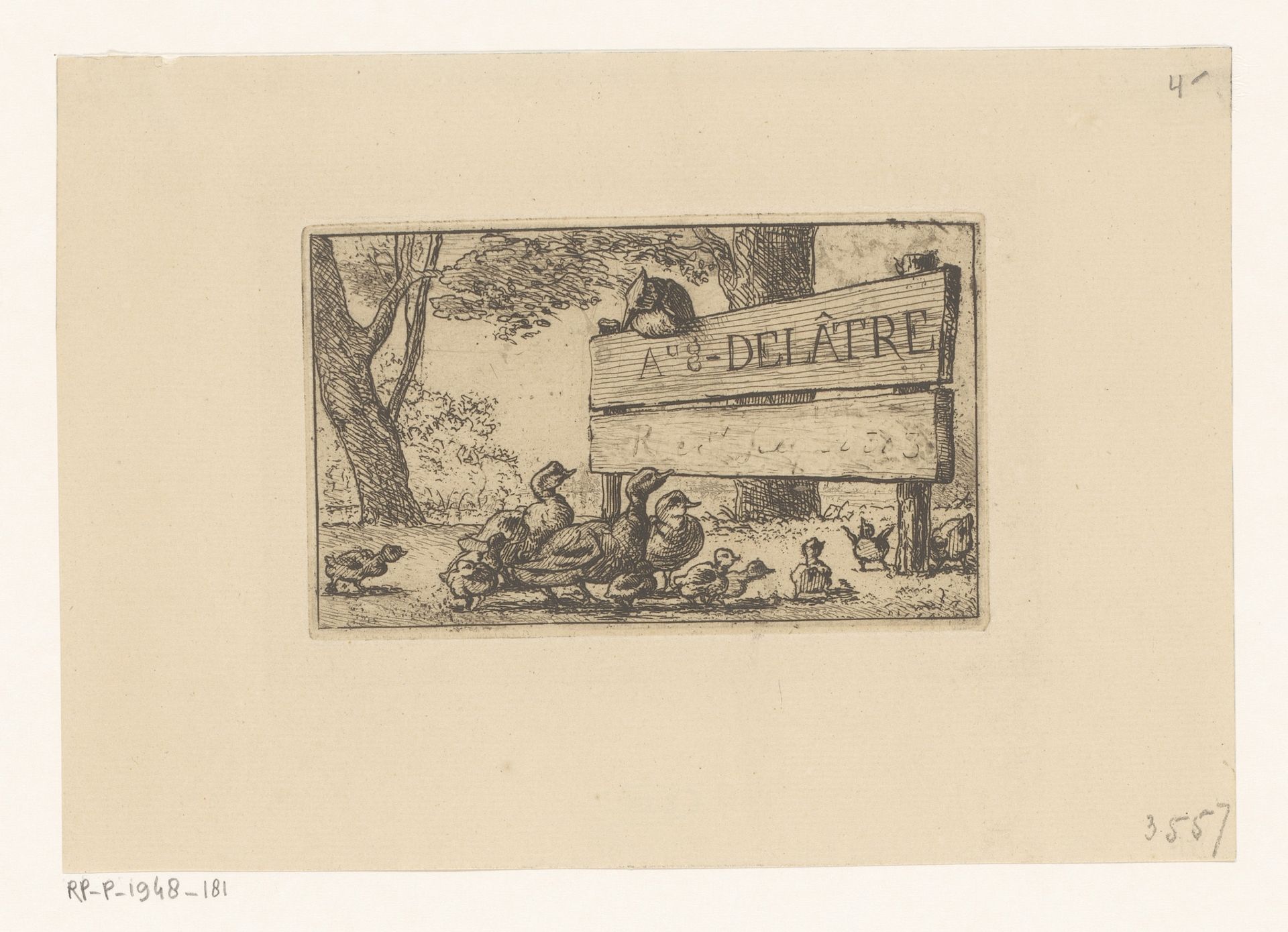
Titelprent met eenden bij een hek

Auguste Delâtre
1822 - 1907Location
RijksmuseumListen to curator's interpretation
Curatorial notes
Curator: We are looking at a print called "Titelprent met eenden bij een hek," or "Title page with ducks near a fence," created between 1832 and 1907 by Auguste Delâtre. Editor: My first thought? Charming! The soft hatching and simple composition gives it an intimate feel, almost like a peek into a private, tranquil moment. What can you tell me about its production? Curator: Delâtre was known for his printmaking innovations, particularly with etching. It’s created with etching and pen on paper. This allowed for the creation of fine lines and intricate details, lending itself well to capturing the nuances of the landscape and the ducks. Editor: Yes, you see that intricacy in the small details of the plumage, which become very appealing. Delâtre signs his name on the placard in the middle of the picture – in fact, there is even a tiny, cute creature standing over his name. It seems, his signature is used almost as a landscape feature. I'm interested in the possible symbolic values in a print like this. The fence, for example – does it act as a border between the tamed and untamed? Curator: That's a lovely thought. More simply, the fence is very much Delâtre indicating ownership or authorship by inserting it into the very same bucolic scenery that he also so skillfully reproduced. His own image is inserted between rural labour and natural beauty. Editor: Indeed, that's quite likely. It strikes me, though, that genre-painting in a rural setting is ripe for multiple interpretations, whether intended or not! Are there particular cultural associations that attach to this sort of imagery? Curator: Certainly, the image speaks to a deep connection with nature. Consider, too, the accessibility of prints; this piece would've been more available to a wider audience. Its themes could resonate within the popular imagery of the period. The image has a wider significance connected with labor. Editor: So, in this small piece, we see a connection between the artist’s labour, the broader artistic movement, and the audience for which it was made. It makes this unassuming etching rather compelling, wouldn't you agree? Curator: Absolutely! Examining its production enriches our viewing experience. It brings together his innovative technique with larger social concerns. Editor: Indeed, considering it now, what originally seemed like a casual image now feels much richer. The interplay of symbolism and material realities gives new meaning to this etching.